Simple outcomes [Probability (Basic)]
Watch this topic in 60 seconds
Free preview · Lesson 1
Understanding Simple outcomes [Probability (Basic)]
Understanding Simple Outcomes in Probability: Your First Step into Predicting the Future!
Have you ever wondered about the chances of something happening? Like, what's the likelihood that it will rain tomorrow? Or what are the odds of your favorite team winning the championship? These questions, and many more, are exactly what the fascinating world of probability helps us answer!
Probability is simply a way to measure and express how likely an event is to occur. It's a foundational concept that helps us make informed decisions, understand risks, and even predict future events (to a certain extent!). In this lesson, we're going to dive into the absolute basics, focusing on 'simple outcomes' – the building blocks of all probability calculations.
The Big Picture: What is Probability?
Imagine you're about to flip a coin. You know it can land on either 'Heads' or 'Tails'. Before you flip, you're uncertain which one it will be. Probability gives us a number to describe this uncertainty. It's usually expressed as a fraction, a decimal, or a percentage between 0 and 1 (or 0% and 100%).
- A probability of 0 (or 0%) means an event is impossible. (e.g., The sun rising in the west.)
- A probability of 1 (or 100%) means an event is certain to happen. (e.g., The sun rising in the east.)
- A probability of 0.5 (or 50%) means an event is equally likely to happen or not happen. (e.g., Flipping a coin and getting heads.)
Core Concept 1: Outcomes - What Can Happen?
Before we can talk about how likely something is, we need to know what can happen. In probability, each possible result of an experiment or situation is called an outcome.
Analogy: Your Favorite Ice Cream Shop
Imagine you walk into an ice cream shop. The 'experiment' is choosing a single scoop of ice cream. What are the possible 'results' or 'flavors' you could pick? If they have Vanilla, Chocolate, Strawberry, and Mint, then each of these flavors is an outcome.
- Experiment: Choosing one scoop of ice cream.
- Outcomes: Vanilla, Chocolate, Strawberry, Mint.
Core Concept 2: Events - What Are We Interested In?
An event is one or more outcomes of an experiment that we are specifically interested in. It's the particular thing we want to happen.
Continuing the Ice Cream Analogy:
Let's say you decide you really want 'Chocolate' ice cream. Wanting 'Chocolate' is your event. It's the specific thing you're hoping for. If you wanted 'a fruit-flavored ice cream', then both Strawberry and Mint (if it's considered fruit-flavored by some stretch!) would be outcomes that satisfy your event.
Core Concept 3: Simple Outcomes - The Smallest Pieces!
This is where our topic gets its name! A simple outcome (or elementary event) is an event that consists of only one single outcome. It cannot be broken down any further. It's the most basic, fundamental result possible from an experiment.
Back to the Ice Cream Analogy:
Getting *just* Vanilla ice cream is a simple outcome. Getting *just* Chocolate ice cream is another simple outcome. Each individual flavor on the menu represents a simple outcome. If you choose 'a scoop of ice cream', that's a broader event, but the simple outcomes that make it up are Vanilla, Chocolate, Strawberry, Mint.
Here are some more examples of simple outcomes:
- Flipping a coin and getting 'Heads'.
- Rolling a standard six-sided die and getting a '3'.
- Picking a 'red' marble from a bag containing red, blue, and green marbles.
Core Concept 4: Sample Space - The Whole Picture!
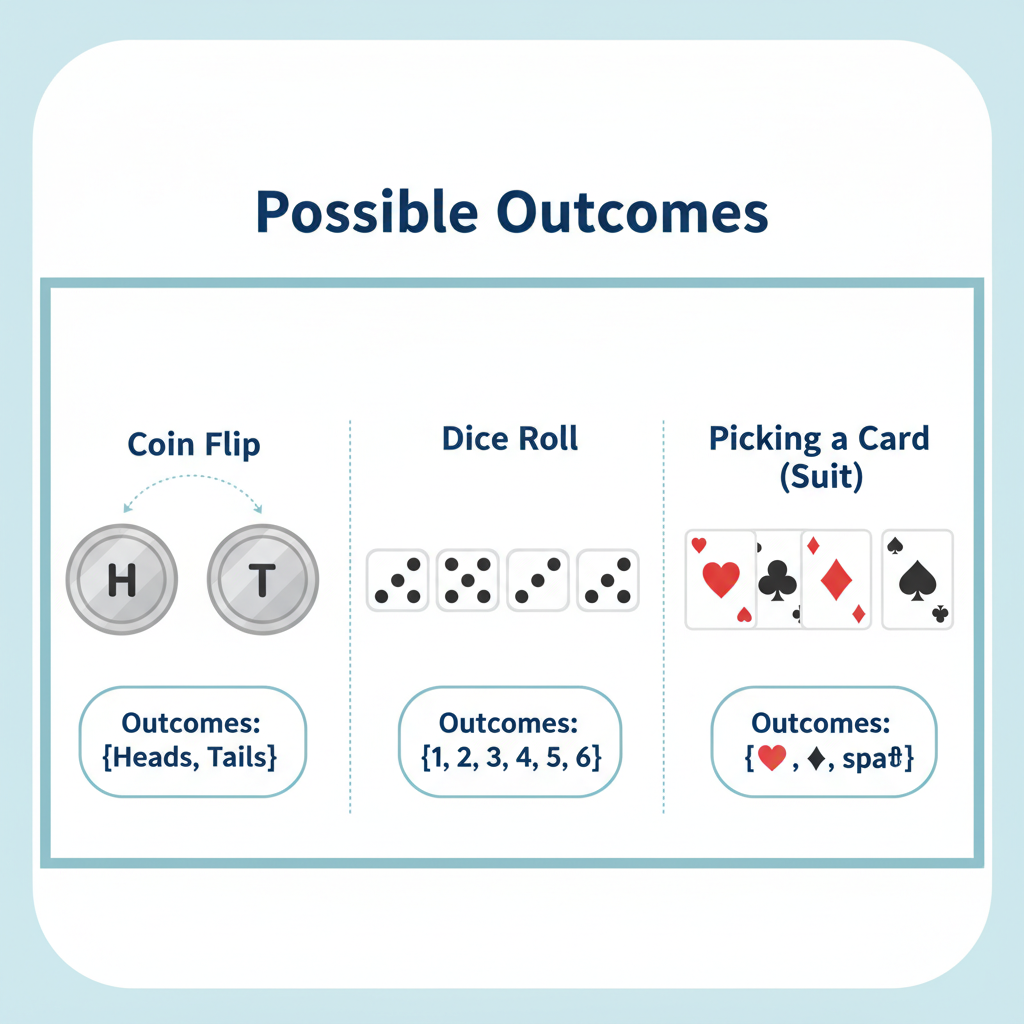
The sample space is the complete set of all possible simple outcomes for an experiment. It's like having a full list of everything that could possibly happen.
The Ice Cream Menu Analogy:
If your ice cream shop has Vanilla, Chocolate, Strawberry, and Mint, then the entire list {Vanilla, Chocolate, Strawberry, Mint} is your sample space. It includes every single simple outcome.
 ⚠️ This picture may have spelling mistakes. Trust the words in the lesson.
Let's look at more examples of sample spaces:
- Experiment: Flipping a single coin.
Sample Space: {Heads, Tails} - Experiment: Rolling a standard six-sided die.
Sample Space: {1, 2, 3, 4, 5, 6} - Experiment: Picking a single marble from a bag containing 3 red, 2 blue, and 1 green marble.
Sample Space: {Red, Blue, Green} (Note: Even though there are 3 red marbles, the 'outcome' itself is just 'Red'. If we wanted to distinguish individual marbles, the sample space would be R1, R2, R3, B1, B2, G1).
Calculating Simple Probability: The Magic Formula!
Now that we understand outcomes, events, simple outcomes, and sample space, we can finally calculate the probability of a simple event! The formula is straightforward:
P(Event) = (Number of Favorable Outcomes) / (Total Number of Possible Outcomes)
- P(Event): This is shorthand for 'The Probability of the Event occurring'.
- Number of Favorable Outcomes: This is how many simple outcomes satisfy your specific event (what you are interested in).
- Total Number of Possible Outcomes: This is the total count of all simple outcomes in the entire sample space.
Think of it like this: You're asking, "Out of all the things that could happen, how many of them are exactly what I want to happen?"
Let's Practice with Examples!
Example 1: Flipping a Coin
What is the probability of getting 'Heads' when you flip a fair coin?
- Experiment: Flipping a coin.
- Sample Space: {Heads, Tails} -> Total Number of Possible Outcomes = 2
- Event: Getting 'Heads'.
- Favorable Outcomes: {Heads} -> Number of Favorable Outcomes = 1
- Calculation: P(Heads) = 1 / 2 = 0.5 or 50%
This means there's a 50% chance of getting heads, which makes sense because there are only two equally likely possibilities.
Example 2: Rolling a Standard Six-Sided Die
A standard die has faces numbered 1, 2, 3, 4, 5, 6.
- Experiment: Rolling the die.
- Sample Space: {1, 2, 3, 4, 5, 6} -> Total Number of Possible Outcomes = 6
a) What is the probability of rolling a '4'?
- Event: Rolling a '4'.
- Favorable Outcomes: {4} -> Number of Favorable Outcomes = 1
- Calculation: P(4) = 1 / 6 (approximately 0.167 or 16.7%)
b) What is the probability of rolling an even number?
- Event: Rolling an even number.
- Favorable Outcomes: {2, 4, 6} -> Number of Favorable Outcomes = 3
- Calculation: P(Even) = 3 / 6 = 1 / 2 = 0.5 or 50%
c) What is the probability of rolling a number greater than 6?
- Event: Rolling a number greater than 6.
- Favorable Outcomes: There are no outcomes in the sample space {1, 2, 3, 4, 5, 6} that are greater than 6. -> Number of Favorable Outcomes = 0
- Calculation: P(>6) = 0 / 6 = 0 or 0%
This is an impossible event!
d) What is the probability of rolling a number less than 7?
- Event: Rolling a number less than 7.
- Favorable Outcomes: {1, 2, 3, 4, 5, 6} -> Number of Favorable Outcomes = 6
- Calculation: P(<7) = 6 / 6 = 1 or 100%
This is a certain event!
Example 3: Marbles in a Bag
A bag contains 5 red marbles, 3 blue marbles, and 2 green marbles. You reach in and pick one marble without looking.
- Experiment: Picking one marble.
- Total Marbles: 5 (red) + 3 (blue) + 2 (green) = 10 marbles.
- Sample Space: If we consider the color as the simple outcome: {Red, Blue, Green}. But for counting purposes, we need to count the distinct marbles: {R1, R2, R3, R4, R5, B1, B2, B3, G1, G2}. -> Total Number of Possible Outcomes = 10
a) What is the probability of picking a red marble?
- Event: Picking a red marble.
- Favorable Outcomes: There are 5 red marbles. -> Number of Favorable Outcomes = 5
- Calculation: P(Red) = 5 / 10 = 1 / 2 = 0.5 or 50%
b) What is the probability of picking a blue marble?
- Event: Picking a blue marble.
- Favorable Outcomes: There are 3 blue marbles. -> Number of Favorable Outcomes = 3
- Calculation: P(Blue) = 3 / 10 = 0.3 or 30%
c) What is the probability of picking a yellow marble?
- Event: Picking a yellow marble.
- Favorable Outcomes: There are no yellow marbles in the bag. -> Number of Favorable Outcomes = 0
- Calculation: P(Yellow) = 0 / 10 = 0 or 0%
Another impossible event!
Why Is This Important in Real Life?
Understanding simple probability isn't just for math class; it has countless real-world applications:
- Games and Sports: From analyzing the odds in card games to understanding team statistics in sports.
- Weather Forecasting: Meteorologists use probability to tell you the chance of rain or snow.
- Medical Decisions: Doctors discuss the probability of success for treatments or the likelihood of certain side effects.
- Insurance: Companies calculate premiums based on the probability of events like accidents or natural disasters.
- Quality Control: Manufacturers use probability to determine the likelihood of a product being defective.
Conclusion
You've taken your first exciting step into the world of probability! By understanding simple outcomes, events, sample spaces, and the basic probability formula, you now have the tools to quantify chance in many everyday situations. Remember, probability gives us a mathematical way to describe uncertainty, making it a powerful tool for understanding our world.
Keep learning, free
Create a free Syllabax account to unlock practice questions and games for this topic.
Visual Learning Enhanced! 🚀
To help you master this topic, we use Advanced Syllabax AI to generate detailed diagrams and visual models.
Note on Visuals: The AI sometimes makes spelling errors in image labels. Please refer to the lesson text for the correct terminology.