Learning Journey
Watch this topic in 60 seconds
Free preview · Lesson 1
Understanding Solids, liquids, gases (CHEMISTRY)
Understanding Solids, Liquids, and Gases: The Awesome States of Matter!
Hey there, young scientists! Have you ever wondered why some things are hard and hold their shape, like a rock, while others flow freely, like water? Or why sometimes you can't even see the air around you, but it's definitely there? Well, today we're going on an exciting adventure to explore the three main ways matter likes to hang out: as a solid, a liquid, or a gas!
Everything around you – from your pencil to the juice you drink, and even the air you breathe – is made of tiny, tiny pieces called particles. You can’t see these particles with your eyes, not even with a regular microscope! But how these tiny particles are arranged and how they move determines whether something is a solid, a liquid, or a gas. Think of it like a dance party for super small things!
1. Solids: Holding Their Shape!
What makes a solid a solid?
Imagine you and your friends are playing 'freeze dance.' When the music stops, everyone freezes in place, super close together, maybe just wiggling a little bit. That's a lot like the particles in a solid!
- Fixed Shape: Solids have their own shape that doesn't change easily. A toy car always looks like a toy car, whether it's on your desk or in your toy box.
- Fixed Volume: Solids also take up the same amount of space. A brick doesn't suddenly get bigger or smaller.
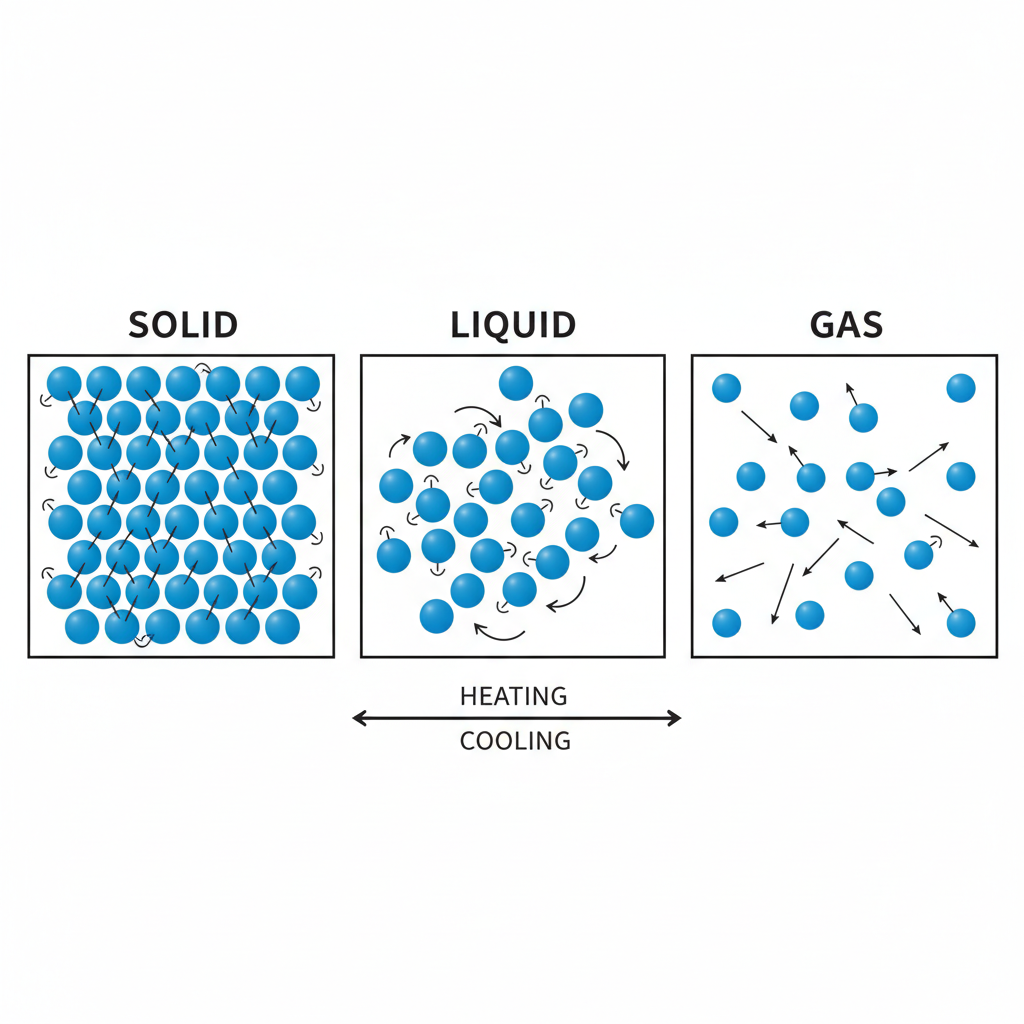
- Particles are 'Stuck': The tiny particles in a solid are packed very tightly together. They're like friends holding hands in a very crowded elevator. They can vibrate or jiggle a little bit, but they can't move past each other.
Analogy Time! Think of a brick wall. Each brick is a particle. They are all lined up neatly, very close, and they can't move around. That's why the wall keeps its strong, unchanging shape!
Examples: Ice cubes, a wooden table, a diamond, a rock, your pencil, your phone.
2. Liquids: The Flowing Friends!
What makes a liquid a liquid?
Now, let's imagine you and your friends are at a party, but there's more room to move. You're still pretty close to each other, but you can slide past your friends, walk to different parts of the room, and even change who you're standing next to. That's how particles in a liquid behave!
- No Fixed Shape: Liquids don't have their own shape. Instead, they take the shape of whatever container they're in. Pour juice into a tall glass, and it looks tall. Pour it into a wide bowl, and it spreads out.
- Fixed Volume: Even though their shape changes, liquids still take up the same amount of space. If you have a cup of water, it's still a cup of water, no matter what container you pour it into.
- Particles are 'Sliders': The particles in a liquid are still close together, but they're not stuck. They can slide and glide past each other, which is why liquids can flow and be poured.
Analogy Time! Imagine a big group of people walking through a crowded shopping mall. They're close to each other, but they can move around and change their positions, flowing like a river of shoppers. This is why liquids can be poured and spill!
Examples: Water, juice, milk, honey, oil, soda.
3. Gases: The Free Spirits!
What makes a gas a gas?
Okay, now imagine you and your friends are playing tag in a giant, empty park. You're running all over the place, far away from each other, bumping into the edges of the park, and going in every direction. That's a gas!
- No Fixed Shape: Gases don't have their own shape. They spread out to fill whatever space they are in.
- No Fixed Volume: Gases also don't take up a fixed amount of space. They will spread out to fill their entire container, no matter how big it is! If you let a gas out of a small balloon, it will spread throughout the entire room.
- Particles are 'Runners': The particles in a gas are very far apart from each other and are moving very fast in all directions. They have lots of energy!
Analogy Time! Think about a balloon filled with air. The air (which is a gas!) fills up the entire balloon. If you let the air out, it doesn't just stay in a small cloud; it spreads out and mixes with all the other air in the room. You can't see the air, but it's there, and its particles are zipping around everywhere!
Examples: The air we breathe (which is a mix of gases like nitrogen and oxygen), steam from boiling water, helium in a balloon, carbon dioxide.
Here's a handy picture to help you visualize how the tiny particles are arranged in each state:
Changing States: A Party with Temperature!
What if you wanted to change a solid into a liquid, or a liquid into a gas? It's all about adding or taking away energy, usually in the form of heat!
- Melting (Solid to Liquid): When you add heat to a solid (like ice), its particles gain more energy and start vibrating faster. Eventually, they get enough energy to break free from their fixed positions and start sliding past each other. The solid melts into a liquid (ice melts into water!).
- Freezing (Liquid to Solid): When you take away heat from a liquid (like water), its particles lose energy and slow down. They get closer together and lock into fixed positions. The liquid freezes into a solid (water freezes into ice!).
- Evaporation/Boiling (Liquid to Gas): If you keep adding a lot of heat to a liquid (like boiling water), its particles gain even more energy and start moving very, very fast and far apart. The liquid turns into a gas (water boils into steam!). Evaporation happens slowly at room temperature, while boiling is very fast.
- Condensation (Gas to Liquid): When you take away heat from a gas (like steam), its particles lose energy, slow down, and move closer together. They come close enough to slide past each other again. The gas condenses into a liquid (steam turns into tiny water droplets on a cold mirror!).
Analogy Time! Think of a group of people:
This image helps visualize these amazing transformations:
Conclusion
So, the next time you see an ice cube melting in your drink, or steam rising from a hot cup of cocoa, you'll know exactly what's happening! It's all about how those super-tiny particles are arranged and how much energy they have. Solids, liquids, and gases are all around us, constantly changing and making our world a fascinating place to explore!
Keep learning, free
Create a free Syllabax account to unlock practice questions and games for this topic.
Visual Learning Enhanced! 🚀
To help you master this topic, we use Advanced Syllabax AI to generate detailed diagrams and visual models.
Note on Visuals: The AI sometimes makes spelling errors in image labels. Please refer to the lesson text for the correct terminology.