Regular polygons [Polygons & 2D Shapes]
Watch this topic in 60 seconds
Free preview · Lesson 1
Understanding Regular polygons [Polygons & 2D Shapes]
Learning About Regular Polygons: Shapes with Perfect Symmetry!
Hello, young mathematicians! Get ready to explore a fascinating world of shapes. Today, we're going to learn about regular polygons. Don't let the big word "polygon" scare you! It's just a fancy way of saying a shape made of straight lines that connect to make a closed loop. Think of it like connecting dots to draw a shape!
What is a Polygon?
Imagine you have a piece of string. If you connect the ends to make a circle, that's a closed loop, but it doesn't have straight sides. Now, imagine you bend that string into straight sections, like making a fence with straight posts. If you connect these straight sections so that they all meet and don't have any gaps, you've made a polygon!
Key features of a polygon:
- It's a closed shape (no openings).
- It's made up of only straight line segments.
- These line segments are called sides.
- The points where the sides meet are called vertices (one point is a vertex, many are vertices).
Think of a stop sign. It has straight sides and is closed. That's a polygon! A pizza slice is not a polygon because it has a curved side. A drawing of a house with a triangle roof is made of polygons (the square part and the triangle part).
What Makes a Polygon "Regular"?
Now, let's add the special word "regular" to our polygons. A regular polygon is like a polygon that went to finishing school and became perfectly balanced! It means two very important things:
- All its sides are exactly the same length.
- All its angles are exactly the same size.
Imagine you have a perfectly round pizza. If you cut it into equal slices, and each slice has sides that are all the same length and corners that are all the same size, then you're dealing with parts of a regular shape!
Let's look at some examples. A square is a perfect example of a regular polygon. It has 4 sides, and all 4 sides are the same length. It also has 4 corners (vertices), and all those corners are right angles (90 degrees), so they are all the same size!
But what about a rectangle that isn't a square? It has 4 sides and 4 corners. All the corners are right angles (same size), but the long sides are different lengths from the short sides. So, a rectangle that is not a square is not a regular polygon. It's a polygon, but not a regular one.
Common Regular Polygons: Let's Meet Them!
We give names to regular polygons based on how many sides they have. The more sides, the fancier the name!
1. Equilateral Triangle (3 sides)
An equilateral triangle is a regular polygon with 3 sides. Think of a slice of a perfectly cut, three-sided pie where all the crust edges are the same length and all the corners are equally sharp. All three sides are equal, and all three angles are equal (each is 60 degrees).
2. Square (4 sides)
As we saw, a square is a regular polygon with 4 sides. It's like a perfectly balanced, four-sided frame. All sides are equal, and all angles are equal (90 degrees).
3. Regular Pentagon (5 sides)
A regular pentagon has 5 sides, and all 5 sides are the same length. All 5 angles are also the same size. Think of the shape of the home plate in baseball, but if all its sides were the exact same length and all its corners were equally sharp. The angles in a regular pentagon are 108 degrees each.
4. Regular Hexagon (6 sides)
A regular hexagon has 6 sides, all equal in length, and 6 equal angles. These shapes are super common! Think about the pattern of honeycomb cells that bees build. Each little cell is a hexagon, and they fit together perfectly because they are regular hexagons! The angles in a regular hexagon are 120 degrees each.
5. Regular Octagon (8 sides)
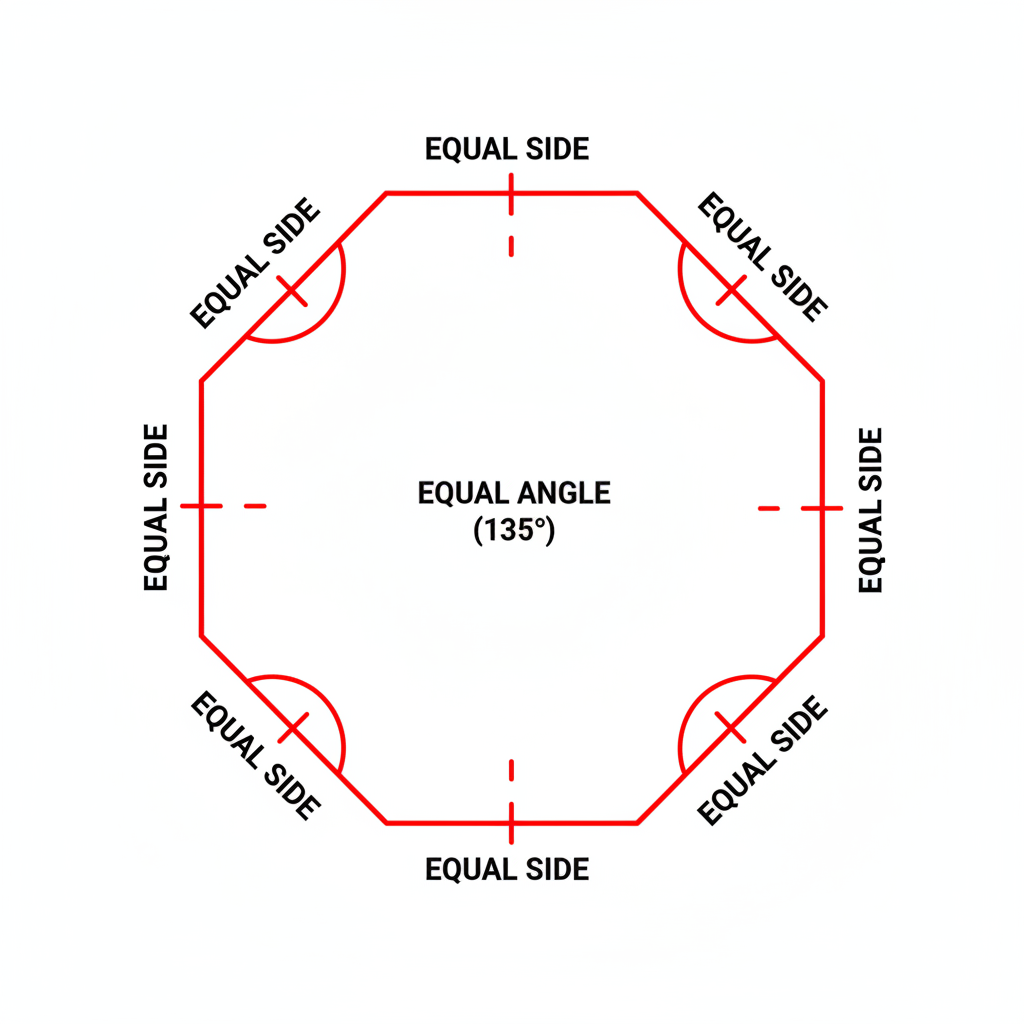
A regular octagon has 8 sides of equal length and 8 equal angles. The most famous example is a stop sign! All 8 sides of a stop sign are the same length, and all 8 corners are the same angle (135 degrees).
Why Are Regular Polygons Important?
Regular polygons are like the building blocks of many things around us. Their perfect symmetry makes them strong and efficient. For example:
- Architecture: Regular shapes are often used in buildings and designs because they are stable and look pleasing to the eye.
- Nature: As we saw with honeycomb, nature uses regular polygons because they pack together without any wasted space.
- Designs and Patterns: From tiles on a floor to patterns in fabrics, regular polygons create beautiful and organized designs.
Let's Recap!
Remember, a polygon is a closed shape with straight sides. A regular polygon is a special kind of polygon where:
- All sides are the same length.
- All angles are the same size.
We have special names for regular polygons based on their number of sides: triangle (3), square (4), pentagon (5), hexagon (6), octagon (8), and many more!
Keep an eye out for these perfectly balanced shapes in the world around you. You'll be surprised how often you see them!
Keep learning, free
Create a free Syllabax account to unlock practice questions and games for this topic.
Visual Learning Enhanced! 🚀
To help you master this topic, we use Advanced Syllabax AI to generate detailed diagrams and visual models.
Note on Visuals: The AI sometimes makes spelling errors in image labels. Please refer to the lesson text for the correct terminology.