Musical instruments[PHYSICS]
Watch this topic in 60 seconds
Free preview · Lesson 1
Understanding Musical instruments[PHYSICS]
The Physics of Sound: How Musical Instruments Make Music!
Have you ever wondered how a guitar makes its beautiful strumming sound, or how a flute can create such clear, high notes? It all comes down to something called physics! Physics is the science that studies how the world around us works, and when it comes to music, it's all about how we make and hear sounds.
What is Sound?
Imagine dropping a pebble into a still pond. What happens? Ripples spread out across the water, right? Sound works in a very similar way, but instead of water, it's the air that ripples. When something makes a sound, like hitting a drum or plucking a string, it vibrates. Vibration means it shakes back and forth really, really fast. These vibrations push and pull the tiny particles (like little balls) in the air around them.
Think of it like a line of dominoes. When you push the first domino, it falls and knocks into the next one, which knocks into the next, and so on. Sound travels through the air in the same way. The vibrating object pushes the air particles next to it, which then push the air particles next to them, and this chain reaction of pushes and pulls travels all the way to your ears. These traveling pushes and pulls are what we call sound waves.
How Do Instruments Create These Sound Waves?
Musical instruments are basically clever machines designed to create and control these vibrations and sound waves in specific ways. Different types of instruments make sound in different ways. Let's explore the main families:
1. String Instruments (like Guitars, Violins, Pianos)
These instruments have strings that vibrate when they are played.
- Plucking/Strumming: When you pluck or strum a guitar string, you pull it away from its resting position and let it go. It snaps back and starts to vibrate back and forth.
- Bowing: With a violin or cello, a bow is used to rub against the string. This friction makes the string vibrate.
- Striking: In a piano, hammers hit the strings when you press the keys, causing them to vibrate.
The length, thickness, and tightness (tension) of the string all affect the sound it makes. A longer, thicker, or looser string vibrates more slowly, creating a lower-pitched sound (a lower note). A shorter, thinner, or tighter string vibrates faster, creating a higher-pitched sound (a higher note). Think of a thick rubber band versus a thin one. When you pluck them, the thicker one usually makes a lower sound because it vibrates more slowly.
The body of these instruments is also important! The vibrating strings make the body of the instrument vibrate too. This larger vibrating surface pushes more air, making the sound louder and richer. It's like a small speaker versus a big one – the big one can move more air and make a much louder sound.
2. Wind Instruments (like Flutes, Trumpets, Clarinets)
These instruments make sound when air is blown into them, causing the air inside to vibrate.
- Buzzing Lips: In trumpets and trombones (brass instruments), the player buzzes their lips into a mouthpiece. This buzzing creates the initial vibration that travels into the instrument.
- Blowing Across an Opening: In flutes and recorders, the player blows air across an edge, like blowing over the top of a bottle. This splits the air and creates vibrations in the air column inside.
- Reeds: In clarinets and saxophones (woodwind instruments), a thin piece of material called a reed vibrates against a mouthpiece. This vibrating reed then causes the air inside to vibrate.
The length of the tube of air inside the instrument is key here. Making the tube longer (by opening and closing valves or keys) makes the air inside vibrate more slowly, producing a lower note. Making the tube shorter makes the air vibrate faster, producing a higher note. Imagine blowing across the top of a bottle. If you fill it with more water, the space for air to vibrate is smaller, and the note is higher. If there's less water, the air column is longer, and the note is lower.
3. Percussion Instruments (like Drums, Cymbals, Xylophones)
These instruments make sound when they are hit, shaken, or scraped. They create vibrations when they are struck.
- Membranes: Drums have a stretched skin or membrane. When you hit it, the membrane vibrates, creating sound waves. The tightness of the membrane affects the pitch – a tighter drum sounds higher.
- Solid Surfaces: Instruments like xylophones or marimbas have bars made of wood or metal. When these bars are struck with mallets, they vibrate. Each bar is a different length, so they vibrate at different speeds and produce different notes.
- Shaking: Maracas or tambourines create sound when small objects inside them hit the walls when shaken.
The size and material of the object being struck are important. A larger drum usually makes a lower sound than a smaller drum because its larger surface can move more air more slowly. The material also matters – metal often vibrates for longer and sounds brighter than wood.
Pitch and Volume: The Two Main Qualities of Sound
When we talk about music, we often describe sounds by their pitch and volume.
- Pitch: This is how high or low a sound is. We've seen how string length, air column length, and the size/tightness of membranes affect pitch. Faster vibrations mean higher pitch, and slower vibrations mean lower pitch. Think of a tiny hummingbird's wings buzzing very fast (high pitch sound) compared to a slow elephant's stomp (low pitch sound).
- Volume: This is how loud or soft a sound is. Volume depends on how much energy the sound wave has. More energy means the air particles are pushed and pulled with more force, creating bigger 'ripples' in the air. This happens when an instrument is played with more force – a harder strum on a guitar, a louder blow into a trumpet, or a harder hit on a drum. More energy = louder sound! Think of shouting versus whispering. Shouting uses more energy and makes a louder sound.
All these factors – vibration, wave creation, string properties, air columns, striking surfaces, pitch, and volume – work together to create the amazing variety of sounds we hear from musical instruments. It's the physics of sound in action!
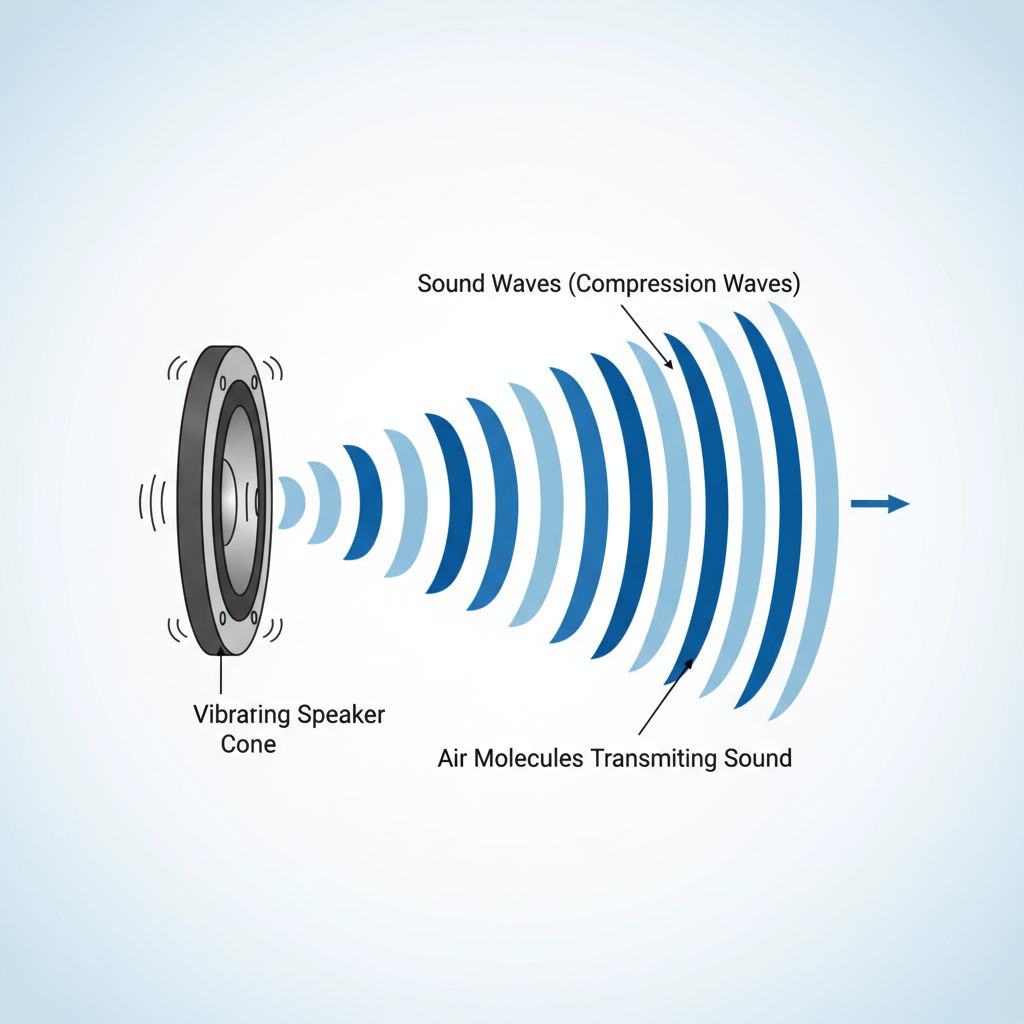 ⚠️ This picture may have spelling mistakes. Trust the words in the lesson.
Keep learning, free
Create a free Syllabax account to unlock practice questions and games for this topic.
Visual Learning Enhanced! 🚀
To help you master this topic, we use Advanced Syllabax AI to generate detailed diagrams and visual models.
Note on Visuals: The AI sometimes makes spelling errors in image labels. Please refer to the lesson text for the correct terminology.