Learning Journey
Watch this topic in 60 seconds
Free preview · Lesson 1
Understanding Electromagnetism[PHYSICS]
Electromagnetism: The Invisible Dance of Electricity and Magnetism (Grade 10 - Foundational)
Welcome, aspiring scientists! Today, we're going to uncover one of the most fundamental and fascinating forces in our universe: Electromagnetism. It might sound like a big, intimidating word, but don't worry! We'll break it down into simple, easy-to-understand pieces, using lots of everyday analogies to make it as clear as possible.
What is Electromagnetism? A Dynamic Duo!
Imagine you have two superheroes: Captain Electricity and Magneto. For a long time, people thought they were completely separate, each with their own powers. But then, brilliant scientists discovered something amazing: these two superheroes are actually two sides of the SAME coin! They can transform into each other and influence each other. This incredible connection is what we call Electromagnetism.
In simple terms, electromagnetism is the study of how electricity and magnetism are related and how they affect each other. It's the reason why your speakers make sound, why your phone vibrates, and how electricity even gets to your house!
A Quick Peek at Electricity (The Flowing River)
Before we dive deeper, let's quickly remind ourselves about basic electricity. You can think of electricity like water flowing in a river:
- Electric Current (I): This is like the actual flow of water in the river. It's the movement of tiny charged particles (usually electrons) through a wire. The more water flowing, the stronger the current. We measure current in Amperes (A).
- Voltage (V): This is like the 'pressure' or 'height difference' that pushes the water through the river. A higher waterfall creates more pressure. Voltage is the electrical 'push' that makes the current flow. We measure voltage in Volts (V).
- Resistance (R): This is like obstacles in the river, such as rocks or narrow sections, that make it harder for the water to flow. In a wire, resistance slows down the flow of electrons. We measure resistance in Ohms (Ω).
A Quick Peek at Magnetism (The Invisible Aura)
Now, let's briefly look at magnetism. You've probably played with magnets before!
- Magnets: These are special materials (like iron or steel) that create an invisible force field around them. Think of it like an invisible 'aura' that can pull or push other magnetic materials.
- Magnetic Poles: Every magnet has two ends called poles – a North (N) pole and a South (S) pole. These are like the 'positive' and 'negative' ends of a battery.
- Attraction and Repulsion: Just like people, magnets have rules for interacting:
- Opposites attract: A North pole will attract a South pole (they like each other!).
- Likes repel: A North pole will push away another North pole, and a South pole will push away another South pole (they don't like each other!).
- Magnetic Field: This is the invisible region around a magnet where its force can be felt. We often draw 'magnetic field lines' to show the direction and strength of this invisible force. These lines always go from North to South outside the magnet.
The Big Discovery: Electricity Creates Magnetism! (Oersted's Aha! Moment)
For centuries, electricity and magnetism were seen as two completely separate things. Then, in 1820, a Danish scientist named Hans Christian Ørsted made an accidental, but monumental, discovery. He was preparing for a lecture and had a wire connected to a battery (carrying electric current) near a compass. He noticed that every time he turned the current ON, the compass needle would move! When he turned the current OFF, the needle returned to its original position.
Analogy: The Magic Wand of Current! Imagine you have a compass, and suddenly, just by holding a wire with electricity flowing through it nearby, the compass needle starts dancing! It's like the wire temporarily became a magnet, even though it's just a regular wire. Ørsted realized that an electric current creates a magnetic field around it!
Magnetic Field Around a Current-Carrying Wire (The Swirling Pattern)
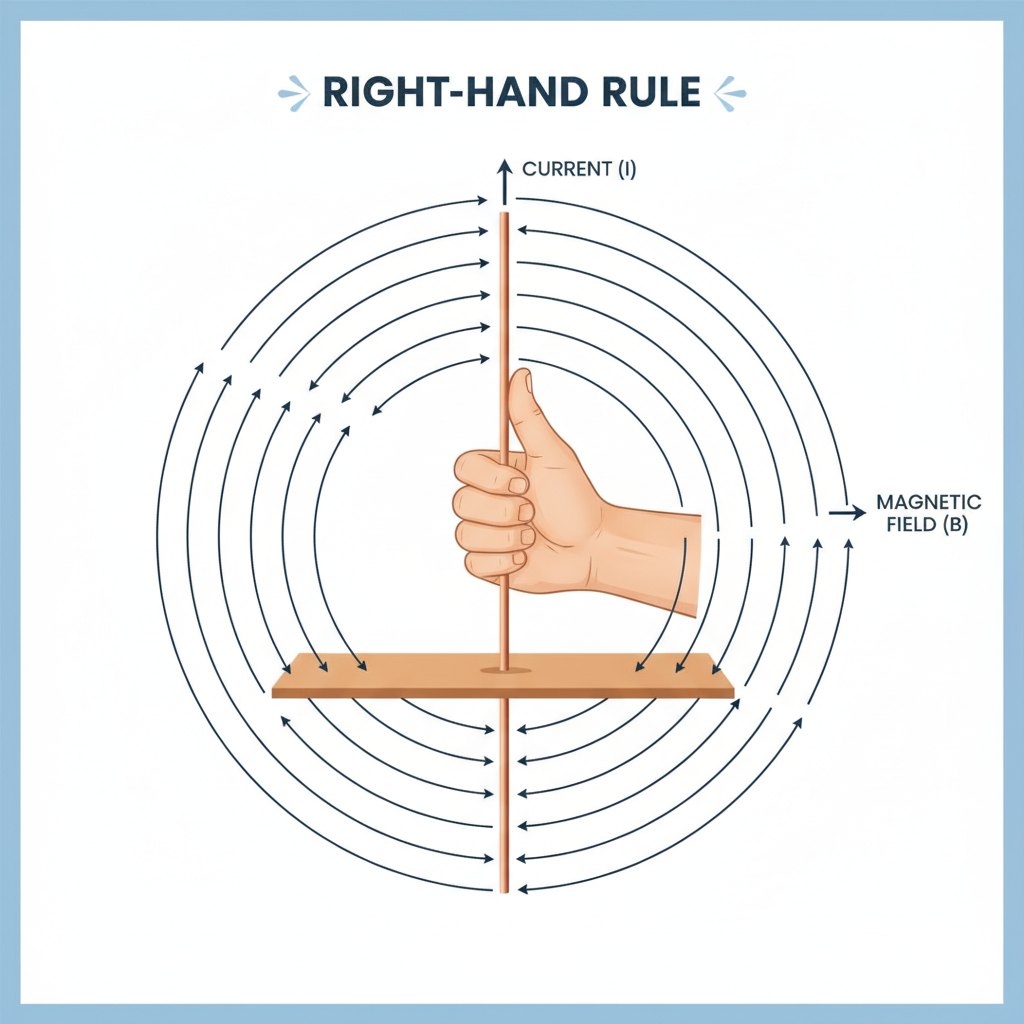
So, an electric current creates a magnetic field. But what does this field look like? Imagine you're looking down at a straight wire carrying current. The magnetic field lines around it form concentric circles, like ripples in a pond after you drop a pebble. The closer you are to the wire, the stronger the magnetic field.
To figure out the direction of this invisible magnetic field, we use a simple trick called the Right-Hand Rule:
- Take your right hand.
- Point your thumb in the direction of the electric current (if current flows upwards, point your thumb up).
- Curl your fingers around the wire. The direction your fingers curl is the direction of the magnetic field lines.
Analogy: The Tornado Around the Wire! Think of the current as a flagpole. If you point your thumb up the flagpole (current direction), your fingers curl around it like a miniature tornado or whirlpool (magnetic field direction). This helps you visualize the swirling, invisible magnetic force.
Electromagnets: Magnets on Demand!
Ørsted's discovery led to the invention of something incredibly useful: the electromagnet. An electromagnet is a temporary magnet created by an electric current. It's essentially a 'magnet on demand' – you can turn its magnetism ON and OFF simply by controlling the electric current!
How do we make an electromagnet?
- Coil of Wire (Solenoid): Instead of a straight wire, we coil the wire into many loops, forming a cylindrical shape. This is called a solenoid. Each loop of wire creates its own magnetic field, and when combined, they create a much stronger overall magnetic field, similar to a bar magnet.
- Iron Core: To make the electromagnet even stronger, we often place a piece of soft iron (or other ferromagnetic material) inside the coil. The iron core gets strongly magnetized when current flows through the coil, significantly boosting the magnetic field.
How to make an electromagnet stronger:
- Increase the current: More electricity flowing means a stronger magnet. (Like making the river flow faster).
- Increase the number of coils: More loops of wire mean a stronger magnetic field. (Like adding more individual magnets).
- Use a stronger core material: A better iron core will concentrate the magnetic field more effectively. (Like using a better antenna to catch signals).
Analogy: The Custom-Built Magnet. Imagine you have a LEGO set to build a temporary magnet. The wire is your LEGO bricks, and the battery is your power source. You can build a small magnet with a few loops, or a super-strong magnet by adding many more loops and sticking a special iron rod (the core) inside! And the best part? You can turn it on and off with a switch!
Applications of Electromagnets: Everyday Magic!
Electromagnets are everywhere! They are crucial components in countless devices:
- Scrap Yard Cranes: Giant electromagnets are used to lift heavy metal objects like cars in junkyards. They can pick up a car by turning on the current and drop it by turning it off.
- Electric Bells/Buzzers: An electromagnet pulls a hammer to strike a bell when current flows.
- Door Locks: Many security door locks use electromagnets to hold the door shut until the current is temporarily interrupted.
- Speakers and Headphones: Electromagnets cause a cone to vibrate, creating sound waves from electrical signals.
- Magnetic Resonance Imaging (MRI): Powerful electromagnets are used in hospitals to create detailed images of the inside of the human body.
Faraday's Discovery: Magnetism Creates Electricity! (The Reverse Trick)
Once scientists knew that electricity could create magnetism, they wondered: could magnetism create electricity? In the 1830s, Michael Faraday (and independently, Joseph Henry) discovered that yes, it can! This phenomenon is called electromagnetic induction.
Faraday found that if you move a magnet near a coil of wire (or move the coil near a magnet), an electric current is generated in the wire. The key here is movement. A stationary magnet next to a coil won't produce current. You need a changing magnetic field through the coil.
Analogy: The Spark of Movement! Imagine you have a magical fishing rod (the wire coil) and a magical fish (the magnet). If you just leave the fish floating next to the rod, nothing happens. But if you start moving the fish back and forth, or wiggle the rod around the fish, suddenly, sparks of electricity fly from your rod! The movement, the change in how the magnet and coil interact, is what generates the current.
Generators and Motors: The Dynamic Duo in Action!
These two fundamental discoveries (electricity creates magnetism, and magnetism creates electricity) are the basis for two of the most important machines ever invented:
- Electric Generators: These machines use electromagnetic induction to convert mechanical energy (like the spinning of a turbine by water, wind, or steam) into electrical energy. They essentially use magnets moving past coils of wire to produce electricity for our homes and industries.
- Electric Motors: These machines use the principle that a current-carrying wire in a magnetic field experiences a force, to convert electrical energy into mechanical energy (motion). They make things spin, like the fan in your computer, the wheels of an electric car, or the blender in your kitchen.
Conclusion: An Intertwined Universe
Electromagnetism shows us that electricity and magnetism are not separate entities but are deeply connected and constantly influencing each other. From the tiny circuits in your smartphone to the massive power plants that light up cities, the principles of electromagnetism are at work, shaping our modern world. Understanding this fundamental force helps us unlock the secrets of the universe and continues to inspire incredible technological innovations.
Keep learning, free
Create a free Syllabax account to unlock practice questions and games for this topic.
Visual Learning Enhanced! 🚀
To help you master this topic, we use Advanced Syllabax AI to generate detailed diagrams and visual models.
Note on Visuals: The AI sometimes makes spelling errors in image labels. Please refer to the lesson text for the correct terminology.