Mineral & Energy Resources – Indian Geography
Watch this topic in 60 seconds
Free preview · Lesson 1
Mineral & Energy Resources – Indian Geography (Foundational)
Mineral & Energy Resources – Indian Geography (Foundational)
Welcome to the study of India's mineral and energy resources! These resources are crucial for India's economic development. This lesson will cover the basics of what these resources are and where they are found in India.
What are Mineral Resources?
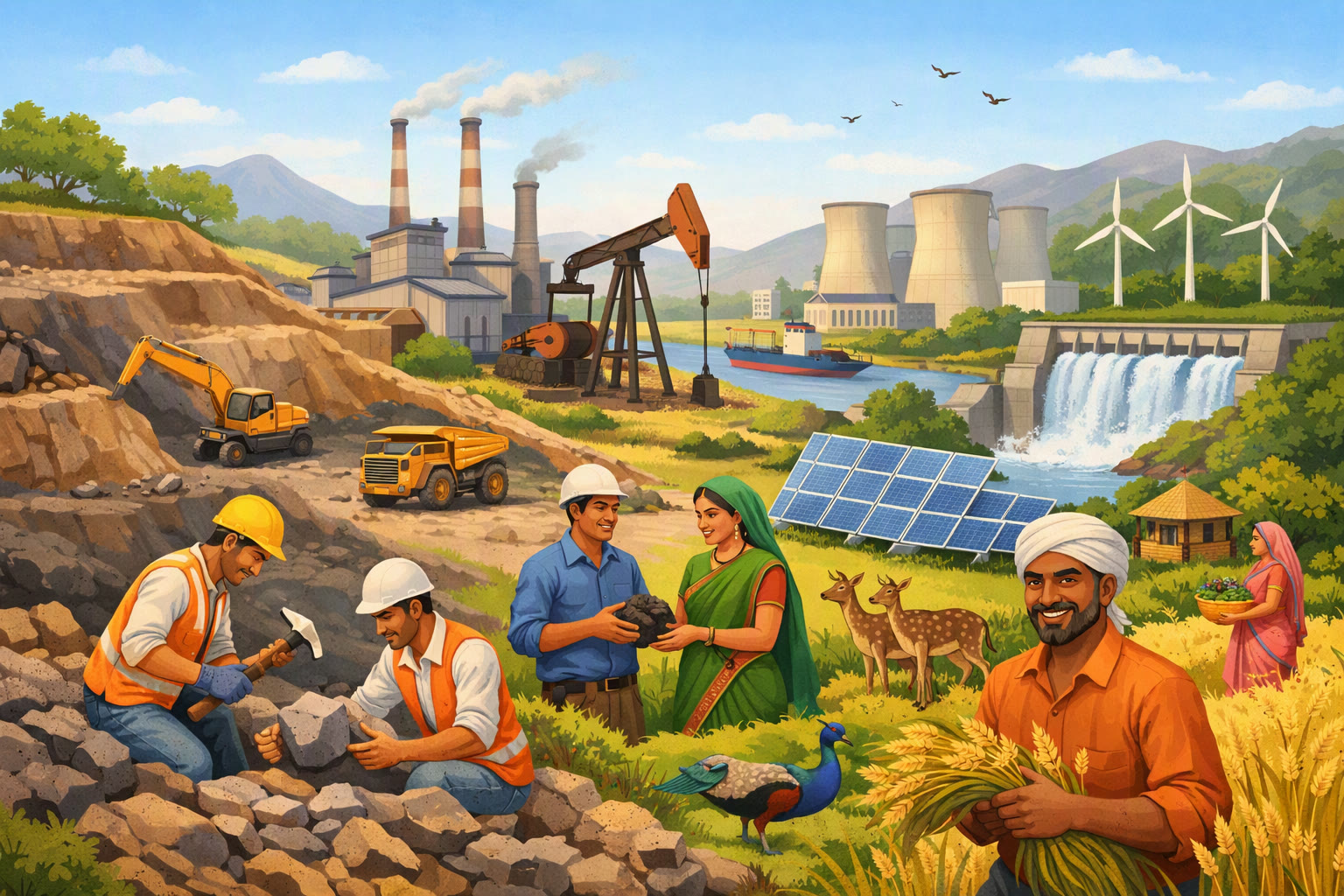
Minerals are naturally occurring substances found in the Earth's crust. They are the building blocks of rocks. These minerals can be extracted and used to make various products, from cars to buildings to electronic devices.
Types of Minerals
Minerals can be broadly classified into two main categories:
- Metallic Minerals: These minerals contain metals. Examples include iron ore, copper, and gold.
- Non-Metallic Minerals: These minerals do not contain metals. Examples include limestone, salt, and mica.
Where are Minerals Found in India?
Minerals are not evenly distributed across India. Some regions are rich in certain minerals, while others have very few. Here are some key mineral-rich areas:
- Chota Nagpur Plateau: This region, covering parts of Jharkhand, Odisha, and Chhattisgarh, is rich in iron ore, coal, and manganese.
- Deccan Plateau: This region, especially parts of Karnataka and Andhra Pradesh, has significant deposits of iron ore, bauxite, and limestone.
- Aravalli Region: This region, in Rajasthan, is known for copper, zinc, and lead.
What are Energy Resources?
Energy resources are substances that can be used to generate power or energy. These resources are vital for industries, transportation, and everyday life.
Types of Energy Resources
Energy resources can be classified into two main categories:
- Conventional Energy Resources: These are traditional sources of energy that have been used for a long time. Examples include coal, petroleum (oil), and natural gas.
- Non-Conventional Energy Resources: These are newer, renewable sources of energy that are becoming increasingly important. Examples include solar energy, wind energy, and geothermal energy.
Where are Energy Resources Found in India?
- Coal: Jharkhand, Odisha, Chhattisgarh, and West Bengal are major coal-producing states.
- Petroleum: Mumbai High (offshore), Gujarat, and Assam are important petroleum-producing regions.
- Natural Gas: Mumbai High, Gujarat, and Andhra Pradesh have significant natural gas reserves.
- Solar Energy: Rajasthan and Gujarat have high potential for solar energy development.
- Wind Energy: Tamil Nadu, Gujarat, and Maharashtra have significant wind energy potential.
Importance of Mineral and Energy Resources
Mineral and energy resources play a vital role in the economic development of India. They provide the raw materials for industries, generate power for homes and businesses, and contribute to employment and export earnings.
Keep learning, free
Create a free Syllabax account to unlock practice questions and games for this topic.
Visual Learning Enhanced! 🚀
To help you master this topic, we use Advanced Syllabax AI to generate detailed diagrams and visual models.
Note on Visuals: The AI sometimes makes spelling errors in image labels. Please refer to the lesson text for the correct terminology.