Addition & subtraction (including large numbers) [Fundamental Operations]
Watch this topic in 60 seconds
Free preview · Lesson 1
Understanding Addition & subtraction (including large numbers) [Fundamental Operations]
Addition and Subtraction: Building Blocks of Numbers!
Welcome, amazing mathematicians! Today, we're going on an adventure into the world of addition and subtraction. These are like the secret codes that help us understand how numbers change. Think of them as the fundamental operations – the very first tools you learn in a toolbox, essential for building anything you want!
What is Addition? Adding Things Together!
Imagine you have a pile of yummy cookies, and your friend gives you more. Addition is like counting how many cookies you have in total after your friend shares. It's about combining groups to find out the whole amount. We use a special symbol for addition: the plus sign +.
Adding Small Numbers: Like Counting Fingers!
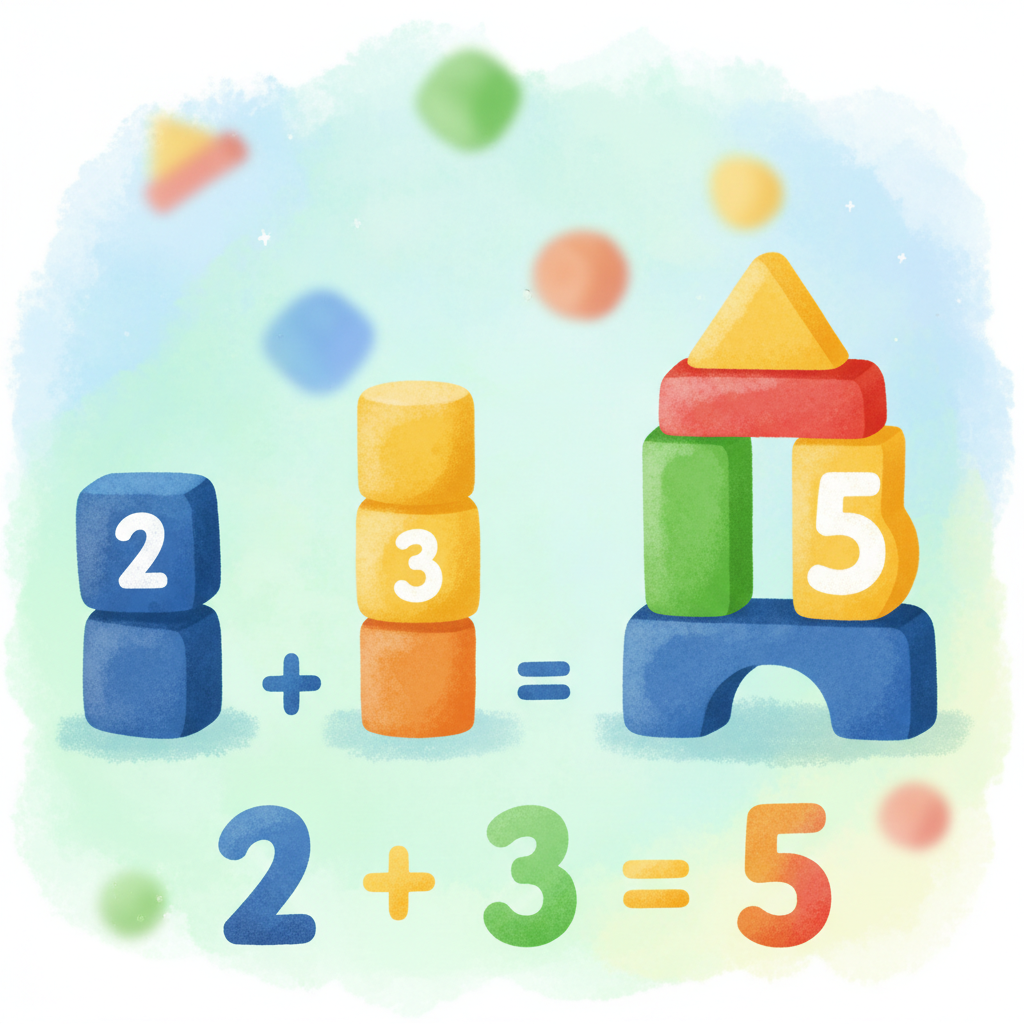
When you were learning, you might have used your fingers. If you have 2 fingers up and then put up 3 more fingers, how many are up altogether? You count them: 1, 2, 3, 4, 5. So, 2 + 3 = 5. Simple, right?
Adding Larger Numbers: Stepping Up!
Now, imagine you have a big box of crayons, maybe 123 crayons, and your grandma gives you another 56 crayons. How many crayons do you have now? We can't easily count this on our fingers! This is where we learn to add numbers by place value. Each digit in a number has a special job based on its position:
- Ones place: The digit on the far right. It tells us how many individual items we have.
- Tens place: The digit to the left of the ones place. It tells us how many groups of ten we have.
- Hundreds place: The digit to the left of the tens place. It tells us how many groups of one hundred we have.
- Thousands place, Ten Thousands place, and so on! These places represent even bigger groups.
To add larger numbers, we line them up vertically, making sure the ones digits are in the same column, the tens digits are in the same column, and so on. This is like making sure all the cookies are in one bowl, all the apples in another, and so on, when you sort them.
Let's add 123 and 56:
  123
+  56
-----
1. Add the ones: 3 + 6 = 9. We write 9 in the ones column.
  123
+  56
-----
    9
2. Add the tens: 2 + 5 = 7. We write 7 in the tens column.
  123
+  56
-----
   79
3. Add the hundreds: We have 1 in the hundreds place in 123 and 0 in the hundreds place in 56 (since it's just 56, not 056). So, 1 + 0 = 1. We write 1 in the hundreds column.
  123
+  56
-----
  179
So, 123 + 56 = 179. You now have 179 crayons!
Carrying Over: When a Group Gets Too Full!
What happens when the sum in a column is 10 or more? Imagine a jar that can only hold 9 marbles. If you try to put in a 10th marble, you need to take those 10 marbles and trade them for one bigger marble (or put them in a new jar). In addition, when the ones column adds up to 10 or more, we 'carry over' the tens part to the tens column. It's like taking 10 ones and turning them into 1 ten.
Let's add 48 + 35:
   48
+  35
----
1. Add the ones: 8 + 5 = 13. Uh oh! This is more than 9. We write down the 3 (the ones part of 13) and carry over the 1 (the tens part of 13) to the top of the tens column.
  ¹48
+  35
-----
    3
2. Add the tens (including the carried-over 1): 1 (carried over) + 4 + 3 = 8. We write 8 in the tens column.
  ¹48
+  35
-----
   83
So, 48 + 35 = 83.
When we add really big numbers, like thousands or even millions, we just keep applying this same rule for each place value column, carrying over whenever a sum is 10 or more. It's like building a very tall tower, block by block, making sure each level is stable.
What is Subtraction? Taking Things Away!
Subtraction is the opposite of addition. It's like when you eat some of your cookies, and you want to know how many are left. It's about finding the difference between two numbers or taking away a part from a whole. We use a special symbol for subtraction: the minus sign -.
Subtracting Small Numbers: Sharing and Giving Away!
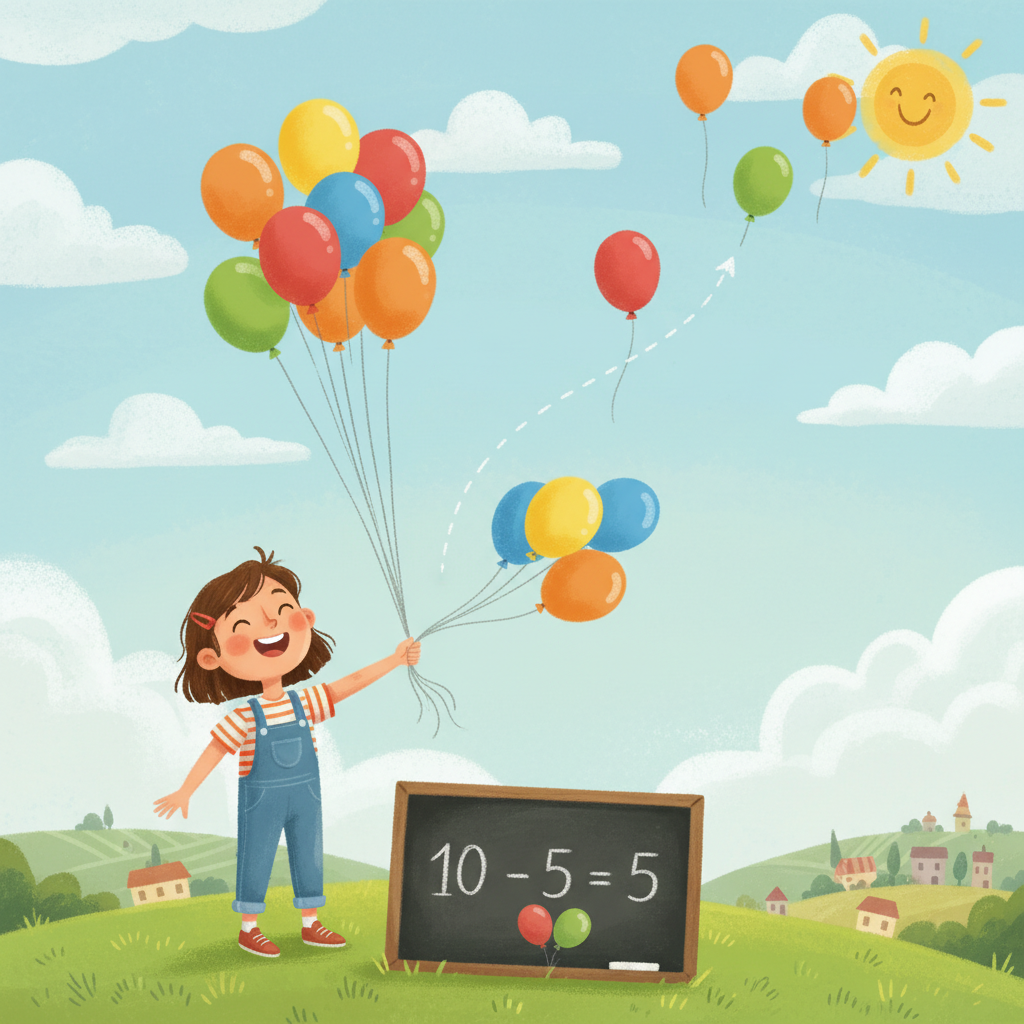
If you have 5 apples and you give 2 apples to your friend, how many do you have left? You count them: 1, 2, 3. So, 5 - 2 = 3. You have 3 apples left.
Subtracting Larger Numbers: Unpacking the Groups!
Let's say you have 179 crayons and you give away 56 crayons to your classmates. How many do you have left? Again, we line up the numbers by place value.
Let's subtract 56 from 179:
  179
-  56
----
1. Subtract the ones: 9 - 6 = 3. We write 3 in the ones column.
  179
-  56
-----
    3
2. Subtract the tens: 7 - 5 = 2. We write 2 in the tens column.
  179
-  56
-----
   23
3. Subtract the hundreds: We have 1 in the hundreds place in 179 and 0 in the hundreds place in 56. So, 1 - 0 = 1. We write 1 in the hundreds column.
  179
-  56
-----
  123
So, 179 - 56 = 123. You have 123 crayons left.
Borrowing: When a Group Doesn't Have Enough!
Sometimes, when we subtract, the digit in the top number is smaller than the digit in the bottom number in the same column. Imagine you have 3 apples, but someone wants to take 5 apples. You don't have enough! You need to get more apples. In subtraction, when this happens, we 'borrow' from the next place value to the left. It's like taking one group of ten from the tens column and turning it into ten individual ones for the ones column.
Let's subtract 35 from 48. (Wait, we just did this with addition! Let's do a different one to show borrowing.)
Let's subtract 38 from 72:
  72
- 38
----
1. Subtract the ones: We need to subtract 8 from 2. We don't have enough! So, we borrow from the tens column. The 7 in the tens column becomes a 6, and we add 10 to the ones column. So, the 2 in the ones column becomes 12.
  ⁶¹²
  7 2
- 3 8
-----
Now, 12 - 8 = 4. We write 4 in the ones column.
  ⁶¹²
  7 2
- 3 8
-----
    4
2. Subtract the tens: Now we have 6 in the tens column (because we borrowed) and we need to subtract 3. So, 6 - 3 = 3. We write 3 in the tens column.
  ⁶¹²
  7 2
- 3 8
-----
   34
So, 72 - 38 = 34. It's like having 72 dollars and spending 38 dollars. You have 34 dollars left.
Just like with addition, when we subtract really large numbers, we continue this process. If we need to borrow in the tens column, we borrow from the hundreds, and so on. It's like taking apart a large building brick by brick, carefully managing each piece.
Addition and subtraction are the fundamental ways we change numbers. They are used everywhere, from counting your toys to managing money, to solving complex scientific problems. Keep practicing, and you'll become a master of these essential operations!
 ⚠️ This picture may have spelling mistakes. Trust the words in the lesson.
Keep learning, free
Create a free Syllabax account to unlock practice questions and games for this topic.
Visual Learning Enhanced! 🚀
To help you master this topic, we use Advanced Syllabax AI to generate detailed diagrams and visual models.
Note on Visuals: The AI sometimes makes spelling errors in image labels. Please refer to the lesson text for the correct terminology.