Real-life applications (Linear Equations in One Variable)
Watch this topic in 60 seconds
Free preview · Lesson 1
Understanding Real-life applications (Linear Equations in One Variable)
Unlocking Everyday Mysteries: Linear Equations in Your Life!
Imagine you're a super-sleuth, and every day, you encounter little mysteries. How much money will you have left after buying that cool game? How long will it take to get to your friend's house if you walk at a certain speed? These aren't just random questions; they're puzzles waiting to be solved, and guess what? A powerful tool called a "Linear Equation in One Variable" is your secret weapon!
What Exactly IS a Linear Equation? Think of a Balanced Scale!
At its heart, a linear equation is like a perfectly balanced seesaw or an old-fashioned scale. On one side, you have some weights; on the other, you have other weights. For the scale to be balanced, both sides must be equal. In math, we use an "equals sign" (=) to show this balance.
- "Linear" means that when you graph it, it makes a straight line. But for us today, it just means our unknown "mystery number" (the variable) isn't squared, cubed, or anything fancy. It's just itself, plain and simple.
- "Equation" means it has an equals sign, showing that two expressions are balanced.
- "One Variable" means there's only one "mystery number" we're trying to find. We often use letters like 'x', 'y', or 'a' to represent this unknown.
So, a linear equation in one variable is a mathematical statement that two things are equal, and there's only one unknown number that makes that statement true. For example: x + 5 = 12. Here, 'x' is our mystery number. What number, when you add 5 to it, gives you 12? (The answer is 7!)
Your Math Toolkit: Key Terms Explained Simply
- Variable: This is your 'x' (or 'y', 'a', etc.) – the mystery number you're trying to find. Think of it as an empty box waiting for you to put a number in it.
- Constant: These are the plain numbers in an equation, like 5 or 12 in our example
x + 5 = 12. Their value doesn't change. - Coefficient: This is a number multiplied by a variable, like the '3' in
3x. It tells you how many of your mystery number you have. If you have 'x', it's like having '1x' (one of the mystery numbers).
Why Bother? Real-Life Scenarios Where YOU Become a Math Detective!
Linear equations aren't just dusty old textbook problems; they're practical tools you use all the time, sometimes without even realizing it! They help us figure out unknowns in situations involving money, time, shopping, and so much more. Let's look at some common scenarios.
Application 1: Money Matters - Smart Spending and Saving
Imagine your allowance is
- The Mystery: How much money is left for snacks? Let's call this 's'.
- What We Know: Total allowance =
- The Equation: Money for snacks + Comic book cost = Total allowance. So,
s + 7 = 20. - Solving It: To find 's', we need to get it by itself. If you take away 7 from the left side, you must also take away 7 from the right side to keep the scale balanced.
s + 7 - 7 = 20 - 7, which simplifies tos = 13. - The Answer: You have $13 left for snacks!
Application 2: Time and Travel - Planning Your Day
You're riding your bike at a steady speed of 10 miles per hour (mph). Your friend lives 15 miles away. How long will it take you to get to their house?
- The Mystery: How long will it take? Let's call this 't' (for time).
- What We Know: Speed = 10 mph. Distance = 15 miles.
- The Formula (Distance = Speed × Time):
15 = 10 × t, or simply10t = 15. - Solving It: To get 't' by itself, we need to undo the multiplication by 10. We do this by dividing both sides by 10.
10t / 10 = 15 / 10, which simplifies tot = 1.5. - The Answer: It will take you 1.5 hours (or 1 hour and 30 minutes) to reach your friend's house.
Application 3: Shopping Deals - Finding the Original Price
You spotted a cool T-shirt on sale for 25% off. The sale price is $18. What was the original price of the T-shirt before the discount?
- The Mystery: What was the original price? Let's call this 'p'.
- What We Know: Discount = 25%. Sale Price = $18.
- Thinking It Through: If you get 25% off, you are paying 100% - 25% = 75% of the original price. So, 75% of the original price is $18.
- The Equation:
0.75 × p = 18(Remember, 75% is 0.75 as a decimal). - Solving It: Divide both sides by 0.75.
0.75p / 0.75 = 18 / 0.75, which simplifies top = 24. - The Answer: The original price of the T-shirt was $24.
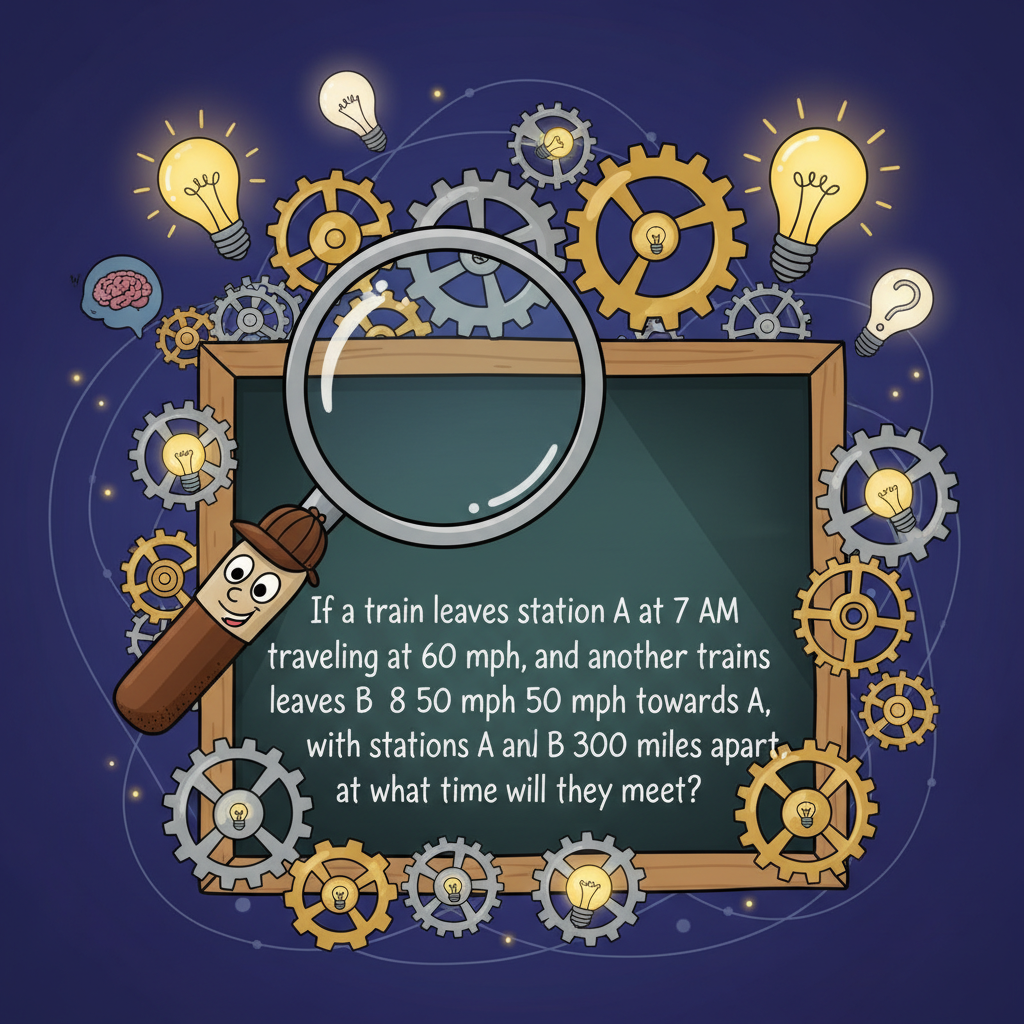 ⚠️ This picture may have spelling mistakes. Trust the words in the lesson.
Application 4: Age Puzzles - Family Fun
Sarah is 3 years older than her brother, Tom. If the sum of their ages is 27, how old is Tom?
- The Mystery: How old is Tom? Let's call Tom's age 't'.
- What We Know: Sarah is 3 years older than Tom, so Sarah's age is
t + 3. Their combined age is 27. - The Equation: Tom's age + Sarah's age = 27. So,
t + (t + 3) = 27. - Solving It: Combine the 't' terms:
2t + 3 = 27. Now, subtract 3 from both sides:2t + 3 - 3 = 27 - 3, which gives2t = 24. Finally, divide both sides by 2:2t / 2 = 24 / 2, sot = 12. - The Answer: Tom is 12 years old. (And Sarah is 12 + 3 = 15 years old. Check: 12 + 15 = 27. It works!)
Application 5: Geometry - Fencing a Garden
You want to put a fence around a rectangular garden. The length of the garden is twice its width. If you have 36 feet of fencing, what are the dimensions (length and width) of the garden?
- The Mystery: What are the width and length? Let's call the width 'w'.
- What We Know: Length is twice the width, so length =
2w. The total fencing is 36 feet, which is the perimeter. - The Formula (Perimeter of a rectangle = 2 × (length + width)):
36 = 2 × (2w + w). - Solving It: First, simplify inside the parentheses:
36 = 2 × (3w), which means36 = 6w. Now, divide both sides by 6:36 / 6 = 6w / 6, sow = 6. - The Answer: The width is 6 feet. Since the length is twice the width, the length is
2 × 6 = 12feet. (Check: Perimeter = 2 * (6 + 12) = 2 * 18 = 36. It works!)
Your Detective's Strategy Guide for Solving Word Problems
Don't be overwhelmed by a word problem! Follow these steps like a detective following clues:
- Read and Understand: Read the problem carefully, more than once if needed. What is the story? What are they asking you to find?
- Identify the Unknown: What is the "mystery number"? Choose a letter (variable) to represent it (e.g., 'x', 'y', 't', 'p').
- Translate to Math: Convert the words into mathematical expressions and an equation. Look for keywords: "sum" means add (+), "difference" means subtract (-), "product" means multiply (×), "quotient" means divide (÷), "is" or "was" often means equals (=).
- Solve the Equation: Use your balancing skills to get the variable by itself. Remember, whatever you do to one side of the equation, you must do to the other!
- Check Your Answer: Plug your answer back into the original word problem. Does it make sense? Does it answer the question?
See? Linear equations are not just math problems; they are tools that help you make sense of the world around you and solve everyday challenges. Keep practicing, and you'll become a master problem-solver in no time!
Keep learning, free
Create a free Syllabax account to unlock practice questions and games for this topic.
Visual Learning Enhanced! 🚀
To help you master this topic, we use Advanced Syllabax AI to generate detailed diagrams and visual models.
Note on Visuals: The AI sometimes makes spelling errors in image labels. Please refer to the lesson text for the correct terminology.