Shadow length changes (basic) (Light & Shadow)
Watch this topic in 60 seconds
Free preview · Lesson 1
Understanding Shadow length changes (basic) (Light & Shadow)
What Makes Shadows Grow Long and Short? (A 4th Grade Adventure with Light!)
Have you ever played with your shadow? Maybe you’ve made it dance, or tried to stomp on your friend’s shadow! Shadows are super fun and a little mysterious, aren't they? They follow us everywhere on a sunny day, but they don't always look the same. Sometimes your shadow is tiny, and sometimes it stretches out super long, like a giant! Have you ever wondered why that happens? Let's go on an adventure to find out the secret of shadow lengths!
What Exactly is a Shadow? (The Basics!)
Before we talk about why shadows change, let's remember what they are. A shadow is simply a dark shape made on a surface (like the ground or a wall) when an object blocks light. It's like the light can't get past the object, so it leaves a dark 'gap' where it should have been. Pretty cool, right?
Think about it like this: Imagine you have a bright flashlight in a dark room. When you turn it on, the light beams straight out, like a laser! Now, if you put your hand in front of the flashlight, what happens? A dark shape, your hand's shadow, appears on the wall behind it! That's because your hand is stopping the light from reaching the wall in that spot.
Analogy 1: The Water Blocker! Imagine a water hose spraying water straight ahead. If you stand in front of the hose, the water hits you and doesn't reach the ground behind you. That spot behind you stays dry! Your shadow is just like that dry spot, but instead of blocking water, your body is blocking light!
The Big Secret: Why Shadows Change Length!
Now for the exciting part! Shadows don't stay the same size all day long. They are constantly changing, growing long and shrinking short. The main reason for this amazing trick is **where the light source is in the sky** (and for us on Earth, that usually means the Sun!).
The Sun's Journey and Your Shadow's Dance
Our wonderful Sun isn't always in the same spot in the sky. It moves across the sky throughout the day, and this movement changes how its light hits everything on Earth. This 'angle' of the light is the super important secret to shadow length!
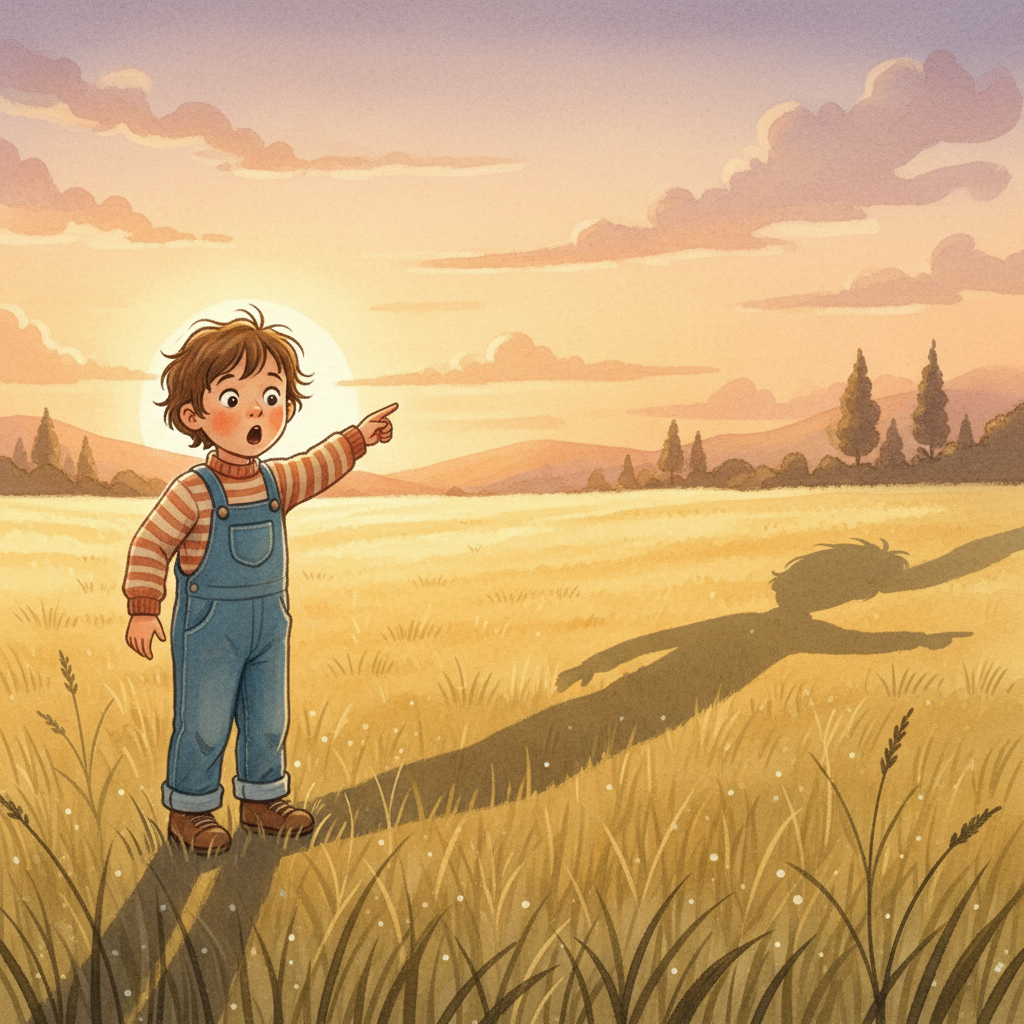
1. Morning Magic (Long Shadows!)
- When the Sun first peeks over the horizon in the morning, it's very **low** in the sky.
- Because the Sun is low, its light hits you and other objects at a **slanting angle**. Think of it like a flashlight shining almost horizontally, or from very far away and low down.
- When the light hits at a slant, your shadow stretches out really long, far away from you. It's like your shadow is a sleepy giant, just waking up and stretching its arms out across the ground!
Analogy 2: Flashlight and Toy Car! Grab a toy car and a flashlight. Stand the toy car up. Hold the flashlight very low to the table, almost touching it, and shine it at the car. See how long the shadow of the car stretches out behind it? That's what happens to your shadow in the morning!
2. Midday Mystery (Short Shadows!)
- As the day goes on, the Sun climbs higher and higher in the sky.
- Around noon (lunchtime!), the Sun is almost directly **overhead** or very high.
- When the Sun is high, its light hits you and other objects more **directly down**.
- When the light hits from directly above, your shadow shrinks down and huddles close to your feet. It becomes the shortest it will be all day, almost hiding right underneath you!
Analogy 3: Flashlight and Toy Car (Again!) Now, take that same flashlight and hold it directly above the toy car, pointing straight down. See how small the car's shadow is, almost completely hidden right underneath it? That's exactly what happens to your shadow at midday!
3. Evening Encore (Long Shadows Again!)
- In the afternoon, the Sun starts to go down again, getting lower and lower in the sky as it gets ready to set.
- Just like in the morning, when the Sun is low, its light hits you at a **slanting angle** again.
- And guess what? Your shadow starts to stretch out and grow long again, getting longer and longer until the Sun finally disappears below the horizon. It's like your shadow is waving goodbye to the day!
The Angle of the Light: The Super Important Player!
So, the most important thing to remember is the **angle** at which the light hits the object. This angle is what makes all the difference for how long or short a shadow will be:
- Low Angle of Light (Morning/Evening Sun) = Long Shadow (The light hits sideways, stretching the shadow far out).
- High Angle of Light (Midday Sun) = Short Shadow (The light hits more directly down, making the shadow small and close).
Analogy 4: A Stick in the Ground! Imagine sticking a straight stick into the ground. In the morning, the sun's low rays hit the stick, and its shadow is very long. At noon, the sun is overhead, and the stick's shadow is tiny, right beneath it. In the evening, the sun is low again, and the stick's shadow becomes long once more! The stick didn't change, but the sun's angle did!
Other Things That Affect Shadows (Quick Peek!)
While the angle of the light is the biggest reason shadows change length during the day, here are a couple of other things that can affect shadows:
- The Object's Height: A tall flag pole will make a much longer shadow than a small rock, even if the sun's angle is the same for both. Taller objects block more light and cast longer shadows.
- How Close the Light Source Is (for artificial lights): If you use a flashlight and hold it very close to your hand, your shadow on the wall can be HUGE! But if you move the flashlight far away, your hand's shadow will get smaller. For the Sun, though, it's so, so far away that we mainly focus on its angle in the sky, not its distance changing much in a day.
Let's Summarize Our Shadow Adventure!
We've learned so much about our mysterious friends, shadows! Here's what we discovered:
- Shadows form when an object blocks light.
- The length of a shadow changes throughout the day because the Sun's position (or angle) in the sky changes.
- When the Sun is low (in the morning or late afternoon/evening), its light hits at a slanted angle, making shadows very long.
- When the Sun is high (around midday), its light hits more directly down, making shadows very short.
Now you're a shadow expert! The next time you see your shadow, you'll know exactly why it's long or short. Go outside on a sunny day and observe for yourself – watch how your shadow dances and changes as the Sun moves across the sky!
Keep learning, free
Create a free Syllabax account to unlock practice questions and games for this topic.
Visual Learning Enhanced! 🚀
To help you master this topic, we use Advanced Syllabax AI to generate detailed diagrams and visual models.
Note on Visuals: The AI sometimes makes spelling errors in image labels. Please refer to the lesson text for the correct terminology.