Independent Events
Watch this topic in 60 seconds
Free preview · Lesson 1
Understanding Independent Events
Understanding Independent Events: When Outcomes Don't Care About Each Other!
Welcome, 8th-grade explorers, to the exciting world of probability! Today, we're going to unravel a fundamental concept called Independent Events. Don't let the fancy name scare you; it's all about understanding when one thing happening doesn't affect another thing happening. Think of it like two separate stories unfolding at the same time, without any character from one story influencing the characters or plot of the other.
What's an 'Event' Anyway?
Before we dive into 'independent,' let's quickly define an 'event.' In probability, an event is just an outcome or a set of outcomes from an experiment. For example, if you flip a coin, 'getting heads' is an event. If you roll a die, 'rolling a 3' is an event, and 'rolling an even number' is also an event.
The Big Idea: Independent Events Explained Simply
Imagine you're having two different things happen. If the outcome of the first thing has absolutely NO impact on the outcome of the second thing, then those two things are called independent events. They don't 'talk' to each other, they don't 'remember' what happened before, and they don't 'care' about each other's results.
Analogy 1: The Coin Flip Conundrum
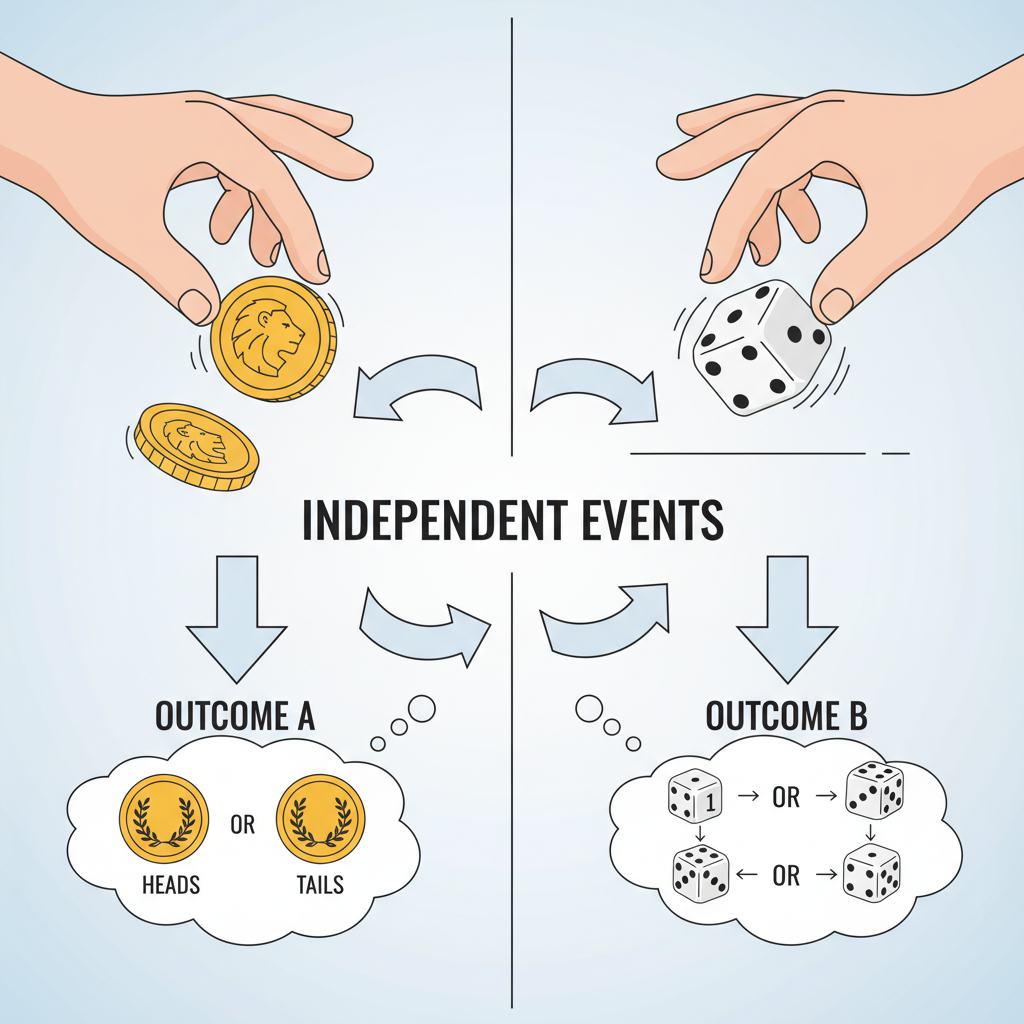
Let's start with a classic example: flipping a coin. If you flip a coin once and get 'Heads,' and then you flip it a second time, does that first 'Heads' make it more or less likely to get 'Heads' again? Absolutely not! Each coin flip is a fresh start. The coin doesn't have a memory. So, getting Heads on the first flip and getting Heads on the second flip are independent events. One flip's result doesn't influence the next.
Analogy 2: Rolling a Die and Picking a Card
Now, let's try something different. You roll a standard six-sided die, and then you draw a card from a shuffled deck of 52 playing cards. Are these two actions independent? Yes! The number you roll on the die (say, a 5) has nothing to do with whether you draw a King of Hearts or a 7 of Clubs. The die is one experiment, the deck of cards is another, and their outcomes don't affect each other at all. They are completely separate, making them independent events.
Analogy 3: Your Outfit and the Weather
Think about your morning routine. You pick out a red shirt. Does picking that red shirt change whether it will rain today? No! The weather is going to do its own thing, completely independent of your fashion choices. Your choice of shirt and the day's weather are independent events.
Official Definition: Two events, A and B, are said to be independent if the probability of event B occurring is not affected by the occurrence of event A. In simpler terms: Event A happening doesn't change the chances of Event B happening.
How Do We Calculate the Probability of Independent Events?
This is where it gets really useful! If you want to know the probability of two independent events both happening, you simply multiply their individual probabilities. It's like combining the chances of two separate things happening.
The Golden Rule: If Event A and Event B are independent, then the probability that both Event A and Event B happen is:
P(A and B) = P(A) * P(B)
Where:
P(A and B)is the probability that both A and B occur.P(A)is the probability of Event A occurring.P(B)is the probability of Event B occurring.
Example Time!
Let's use our coin and die example:
- What is the probability of flipping a coin and getting Heads?
There are 2 sides (Heads, Tails). 1 of them is Heads.
P(Heads) = 1/2 - What is the probability of rolling a standard die and getting a 4?
There are 6 sides (1, 2, 3, 4, 5, 6). 1 of them is a 4.
P(rolling a 4) = 1/6 - What is the probability of flipping a coin and getting Heads AND rolling a die and getting a 4?
Since these are independent events, we multiply their probabilities:
P(Heads and 4) = P(Heads) * P(rolling a 4) = (1/2) * (1/6) = 1/12
So, there's a 1 in 12 chance that both of those things will happen exactly as described!
Another Example: Drawing Marbles (with replacement)
Imagine a bag with 3 red marbles and 2 blue marbles (total of 5 marbles). You draw one marble, note its color, put it back in the bag (this is key!), and then draw another marble.
- What is the probability of drawing a red marble first?
P(Red first) = 3 (red marbles) / 5 (total marbles) = 3/5 - You put the red marble back. What is the probability of drawing a blue marble second?
Since you put the red marble back, the bag is exactly the same as it was before (3 red, 2 blue, 5 total).
P(Blue second) = 2 (blue marbles) / 5 (total marbles) = 2/5 - What is the probability of drawing a red marble first AND then a blue marble second (with replacement)?
Since putting the marble back makes the second draw unaffected by the first, these are independent events.
P(Red first and Blue second) = P(Red first) * P(Blue second) = (3/5) * (2/5) = 6/25
If you didn't put the marble back, the events would be called 'dependent,' because the first draw would change the number of marbles left for the second draw. But that's a topic for another day!
Why is this important?
Understanding independent events helps us make better predictions and decisions. From predicting weather patterns (mostly independent of what you had for breakfast) to understanding the chances of multiple components in a machine failing at the same time, this concept is everywhere. It's a foundational building block for more complex probability problems.
Keep practicing identifying independent events and using the multiplication rule, and you'll be a probability pro in no time!
Keep learning, free
Create a free Syllabax account to unlock practice questions and games for this topic.
Visual Learning Enhanced! 🚀
To help you master this topic, we use Advanced Syllabax AI to generate detailed diagrams and visual models.
Note on Visuals: The AI sometimes makes spelling errors in image labels. Please refer to the lesson text for the correct terminology.