Conductors & insulators[PHYSICS]
Watch this topic in 60 seconds
Free preview · Lesson 1
Understanding Conductors & insulators[PHYSICS]
Conductors and Insulators: The Flow of Electricity
Welcome, young scientists, to the fascinating world of electricity! Have you ever wondered how the lights turn on in your room, how your phone charges, or how a toaster gets hot? It all comes down to how electricity flows, and that flow depends on the materials around us. Today, we're going to explore two very important types of materials when it comes to electricity: conductors and insulators.
What is Electricity Anyway?
Before we dive into conductors and insulators, let's quickly touch on what electricity is. Imagine tiny, tiny particles called electrons. These electrons are like little messengers carrying energy. When these electrons start moving in a steady stream, we call that stream an electric current. Think of it like a river of water – the water molecules are like electrons, and the flowing river is the electric current. This flow of electrons is what powers our devices.
Conductors: The Open Road for Electrons
Some materials are like a superhighway for electrons. They let these tiny messengers zoom through with very little resistance. These materials are called conductors. In conductors, the electrons are not tightly held by the atoms of the material. They are free to move around, like a crowd of people milling about in a large, open square, easily able to move from one side to the other.
Why are they good conductors?
The reason conductors are so good at letting electricity flow is because of their atomic structure. In metals, for example, the outer electrons of the atoms are a bit lazy. They don't stick very closely to their own atoms. Instead, they form a kind of 'sea' of electrons that can easily travel throughout the metal when an electrical push (called a voltage) is applied.
Examples of Conductors:
- Metals: This is the most common group. Think of copper wires in your home, the aluminum foil in your kitchen, or the steel in a car. They all conduct electricity beautifully. Copper is especially good, which is why it's used so much in electrical wiring.
- Water (with impurities): Pure water is actually not a very good conductor. But the water we usually encounter – tap water, rainwater – has dissolved minerals and salts in it. These dissolved bits make the water able to conduct electricity. Think of it like adding pebbles to a clear stream; the water can still flow, but the pebbles might make it a bit harder, and those pebbles represent the dissolved ions that help carry the electric charge.
- Graphite: This is the 'lead' in your pencil! It's a form of carbon that can conduct electricity.
Analogy: A Busy Highway
Imagine you want to send a message across town. If you have a clear, open highway with no traffic, your message (the electrons) can travel very quickly. Conductors are like that highway – they allow the electric current to flow easily and efficiently.
Insulators: The Roadblocks for Electrons
On the other end of the spectrum, we have insulators. These materials act like roadblocks or speed bumps for electrons. They make it very difficult for electricity to flow through them. In insulators, the electrons are held very tightly by their atoms. They are not free to roam, like people stuck in separate, locked rooms; they can't easily move from one room to another.
Why are they good insulators?
Insulators have a different atomic structure. Their electrons are strongly bound to their atoms. They require a lot of energy to be knocked loose and start moving. This is why they don't let electric currents pass through easily.
Examples of Insulators:
- Rubber: The outer coating on electrical cords is usually made of rubber or a similar plastic. This is a great insulator, protecting you from electric shocks.
- Plastic: Many handles of electrical tools, like screwdrivers, are made of plastic. This prevents the electricity from reaching your hand.
- Glass: You might have seen old electrical posts with glass or ceramic insulators. They prevent electricity from escaping the wires.
- Dry Wood: Dry wood does not conduct electricity well, which is why wooden ladders are sometimes used around electrical work (though caution is always advised!).
- Air: The air around us is a pretty good insulator. That's why lightning, a massive flow of electricity, usually happens between clouds or between a cloud and the ground, and doesn't just jump to every object in its path.
Analogy: A Traffic Jam
Imagine you're trying to send that same message across town, but this time the roads are completely blocked with traffic. Your message (the electrons) can't get through. Insulators are like that traffic jam – they stop or severely slow down the flow of electric current.
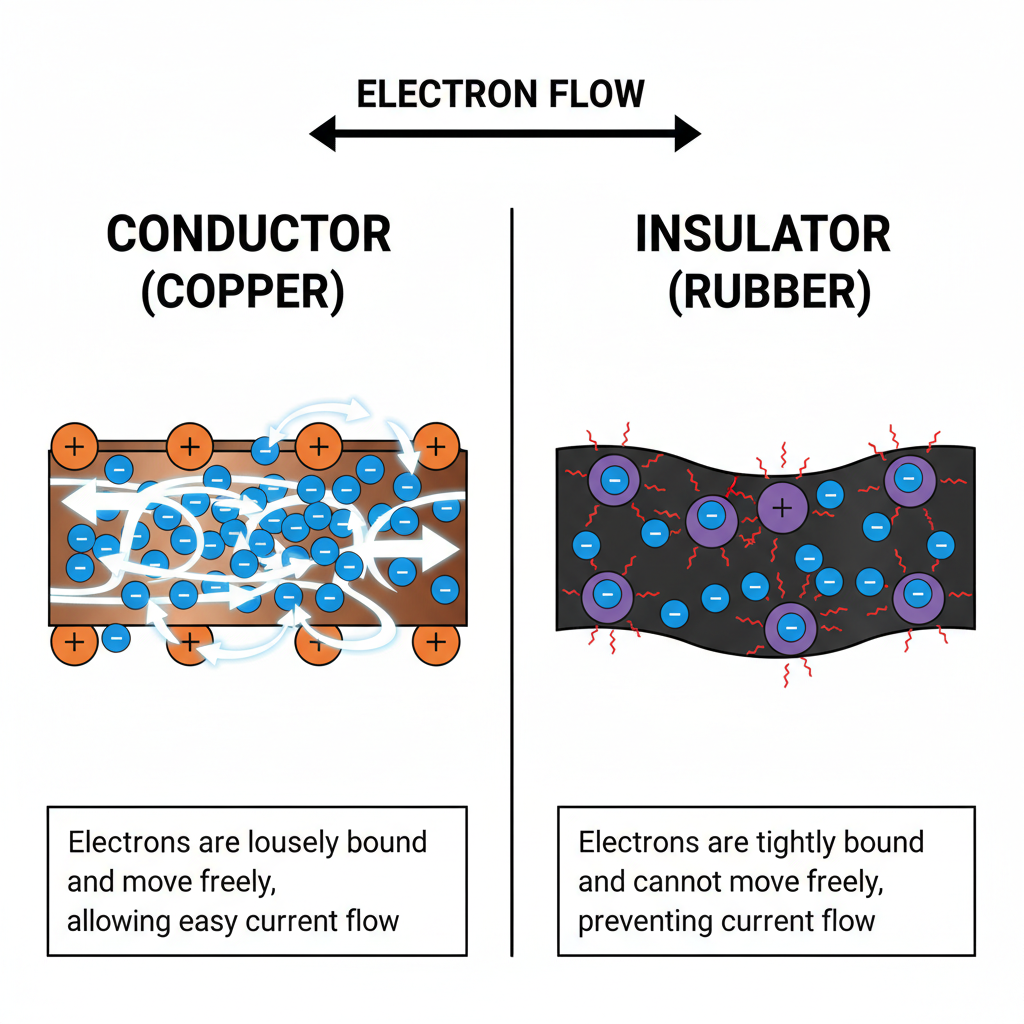 ⚠️ This picture may have spelling mistakes. Trust the words in the lesson.
Why Do We Need Both?
It might seem like conductors are always better because they let electricity flow, but both conductors and insulators are absolutely essential for our electrical systems to work safely and effectively.
Conductors are used to carry the electricity where we want it to go. The copper wires in your walls carry electricity from the power outlet to your lamp. The metal contacts on your phone charger carry electricity to your phone.
Insulators are used to keep the electricity where it belongs and to protect us from getting shocked. The plastic or rubber coating around electrical wires prevents you from accidentally touching a live wire. The ceramic base of a light bulb prevents electricity from flowing into the socket and the lampshade.
Safety First!
Understanding conductors and insulators is key to electrical safety. That's why electrical cords have that rubber or plastic coating. It's there to keep the electricity safely inside the wire and away from you.
A Quick Summary
So, to recap:
- Conductors let electricity (the flow of electrons) move easily through them. They are like open roads for electrons.
- Insulators block or greatly slow down the flow of electricity. They are like traffic jams for electrons.
- We need both to build safe and functional electrical devices and systems.
Keep an eye out for conductors and insulators in your everyday life! You'll be surprised how often you see them working together.
Keep learning, free
Create a free Syllabax account to unlock practice questions and games for this topic.
Visual Learning Enhanced! 🚀
To help you master this topic, we use Advanced Syllabax AI to generate detailed diagrams and visual models.
Note on Visuals: The AI sometimes makes spelling errors in image labels. Please refer to the lesson text for the correct terminology.