Quadratic formula (Quadratic Equations)
Watch this topic in 60 seconds
Free preview · Lesson 1
Understanding Quadratic formula (Quadratic Equations)
Unlocking the Secrets of Quadratic Equations: The Quadratic Formula!
Imagine you're an adventurer on a quest, and you've stumbled upon a mysterious ancient puzzle. This puzzle isn't solved by brute force; it requires a special, magic key. In the world of mathematics, especially when dealing with shapes like parabolas or problems involving motion and optimization, we often encounter a type of puzzle called a Quadratic Equation. And just like our adventure, there's a powerful magic key to solve them all: The Quadratic Formula!
What is a Quadratic Equation?
Before we use our magic key, let's understand the puzzle itself. A quadratic equation is a polynomial equation of the second degree. Don't let the fancy words scare you! In simple terms, it's an equation where the highest power of the variable (usually 'x') is 2. It looks like this:
ax2 + bx + c = 0
- 'x' is our unknown variable – the treasure we're trying to find!
- 'a', 'b', and 'c' are just numbers (we call them coefficients). These numbers can be positive, negative, or zero (with one crucial exception).
- Important Rule: The number 'a' can never be zero! If 'a' were zero, the
x2term would disappear, and it wouldn't be a quadratic equation anymore; it would be a simple linear equation (likebx + c = 0).
Think of 'a', 'b', and 'c' as the unique 'ingredients' or 'clues' in our puzzle. Every quadratic equation has its own set of these numbers, which dictate its unique properties and solutions.
Why Do We Need a 'Magic Key'? Can't We Just Factor?
You might have learned about factoring quadratic equations. Factoring is like having a specific tool for a specific lock. It works great for some quadratic equations – the ones where the numbers 'fit' together nicely and allow you to break down the expression into simpler multiplications. But what if the numbers don't fit? What if the lock is too complicated for our basic tools? That's where factoring falls short. Not all quadratic equations can be easily factored, or even factored at all using simple integers. This is like trying to open a high-tech vault with just a regular crowbar – it just won't work!
This is precisely why mathematicians developed the Quadratic Formula. It's the ultimate, universal tool – the master key that can unlock ANY quadratic equation, no matter how tricky its numbers 'a', 'b', and 'c' might be. It guarantees you a solution (or solutions!) every single time.
Introducing the Ultimate Master Key: The Quadratic Formula!
Here it is, in all its glory. Take a deep breath, it might look a little intimidating at first, but we'll break it down piece by piece. This formula is your trusty guide to finding the 'x' values that make the equation true.
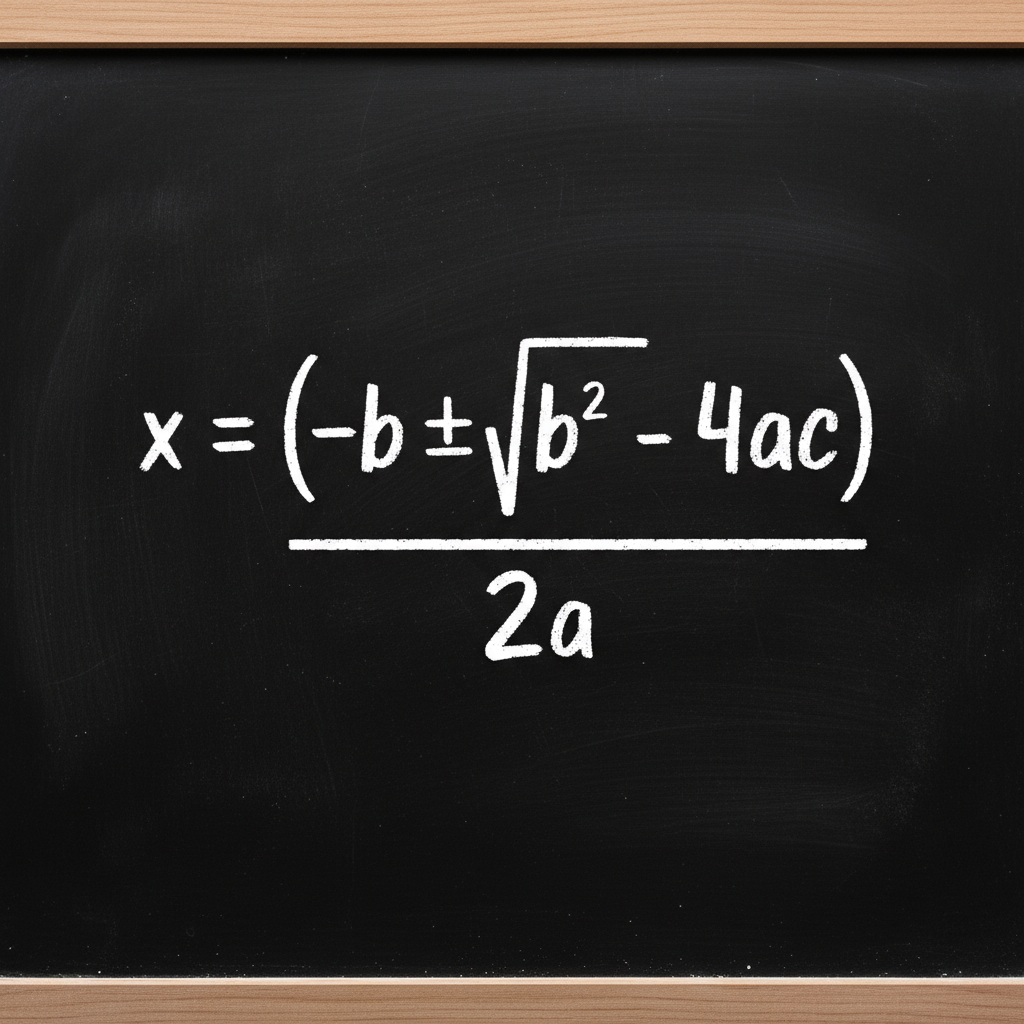
x = [-b ± √(b2 - 4ac)] / 2a
This formula tells us exactly what 'x' (our unknown treasure!) is, simply by plugging in the 'a', 'b', and 'c' values from our quadratic equation. It's like having a step-by-step instruction manual for every puzzle, transforming those mysterious coefficients into concrete solutions!
Breaking Down the Magic Key: What Each Part Means
Let's dissect this powerful formula to understand its components and their roles:
-b: This simply means 'the opposite of b'. If 'b' is 5, then '-b' is -5. If 'b' is -3, then '-b' is 3. This is usually the first number you write down.±(Plus or Minus): This is super important! It means you'll do two separate calculations: one using the '+' sign and one using the '-' sign. This is why most quadratic equations have two solutions! Think of it like a fork in the road – you can go left or right, and each path leads to a valid solution to your equation.√(...)(Square Root): You'll calculate everything inside the square root first, and then find its square root. The square root undoes a squaring operation. For example, √9 = 3 because 32 = 9.b2 - 4ac(The Discriminant): This part is so special it has its own name! It's called the discriminant. It's like a 'fortune teller' for your solutions, predicting how many real answers (real numbers) your equation will have even before you finish solving!- If
b2 - 4acis positive (greater than 0), you'll have two different real solutions. (Two distinct paths from our fork in the road!) - If
b2 - 4acis zero, you'll have exactly one real solution (sometimes called a 'repeated root' because both paths lead to the same answer). (One clear path, no real fork!) - If
b2 - 4acis negative (less than 0), you'll have no real solutions. (The path is blocked, as you can't take the square root of a negative number in the real number system. You would need 'imaginary numbers' to proceed, which you'll learn about later!) 2a: This is the denominator, the number you divide by at the very end. It's simply two times the 'a' value.
How to Use the Quadratic Formula: Your Step-by-Step Guide
Here's how to apply our magic key to any quadratic equation. Follow these steps carefully, like following a recipe to bake a perfect cake:
- Get it in Standard Form: First, ensure your equation is written as
ax2 + bx + c = 0. If terms are scattered or not equal to zero, rearrange them using basic algebra so all terms are on one side and the equation equals zero. - Identify 'a', 'b', and 'c': Carefully identify the numerical values (including their signs!) for 'a', 'b', and 'c'. Remember, if a term is missing (e.g., no 'x' term), its coefficient is 0. If there's just
x2, thena=1. Be meticulous with positive and negative signs! - Substitute into the Formula: Plug these 'a', 'b', and 'c' values into the quadratic formula. This is where many errors occur, so be extra careful with negative signs! It's often helpful to use parentheses for substitution, especially when 'b' or 'c' are negative.
- Calculate the Discriminant: First, calculate the value inside the square root:
b2 - 4ac. This is often the trickiest part, so take your time and follow the order of operations (PEMDAS/BODMAS): exponents first, then multiplication, then subtraction. - Find the Square Root: Once you have the value of the discriminant, find its square root. If it's a perfect square (like 1, 4, 9, 16, etc.), you'll get a whole number. If not, you might leave it as a simplified radical or approximate it with a calculator.
- Solve for Both Paths (+ and -): Now, separate the equation into two parts: one where you use the '+' sign and one where you use the '-' sign from the
±symbol. These will be your two potential solutions for 'x'. - Simplify: Perform the addition/subtraction in the numerator for both paths, and then divide by the denominator (2a). Simplify your answers as much as possible, reducing fractions if necessary. These are your final solutions, the 'treasures' you've been looking for!
Let's Practice with an Example! (The first treasure hunt!)
Solve the equation: x2 + 5x + 6 = 0
- Standard Form? Yes, it already is:
x2 + 5x + 6 = 0. - Identify 'a', 'b', 'c':
a = 1(because it's1x2)b = 5c = 6
- Substitute:
x = [-5 ± √(52 - 4 * 1 * 6)] / (2 * 1) - Calculate Discriminant:
First,
52 = 25. Then,4 * 1 * 6 = 24. So,25 - 24 = 1. The discriminant is 1. - Find Square Root:
√1 = 1 - Solve for Both Paths:
Path 1 (using +):
x = [-5 + 1] / 2 = -4 / 2 = -2Path 2 (using -):
x = [-5 - 1] / 2 = -6 / 2 = -3 - Solutions: The solutions (or roots) are
x = -2andx = -3.
Another Example! (A slightly trickier treasure chest!)
Solve the equation: 2x2 - 3x - 5 = 0
- Standard Form? Yes, it is.
- Identify 'a', 'b', 'c':
a = 2b = -3(don't forget the negative sign!)c = -5(don't forget the negative sign!)
- Substitute:
x = [-(-3) ± √((-3)2 - 4 * 2 * -5)] / (2 * 2)Notice how
-bbecomes-(-3) = 3and we used parentheses for(-3)2and-5to avoid errors, especially with negative numbers. - Calculate Discriminant:
First,
(-3)2 = 9. Then,4 * 2 * -5 = -40. So,9 - (-40) = 9 + 40 = 49. The discriminant is 49. - Find Square Root:
√49 = 7 - Solve for Both Paths:
Path 1 (using +):
x = [3 + 7] / 4 = 10 / 4 = 5/2Path 2 (using -):
x = [3 - 7] / 4 = -4 / 4 = -1 - Solutions: The solutions are
x = 5/2(or 2.5) andx = -1.
Why is the Quadratic Formula So Important?
The quadratic formula isn't just a math trick; it's a fundamental tool with real-world applications across many fields! It provides a powerful, reliable method for solving problems that involve quadratic relationships.
- Engineering: Used in designing bridges, understanding the trajectory of objects (like how a thrown ball flies or how water flows from a fountain), and calculating structural stability.
- Physics: Crucial for calculating projectile motion (e.g., the path of a cannonball), determining maximum height or distance in various scenarios, and analyzing energy transfer.
- Economics: Applied to model supply and demand curves, find optimal prices for products to maximize profit, or predict market trends.
- Architecture: Used in designing curved structures, arches, and optimizing spaces, as parabolas often appear in architectural elements.
- Science: Helps in modeling growth, decay, and reactions, such as the concentration of reactants over time.
It's the reliable method that works every single time, giving you precise answers even when other methods (like factoring by inspection) fail. It ensures you always have the master key to unlock these mathematical puzzles!
Conclusion
Congratulations, you've now been introduced to one of the most powerful tools in algebra: the Quadratic Formula! You've learned what a quadratic equation is, why this formula is essential (especially when factoring is tricky or impossible), and how to use it step-by-step. Remember, practice is key to becoming a master of this formula. Work through examples, pay close attention to signs, and soon, solving quadratic equations will feel like second nature! You now possess a universal key to unlock countless mathematical mysteries.
Keep learning, free
Create a free Syllabax account to unlock practice questions and games for this topic.
Visual Learning Enhanced! 🚀
To help you master this topic, we use Advanced Syllabax AI to generate detailed diagrams and visual models.
Note on Visuals: The AI sometimes makes spelling errors in image labels. Please refer to the lesson text for the correct terminology.