Marked price, selling price, cost price (Commercial Math)
Watch this topic in 60 seconds
Free preview · Lesson 1
Understanding Marked price, selling price, cost price (Commercial Math)
Understanding Commercial Math: Prices, Profit, and Discounts!
Have you ever wondered how shopkeepers decide the price of things they sell? Or how a store offers a "sale" and still makes money? This is where Commercial Math comes in! It's all about the numbers behind buying and selling, helping us understand how businesses work and how to make smart choices as shoppers.
In this lesson, we're going to unlock the secrets behind three very important prices: Cost Price (CP), Marked Price (MP), and Selling Price (SP). We'll also learn about exciting concepts like Profit, Loss, and everyone's favorite—Discounts!
1. The Cost Price (CP): The Shopkeeper's Investment
Imagine you want to open a lemonade stand. Before you can sell any lemonade, you need to buy lemons, sugar, water, and cups. The total money you spend on these ingredients to make your lemonade is your Cost Price (CP).
- Definition: The Cost Price (CP) is the original price at which a shopkeeper or a seller buys an item. It's their initial investment.
- Analogy: Think of a baker. The cost of flour, eggs, sugar, and electricity to bake a cake is the Cost Price for that cake. Or, for a clothing store, it's the price they pay the factory for a shirt. This is the money going out of the seller's pocket to get the product ready.
- Key Idea: A seller always hopes to sell an item for more than its Cost Price to make money!
2. The Marked Price (MP) or List Price: The Sticker Price
Once you have your lemonade ingredients, you decide to put a price tag on your lemonade cup. You might think, "I want to sell this for $2." This initial price you decide to put on the item, even before anyone buys it, is called the Marked Price (MP) or sometimes the List Price.
- Definition: The Marked Price (MP) is the price that is printed on the tag, label, or catalog of a product. It's the price the seller intends to sell the item for.
- Analogy: When you go to a clothing store, you see a tag on a shirt that says "$50". That's the Marked Price. When you look at a menu in a restaurant, the prices next to each dish are the Marked Prices. It's the "advertised" price before any special offers or discounts.
- Why have a Marked Price? Sometimes, sellers want to attract customers by offering discounts. By having a Marked Price, they can show customers how much they are saving when a discount is applied.
3. The Selling Price (SP): The Price You Actually Pay
You've decided your lemonade's Marked Price is
- Definition: The Selling Price (SP) is the actual price at which an item is sold to the customer. It's the money that actually comes into the seller's pocket from the sale.
- Analogy: When you buy groceries, the amount you pay at the cash register is the Selling Price. If a book originally costs
- Relationship: The Selling Price can be the same as the Marked Price, or it can be lower if a discount is given.
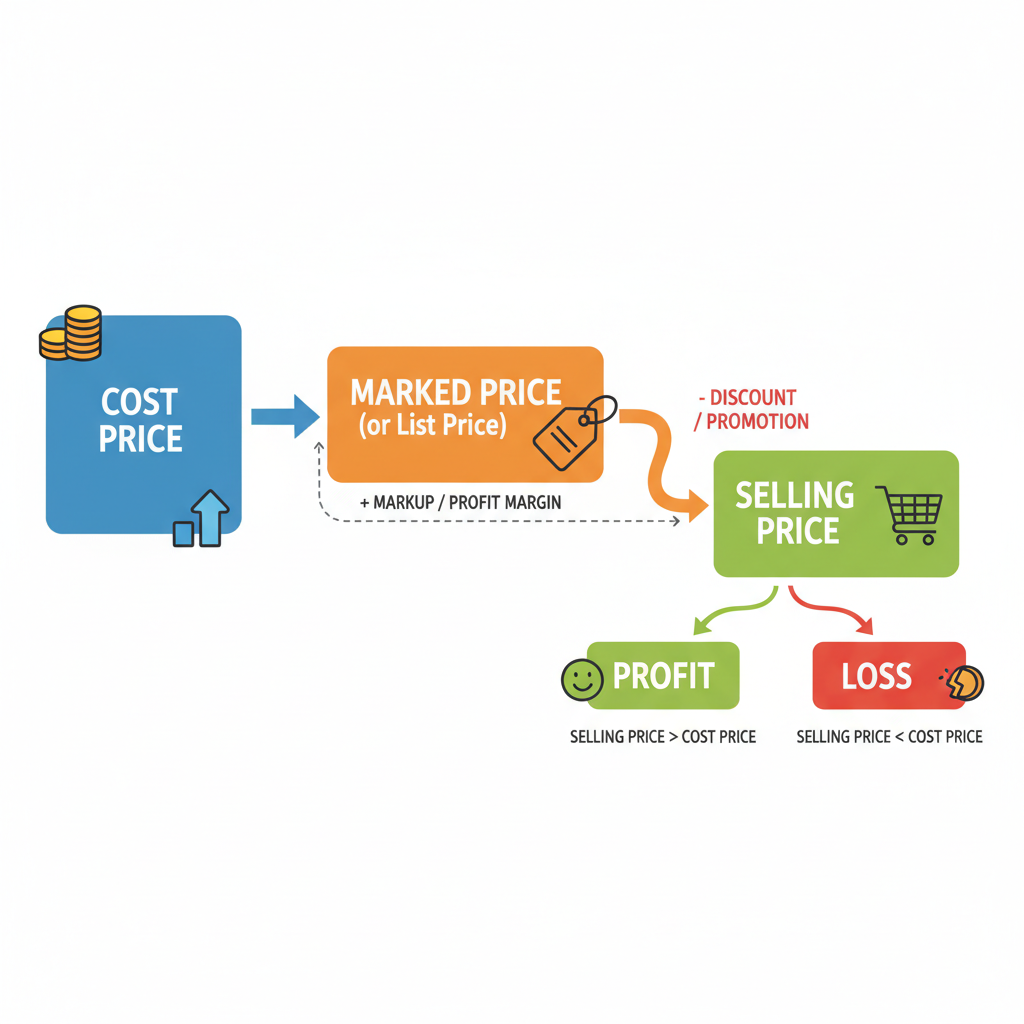
4. Profit and Loss: The Outcome of Selling
Now, let's see how the Cost Price and Selling Price determine if the seller makes money or loses money.
What is Profit?
Imagine your lemonade ingredients cost you
- Definition: Profit occurs when the Selling Price (SP) is greater than the Cost Price (CP). It's the extra money earned by the seller.
- Formula:
Profit = Selling Price (SP) - Cost Price (CP) - Analogy: If you buy a comic book for
What is Loss?
What if your lemonade ingredients cost you
- Definition: Loss occurs when the Selling Price (SP) is less than the Cost Price (CP). It means the seller lost money on the transaction.
- Formula:
Loss = Cost Price (CP) - Selling Price (SP) - Analogy: If you bought a toy for
No Profit, No Loss (Break-even)
If you sell your lemonade for exactly the amount it cost you to make it (SP = CP), then you have made no profit and no loss. This is called breaking even. You covered your costs, but didn't earn any extra money.
5. Discount: Giving a Little Off the Top!
Sometimes, stores want to attract more customers or clear out old stock. What do they do? They offer a Discount!
- Definition: A Discount is a reduction in the price of an item, usually given on the Marked Price (MP). It's a special offer to make an item more attractive to buyers.
- Analogy: When a store has a "20% off" sale, they are giving a discount. If a pizza normally costs
- Relationship: When a discount is applied, the Selling Price (SP) will be lower than the Marked Price (MP).
- Formula:
Discount = Marked Price (MP) - Selling Price (SP) - Important Note: Discounts are almost always calculated based on the Marked Price, not the Cost Price. This is because the Marked Price is what the customer sees and expects a reduction from.
Putting It All Together with Percentages!
In the real world, profit, loss, and discounts are often expressed as percentages. This helps us compare how much profit or loss was made relative to the investment, or how big a discount was offered.
- Profit Percentage (%): This tells us what percentage of the Cost Price was earned as profit.
Profit % = (Profit / Cost Price) × 100
- Loss Percentage (%): This tells us what percentage of the Cost Price was lost.
Loss % = (Loss / Cost Price) × 100
- Discount Percentage (%): This tells us what percentage of the Marked Price was reduced.
Discount % = (Discount / Marked Price) × 100
Quick Summary of Relationships:
Remember these key connections:
- When there is a Profit: SP > CP. And SP = CP + Profit.
- When there is a Loss: SP < CP. And SP = CP - Loss.
- When there is a Discount: SP < MP. And SP = MP - Discount.
Understanding these basic concepts is like learning the secret language of shops and businesses. It helps you understand the value of items, the deals you're getting, and how sellers make their living. Keep practicing, and you'll become a master of commercial math!
Keep learning, free
Create a free Syllabax account to unlock practice questions and games for this topic.
Visual Learning Enhanced! 🚀
To help you master this topic, we use Advanced Syllabax AI to generate detailed diagrams and visual models.
Note on Visuals: The AI sometimes makes spelling errors in image labels. Please refer to the lesson text for the correct terminology.