Learning Journey
Free preview · Lesson 1
Understanding Data Collection Methods: Surveys
Understanding Data Collection: Surveys (Grade 9, Foundational)
Imagine you're trying to figure out what kind of pizza your friends like best for a party. Would you just guess? Probably not, because you might end up ordering pineapple when everyone secretly hates it! Instead, you'd probably ask them directly. That act of asking questions to gather information is exactly what data collection is all about, and one of the most common ways to do it is through something called a survey.
What is Data, Anyway?
Before we dive into surveys, let's talk about data. Think of data as tiny pieces of information, like ingredients in a recipe. Each ingredient (a cup of flour, two eggs, a teaspoon of sugar) on its own might not tell you much, but when you put them all together, you can create something amazing, like a delicious cake! In the world of information, data can be anything from someone's favorite color to the number of students in a class, or how often people use a library. It's the raw material we use to understand the world around us.
Why Do We Collect Data?
Just like a detective collects clues to solve a mystery, we collect data to answer questions and make smart decisions. If a school wants to know if students feel safe, they collect data. If a company wants to know if people like their new phone, they collect data. Without data, we'd be making guesses, which is a bit like trying to play a game with a blindfold on – you might get lucky, but you're more likely to stumble!
Enter the Survey: Your Friendly Information Gatherer
A survey is simply a systematic way of collecting information from a group of people by asking them a series of questions. It's like being a super organized detective, but instead of looking for footprints, you're asking people directly what they know or think. Surveys are everywhere! You've probably filled one out without even realizing it – perhaps a customer satisfaction survey after buying something online, or a poll in class about a field trip destination.
Key Ingredients of a Survey:
- The Questions: These are the core of your survey. Just like you wouldn't ask a chef for 'some stuff' to cook, you need clear, specific questions.
- The Participants (Respondents): These are the people you're asking. They are the 'friends' you're inviting to the pizza party.
- The Method of Delivery: How do you get the questions to the participants? Do you email them? Hand out paper forms? Talk to them on the phone?
How Do Surveys Work? (A Simple Walkthrough)
Let's use our pizza party analogy. Imagine you want to know everyone's favorite pizza topping. Here's how a survey would play out:
- Step 1: Define Your Goal: Your goal is to find out the most popular pizza topping among your friends.
- Step 2: Create Your Questions: You might ask: "What is your absolute favorite pizza topping?" or give choices: "Which of these toppings do you prefer most? (A) Pepperoni (B) Mushroom (C) Cheese (D) Veggie."
- Step 3: Choose Your Participants: You decide to ask all 10 friends who are coming to the party.
- Step 4: Deliver the Survey: You could text each friend, or simply ask them when you see them.
- Step 5: Collect and Analyze Data: You write down everyone's answers. Then, you count up how many chose pepperoni, how many chose mushroom, and so on.
- Step 6: Make a Decision: If 7 out of 10 friends choose pepperoni, you know what to order!
That's the basic process of a survey in action!
The Good Stuff: Advantages of Using Surveys
Surveys are popular for a reason! They have several big advantages:
- Reach Many People: You can ask a lot of people relatively quickly. Think of it like sending out one message that reaches everyone at once, rather than talking to each person individually for a long time.
- Cost-Effective: Sending out an email survey or using an online tool can be very cheap, especially compared to hiring people to conduct long interviews.
- Easy to Compare Answers: When you ask the same question to everyone, it's much easier to compare their responses and spot trends. If 80% of students say they want more recess, that's a clear signal!
- Quick Results: Especially with online surveys, you can often get results and see trends almost instantly.
The Tricky Bits: Disadvantages of Using Surveys
However, surveys aren't perfect, and it's important to be aware of their downsides:
- Honesty Can Be an Issue: Sometimes people don't tell the complete truth, especially if the question is sensitive or if they think there's a "right" answer. It's like asking someone if they brushed their teeth – they might say yes, even if they forgot!
- Misunderstanding Questions: If a question isn't super clear, people might interpret it differently and give answers that aren't truly what they meant. "Are you satisfied with school?" could mean different things to different people.
- Low Response Rates: Not everyone you ask will complete your survey. Imagine inviting 100 people to a party, but only 20 show up – you might not get a complete picture.
- Lack of Depth: Surveys are great for getting broad answers, but they usually don't allow for really deep, detailed explanations from respondents.
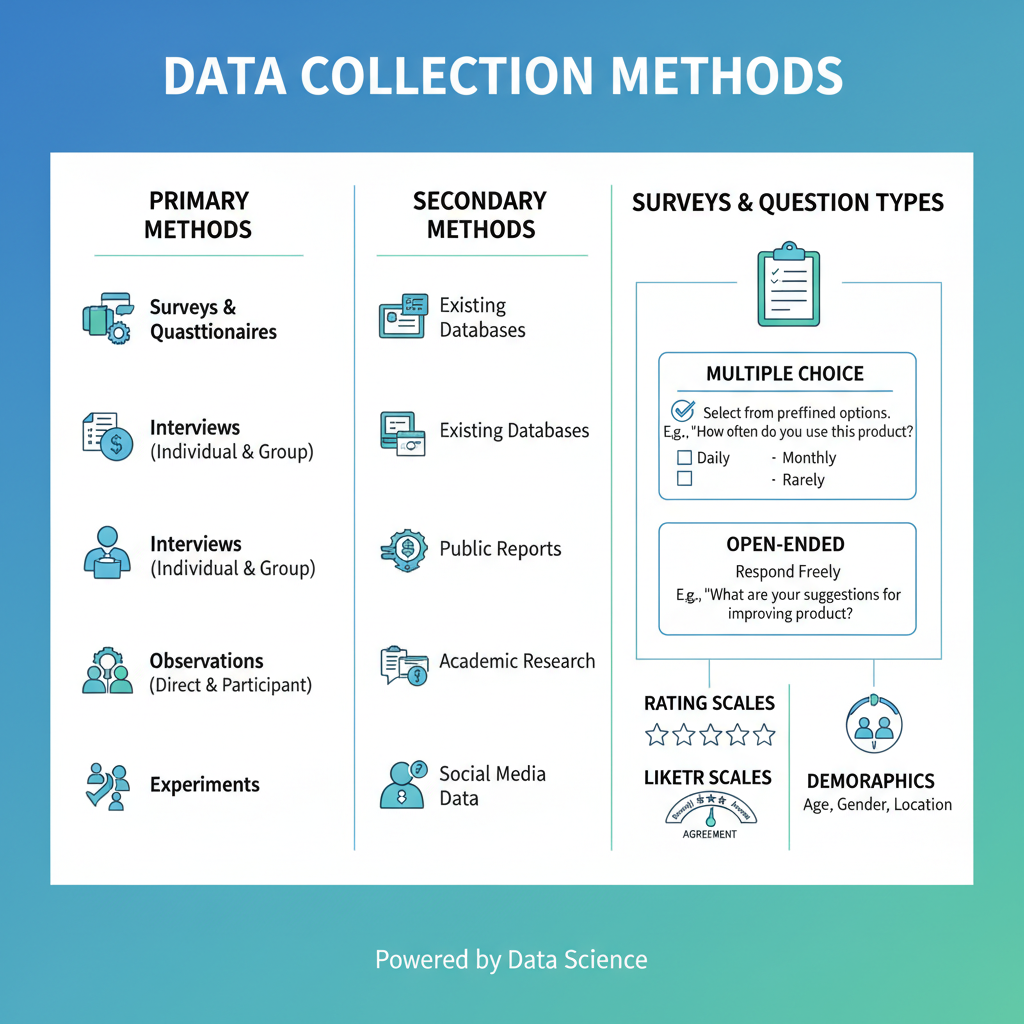 ⚠️ This picture may have spelling mistakes. Trust the words in the lesson.
Types of Survey Questions (A Quick Peek)
Just like there are different types of questions you ask a friend (e.g., "What's your favorite color?" vs. "Tell me about your summer vacation"), there are different survey questions:
- Closed-Ended Questions: These give respondents a limited set of choices. Like a multiple-choice quiz! Examples: Yes/No, A/B/C/D options, rating scales (e.g., "Strongly Agree" to "Strongly Disagree"). These are easy to analyze.
- Open-Ended Questions: These allow respondents to answer in their own words, giving more detailed insights. Example: "What do you like most about your school?" These can be harder to summarize.
Tips for Designing a Good Survey (Foundational Level)
If you ever create a survey, keep these simple tips in mind:
- Keep it Simple: Use clear, easy-to-understand language. Avoid jargon or complicated words.
- Be Specific: Make sure each question is about one thing only. Don't ask, "Do you like school and recess?" because someone might like one but not the other!
- Keep it Short: People lose interest quickly. Only ask what's absolutely necessary.
- Test It Out: Before sending it to everyone, ask a few friends to try your survey. Did they understand all the questions? This is like doing a 'dress rehearsal' before a big performance.
Ethical Considerations: Being Fair and Respectful
When collecting data from people, it's super important to be ethical. This means being fair and respectful. Key ideas include:
- Privacy: Protecting people's personal information.
- Anonymity: Not knowing who gave which answer, so people feel safe to be honest.
- Confidentiality: Keeping people's answers private, even if you know who said what.
Think of it like keeping a secret for a friend – you don't share their information without permission.
Conclusion
Surveys are a powerful tool in data collection, helping us gather information efficiently from many people. Whether it's to find out what pizza to order, how students feel about their school, or what consumers think about a new product, surveys help us move from guessing to making informed decisions. By understanding their strengths and weaknesses, and by designing them thoughtfully, we can use surveys to unlock valuable insights about the world around us.
Keep learning, free
Create a free Syllabax account to unlock practice questions and games for this topic.
Visual Learning Enhanced! 🚀
To help you master this topic, we use Advanced Syllabax AI to generate detailed diagrams and visual models.
Note on Visuals: The AI sometimes makes spelling errors in image labels. Please refer to the lesson text for the correct terminology.