Learning Journey
Watch this topic in 60 seconds
Free preview · Lesson 1
Understanding Factorization method (Quadratic Equations)
Unlocking Quadratic Equations: The Factorization Method (Grade 10)
Hello, Future Math Whizzes!
Imagine you're an explorer trying to find hidden treasure. Sometimes, the path is straightforward, but other times, you encounter mysterious ancient puzzles. In algebra, those "puzzles" often come in the form of equations. Today, we're going to tackle a special kind of puzzle called a Quadratic Equation, and we'll learn a powerful method to solve it: the Factorization Method!
What are Quadratic Equations? The Basics!
Think about a simple equation like x + 3 = 7. Easy, right? x must be 4. This is a linear equation because the highest power of x is 1 (like x1).
Now, what if we have x2 = 9? Here, x could be 3, because 3 * 3 = 9. But wait! What about -3? Yes, (-3) * (-3) = 9 also! So, x could be 3 or -3. This is our first peek into a quadratic equation.
A Quadratic Equation is any equation where the highest power of the variable (usually x) is 2. It looks like a mathematical "arch" or "U-shape" when graphed. The standard form of a quadratic equation is:
ax2 + bx + c = 0
Where:
a,b, andcare just numbers (constants).acannot be zero (otherwise, it wouldn't be quadratic!).xis the variable we want to find. These values ofxare called the "roots" or "solutions" of the equation.
Analogy Time! Think of a quadratic equation as a recipe with three main ingredients: the "squared" ingredient (ax2), the "single" ingredient (bx), and the "plain number" ingredient (c). And just like a good recipe, everything needs to equal zero in the end for our method to work!
Why Solve Quadratic Equations?
Quadratic equations pop up everywhere! From calculating the path of a thrown ball (like a quarterback's throw) to designing satellite dishes, understanding how an object falls, or even optimizing business profits. Finding the "solutions" means finding the specific points or values that make a real-world scenario true.
Introducing Our Superpower: The Factorization Method!
There are several ways to solve quadratic equations, but the factorization method is often the quickest and most elegant, especially when it's possible to factor the expression easily. It's like having a secret key to unlock the treasure chest!
What is "Factoring" Anyway? A Quick Review!
Before we dive into quadratic equations, let's quickly remember what "factoring" means. When you factor a number, you break it down into numbers that multiply together to give you the original number. For example, the factors of 12 are 1, 2, 3, 4, 6, 12. You can write 12 as 2 * 6 or 3 * 4.
In algebra, factoring means rewriting an expression as a product of simpler expressions (usually binomials). It's like taking a fully built LEGO model and breaking it back down into its original, simpler blocks. For example, x2 + 5x + 6 can be factored into (x + 2)(x + 3). If you multiply (x + 2) by (x + 3), you'll get x2 + 5x + 6.
Analogy: Imagine you have a locked combination safe (your quadratic expression). Factoring is like figuring out the individual numbers (the simpler expressions) that, when combined correctly, will open the safe.
The Golden Rule: The Zero Product Property
This property is the heart and soul of the factorization method. It sounds fancy, but it's super simple:
If the product of two or more factors is zero, then at least one of the factors MUST be zero.
In mathematical terms: If A * B = 0, then either A = 0 or B = 0 (or both!).
Analogy: Imagine you and a friend are playing a game. If your combined score for a round is zero, it means either *you* scored zero, or your *friend* scored zero, or both of you did! There's no other way to get a product of zero unless one of the parts is zero.
This is extremely powerful because it turns a complicated quadratic equation into two much simpler linear equations!
Step-by-Step Guide to the Factorization Method
Let's break down the process into easy-to-follow steps:
Step 1: Get Everything to One Side and Set Equal to Zero
Before you do anything else, make sure your quadratic equation is in the standard form: ax2 + bx + c = 0. All terms must be on one side of the equals sign, and the other side must be zero.
Example: If you have x2 + 5x = -6, you need to move the -6 to the left side by adding 6 to both sides:
x2 + 5x + 6 = 0
Analogy: Think of this as getting all your puzzle pieces onto one side of the table before you start assembling them. You can't solve it if pieces are scattered everywhere!
Step 2: Factor the Quadratic Expression
This is often the trickiest but most rewarding step. You need to rewrite the ax2 + bx + c part as a product of two binomials (two expressions with two terms each), like (px + q)(rx + s).
For Grade 10, a common method for factoring trinomials (expressions with three terms) like x2 + bx + c (where a = 1) is finding two numbers that:
- Multiply to
c(the constant term). - Add up to
b(the coefficient of thexterm).
Let's use our example: x2 + 5x + 6 = 0
We need two numbers that multiply to 6 and add to 5.
- Factors of 6: (1, 6), (2, 3), (-1, -6), (-2, -3)
- Which pair adds to 5? Ah, 2 and 3!
2 * 3 = 6and2 + 3 = 5.
So, we can factor x2 + 5x + 6 as (x + 2)(x + 3).
What if 'a' is not 1? (e.g., 2x2 + 7x + 3 = 0)
This is a bit more advanced but still falls under factoring. A common method is "splitting the middle term" or the "product-sum" method:
- Multiply
aandc. (In2x2 + 7x + 3,a=2, c=3, soac = 6). - Find two numbers that multiply to
ac(6) and add tob(7). (These numbers are 1 and 6:1 * 6 = 6,1 + 6 = 7). - Rewrite the middle term (
bx) using these two numbers. - Factor by grouping. Group the first two terms and the last two terms.
- Notice that
(2x + 1)is now a common factor. Factor it out!
2x2 + 1x + 6x + 3 = 0
(2x2 + 1x) + (6x + 3) = 0
Factor out the common factor from each group:
x(2x + 1) + 3(2x + 1) = 0
(2x + 1)(x + 3) = 0
You've successfully factored the quadratic expression!
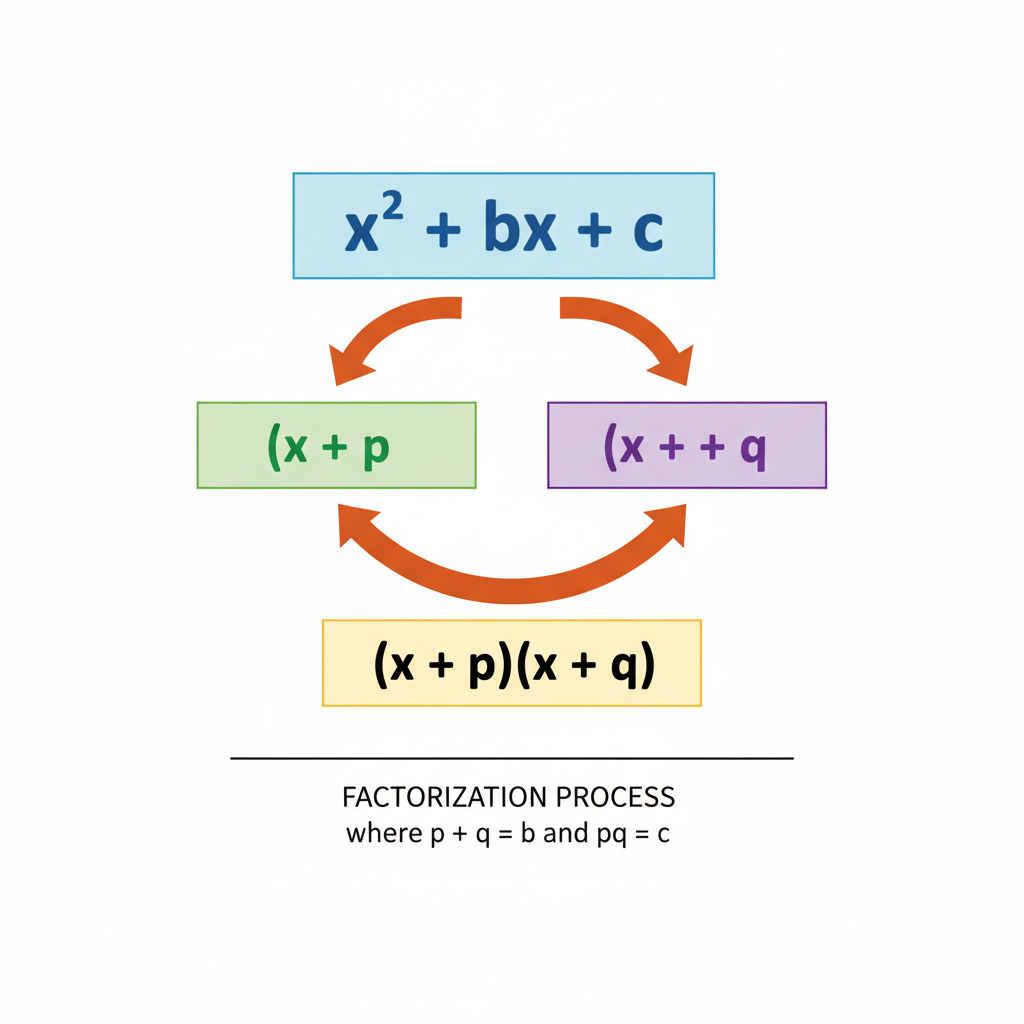 ⚠️ This picture may have spelling mistakes. Trust the words in the lesson.
Step 3: Apply the Zero Product Property
Now that you have your quadratic expression factored into two parts that multiply to zero, you can use our Golden Rule!
For our first example: (x + 2)(x + 3) = 0
This means either (x + 2) = 0 OR (x + 3) = 0.
For our second example: (2x + 1)(x + 3) = 0
This means either (2x + 1) = 0 OR (x + 3) = 0.
Analogy: It's like finding two switches, and if either one is "off," the whole system (the equation) becomes zero. You just need to figure out when each switch is "off."
Step 4: Solve the Resulting Linear Equations
You now have two simple linear equations. Solve each one for x.
From (x + 2)(x + 3) = 0:
x + 2 = 0→ Subtract 2 from both sides →x = -2x + 3 = 0→ Subtract 3 from both sides →x = -3
So, the solutions (roots) for x2 + 5x + 6 = 0 are x = -2 and x = -3.
From (2x + 1)(x + 3) = 0:
2x + 1 = 0→ Subtract 1 →2x = -1→ Divide by 2 →x = -1/2x + 3 = 0→ Subtract 3 →x = -3
So, the solutions for 2x2 + 7x + 3 = 0 are x = -1/2 and x = -3.
Quadratic equations usually have two solutions, but sometimes they can have one repeated solution or no real solutions (we'll explore those later!).
Step 5 (Optional but Recommended): Check Your Solutions!
To be absolutely sure, plug your solutions back into the *original* quadratic equation. If both sides of the equation are equal, your solutions are correct!
Let's check x = -2 for x2 + 5x + 6 = 0:
(-2)2 + 5(-2) + 6 = 0
4 - 10 + 6 = 0
-6 + 6 = 0
0 = 0 (It works!)
Let's check x = -3 for x2 + 5x + 6 = 0:
(-3)2 + 5(-3) + 6 = 0
9 - 15 + 6 = 0
-6 + 6 = 0
0 = 0 (It works too!)
Checking your answers is like double-checking your work on a treasure map – you want to make sure you really found the spot!
Putting it all together: Another Example!
Solve: 3x2 - 10x + 8 = 0
Step 1: Already in standard form: 3x2 - 10x + 8 = 0
Step 2: Factor the expression 3x2 - 10x + 8.
a=3, b=-10, c=8- Multiply
a*c = 3 * 8 = 24. - Find two numbers that multiply to 24 and add to -10.
- Factors of 24: (1, 24), (2, 12), (3, 8), (4, 6) and their negative counterparts.
- Which pair adds to -10? -4 and -6! (
-4 * -6 = 24and-4 + -6 = -10).
- Split the middle term:
3x2 - 4x - 6x + 8 = 0 - Factor by grouping:
(3x2 - 4x) + (-6x + 8) = 0x(3x - 4) - 2(3x - 4) = 0(Be careful with the negative sign when factoring out -2!)(3x - 4)(x - 2) = 0
Step 3: Apply the Zero Product Property:
3x - 4 = 0ORx - 2 = 0
Step 4: Solve the linear equations:
- From
3x - 4 = 0:3x = 4x = 4/3
- From
x - 2 = 0:x = 2
The solutions are x = 4/3 and x = 2.
Step 5: Check the solutions (you can do this on your own to practice!).
Common Mistakes to Avoid!
- Forgetting to set the equation to zero: This is crucial! You cannot use the Zero Product Property if the equation is not equal to zero. (e.g.,
(x+1)(x+2)=6does NOT meanx+1=6orx+2=6). - Factoring incorrectly: Practice your factoring skills! This is the most common hurdle.
- Sign errors: Be very careful with positive and negative signs when factoring and solving.
- Stopping after factoring: Remember the final step is to solve for
xusing the Zero Product Property.
Recap and Final Thoughts
The factorization method is a powerful tool for solving quadratic equations. It relies on your ability to factor algebraic expressions and the fundamental "Zero Product Property." With practice, you'll become a master at breaking down these quadratic puzzles!
Keep practicing, and soon you'll find yourself solving quadratic equations with confidence, unlocking all sorts of mathematical treasures!
Keep learning, free
Create a free Syllabax account to unlock practice questions and games for this topic.
Visual Learning Enhanced! 🚀
To help you master this topic, we use Advanced Syllabax AI to generate detailed diagrams and visual models.
Note on Visuals: The AI sometimes makes spelling errors in image labels. Please refer to the lesson text for the correct terminology.