Calculating the Mean
Watch this topic in 60 seconds
Free preview · Lesson 1
Understanding Calculating the Mean
Understanding the Mean: Finding the "Fair Share" or "Average"
Welcome, 6th-grade mathematicians! Today, we're going to unlock a super useful math tool called the mean. Don't let the fancy name scare you! The mean is just a way to find an "average" or a "fair share" when you have a bunch of numbers. Think of it like evening things out.
What is the Mean? (The "Fair Share" Idea)
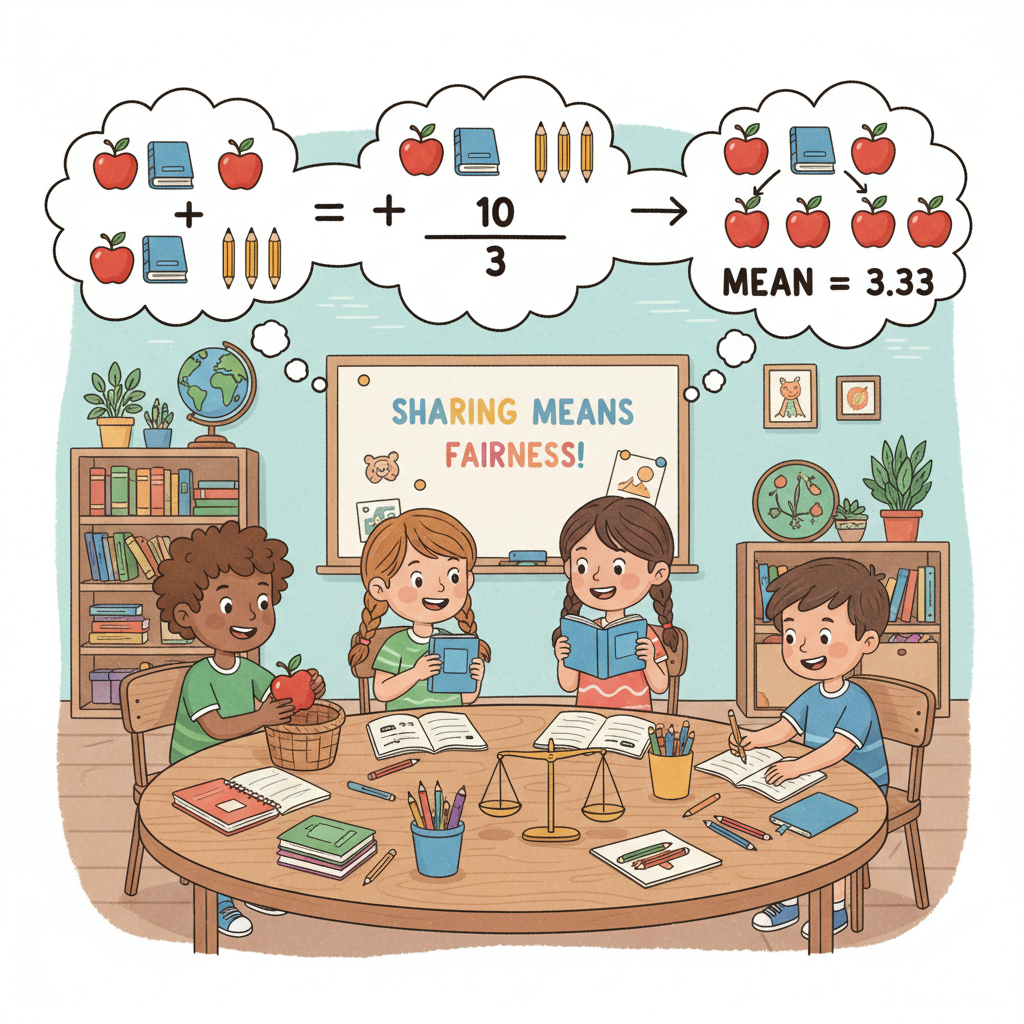
Imagine you and three friends collected candy. You have 5 pieces, Friend A has 3 pieces, Friend B has 7 pieces, and Friend C has 5 pieces. That's not very fair, is it? Some have more, some have less.
If you wanted to share all the candy equally so everyone had the exact same amount, what would you do? You'd gather all the candy together, count it all up, and then share it out equally among everyone. That equal amount each person gets? That's the mean!
In math terms, the mean is the average of a set of numbers. It tells us what each number would be if all the values were distributed equally among them.
Why Do We Use the Mean?
The mean helps us understand a typical value in a group. For example:
- What's the average number of points a basketball player scores per game?
- What's the typical height of students in your class?
- What's the average temperature for a city in July?
It gives us a single number that summarizes a whole group of numbers.
How to Calculate the Mean: Step-by-Step!
Calculating the mean is like a two-step dance. It's easy once you know the moves!
Step 1: Add 'Em All Up! (Find the Sum)
The very first thing you do is take all your numbers and add them together. This total is called the sum.
Let's go back to our candy example: You had 5, Friend A had 3, Friend B had 7, and Friend C had 5.
Sum = 5 + 3 + 7 + 5 = 20 pieces of candy.
Step 2: Divide by How Many There Are! (Find the Count)
Next, you need to count how many separate numbers (or people, or items) you have in your group. This is called the count.
In our candy example: There were 4 people sharing the candy (You, Friend A, Friend B, Friend C). So, the count is 4.
Now, take the sum from Step 1 and divide it by the count from Step 2. That's your mean!
Mean = Sum / Count
Candy Example Calculation: Mean = 20 / 4 = 5
So, if you shared all 20 pieces of candy equally among 4 people, each person would get 5 pieces. The mean number of candies is 5!
Another Example: Test Scores
Let's say a student gets the following scores on their math quizzes:
80, 90, 70, 100, 60
What is the mean (average) score?
- Add them all up (Sum):
80 + 90 + 70 + 100 + 60 = 400 - Count how many scores there are (Count):
There are 5 scores. - Divide the sum by the count:
Mean = 400 / 5 = 80
So, the student's mean (average) math quiz score is 80. If all their scores were exactly the same, they would each be 80.
Think of it like Leveling a Roller Coaster!
Imagine you have a roller coaster track. Some parts are very high, some are very low. If you wanted to make the track perfectly flat (level) at a certain height, the mean is like finding that 'level ground' height. It takes all the ups and downs and finds the spot where everything would balance out evenly.
Key Words to Remember:
- Sum: The total you get when you add all the numbers together.
- Count: The number of values in your data set.
- Mean: The average; the result of dividing the sum by the count.
You've got this! Calculating the mean is a fundamental skill that will help you understand data and make sense of numbers in the world around you.
Keep learning, free
Create a free Syllabax account to unlock practice questions and games for this topic.
Visual Learning Enhanced! 🚀
To help you master this topic, we use Advanced Syllabax AI to generate detailed diagrams and visual models.
Note on Visuals: The AI sometimes makes spelling errors in image labels. Please refer to the lesson text for the correct terminology.