Tiling & grid-based area [Area]
Watch this topic in 60 seconds
Free preview · Lesson 1
Understanding Tiling & grid-based area [Area]
Understanding Area: Tiling and Grids - A Fifth Grade Adventure!
Welcome, super mathematicians, to an exciting journey into the world of area! Have you ever wondered how much space a rug covers on the floor, or how many tiles are needed to fill a bathroom wall? That's what area is all about – measuring the flat, two-dimensional space inside a shape. Think of it like a giant blanket covering a bed; the area is the size of that blanket!
What is Area, Anyway?
Area is simply the measure of how much surface is covered by something flat. We often measure area in square units, like square inches, square feet, or square meters. Imagine you have a chocolate bar divided into little squares. The area of the chocolate bar is the total number of those little squares it's made of.
Tiling: The Art of Covering Space!
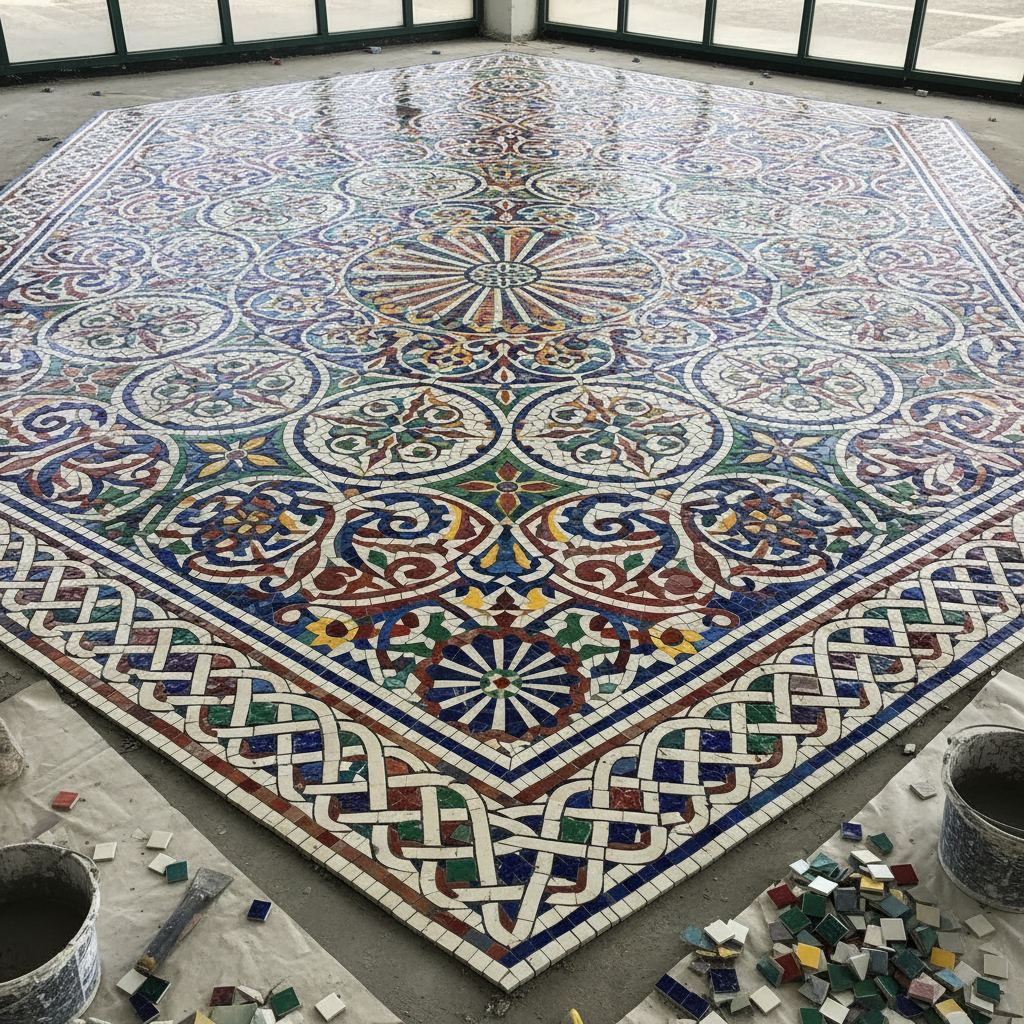
One of the best ways to understand area is by thinking about tiling. Tiling is like putting together a puzzle with shapes, usually squares or rectangles, to cover a surface completely without any gaps or overlaps. Think about a checkerboard! It's covered with square tiles. Or imagine laying tiles on your kitchen floor – you're covering the entire floor space with those tiles.
Each tile is a little square. When we count how many tiles fit inside a shape, we are essentially measuring the area of that shape. If a floor needs 100 square tiles to cover it, then the area of that floor is 100 square units (where each unit is the size of one tile).
 ⚠️ This picture may have spelling mistakes. Trust the words in the lesson.
Grids: Our Area Measurement Tools!
Grids are like graph paper or a map with many little squares. They help us visualize and measure area. Imagine a grid drawn on a piece of paper. Each tiny square within the grid can be our 'unit' of measurement. If we want to find the area of a shape drawn on this grid, we just need to count how many squares the shape covers.
Analogy Time! Think of a parking lot. It's divided into many parking spaces. Each parking space is like a square unit. If you want to know how much space the entire parking lot can hold, you would count all the parking spaces. In the same way, when we count the squares in a grid that a shape covers, we find its area.
Calculating Area with Grids: Simple Counting!
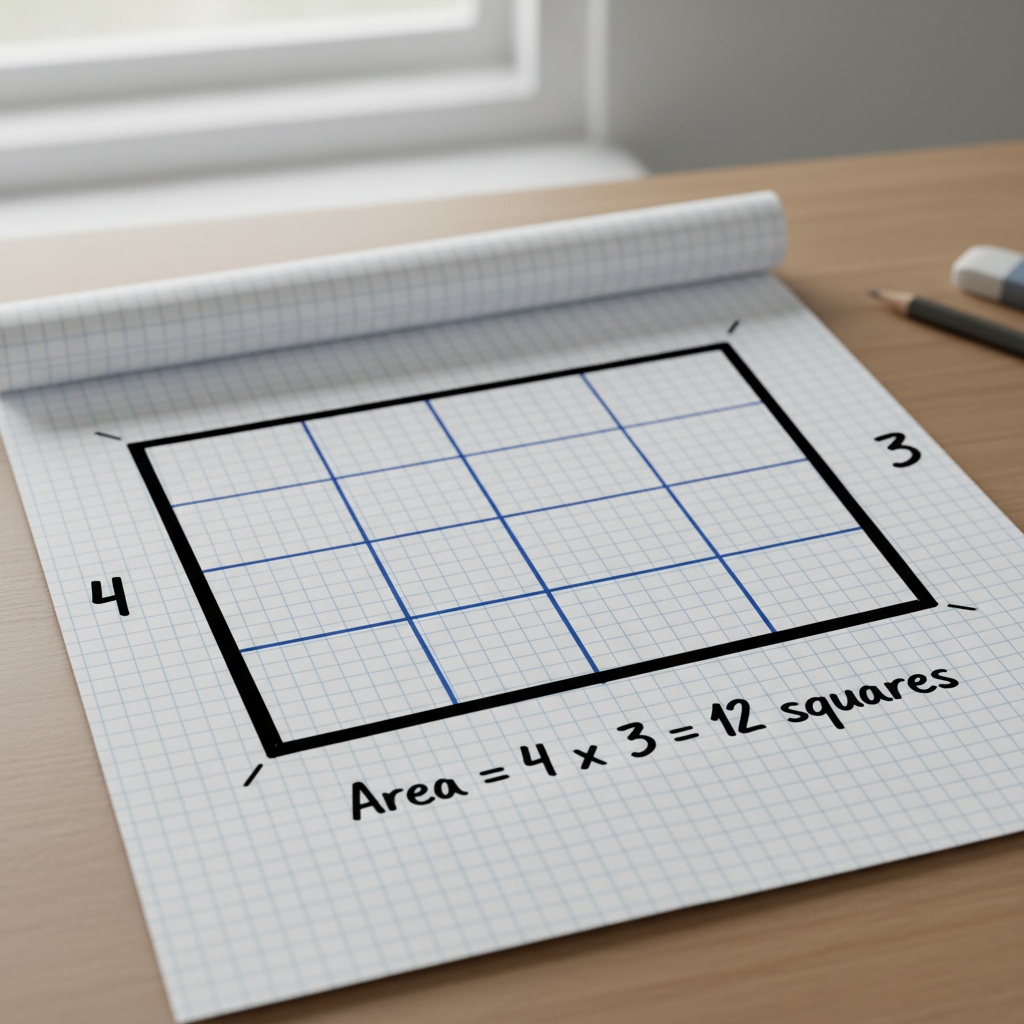
Let's look at a simple rectangle drawn on a grid:
Imagine a rectangle that is 4 squares long and 3 squares wide. To find its area, we can simply count all the squares inside the rectangle. If you count them, you'll find there are 12 squares in total. So, the area of this rectangle is 12 square units.
Another Analogy: Building with Blocks! Imagine you are building a small wall with Lego bricks. If your wall is 5 bricks long and 2 bricks high, you can count the total number of bricks used. That's 10 bricks! Similarly, counting the squares on a grid tells us the total 'building blocks' (square units) that make up the shape.
The Magic Formula: Length x Width
As we get better at counting, mathematicians discovered a shortcut for rectangles! Instead of counting every single square, we can multiply the length of the rectangle by its width.
For our rectangle that was 4 squares long and 3 squares wide:
- Length = 4 squares
- Width = 3 squares
- Area = Length × Width = 4 × 3 = 12 square units
This formula, Area = Length × Width, works for all rectangles. It's like having a super-speedy way to count all those squares without actually counting them one by one!
Why is Area Important?
Understanding area is super useful in real life!
- Home Improvement: Figuring out how much paint you need for a wall, or how many tiles for a floor or backsplash.
- Gardening: Deciding how much space your garden will take up in the yard.
- Art: Creating mosaics or understanding the size of a canvas.
- Games: Many board games use grids, and understanding the space is key!
So, next time you see a tiled floor, a grid on paper, or a pattern made of squares, you'll know you're looking at the fascinating world of area!
Keep learning, free
Create a free Syllabax account to unlock practice questions and games for this topic.
Visual Learning Enhanced! 🚀
To help you master this topic, we use Advanced Syllabax AI to generate detailed diagrams and visual models.
Note on Visuals: The AI sometimes makes spelling errors in image labels. Please refer to the lesson text for the correct terminology.