Addition & subtraction of decimals [Decimals]
Watch this topic in 60 seconds
Free preview · Lesson 1
Understanding Addition & subtraction of decimals [Decimals]
Adding and Subtracting Decimals: Making Numbers Work Together!
Hello awesome mathematicians! Today, we're going to dive into the exciting world of decimals. Think of decimals as special numbers that help us talk about parts of a whole, like when we're measuring ingredients for a yummy cake or figuring out how much money we have down to the very last penny.
What Exactly ARE Decimals?
Imagine you have a whole pizza. A decimal helps us talk about slices of that pizza without having to say 'one half' or 'one quarter' all the time. It's a shorthand way to write those fractions. The little dot, called a decimal point, is the magic marker that separates the whole numbers from the decimal parts.
For example, in the number 12.34:
- The '12' is the whole number part. It means you have 12 whole things (like 12 whole pizzas).
- The '.' is the decimal point.
- The '3' is in the tenths place. It means 3 out of 10 equal parts of a whole. Think of it as 3 out of 10 slices of one pizza.
- The '4' is in the hundredths place. It means 4 out of 100 equal parts of a whole. Think of it as 4 out of 100 tiny pieces of one pizza.
So, 12.34 means 12 whole things, plus 3 tenths of another thing, plus 4 hundredths of that same thing. It's like having 12 full pizzas and then a few more slices from another pizza.
Adding Decimals: Putting Things Together
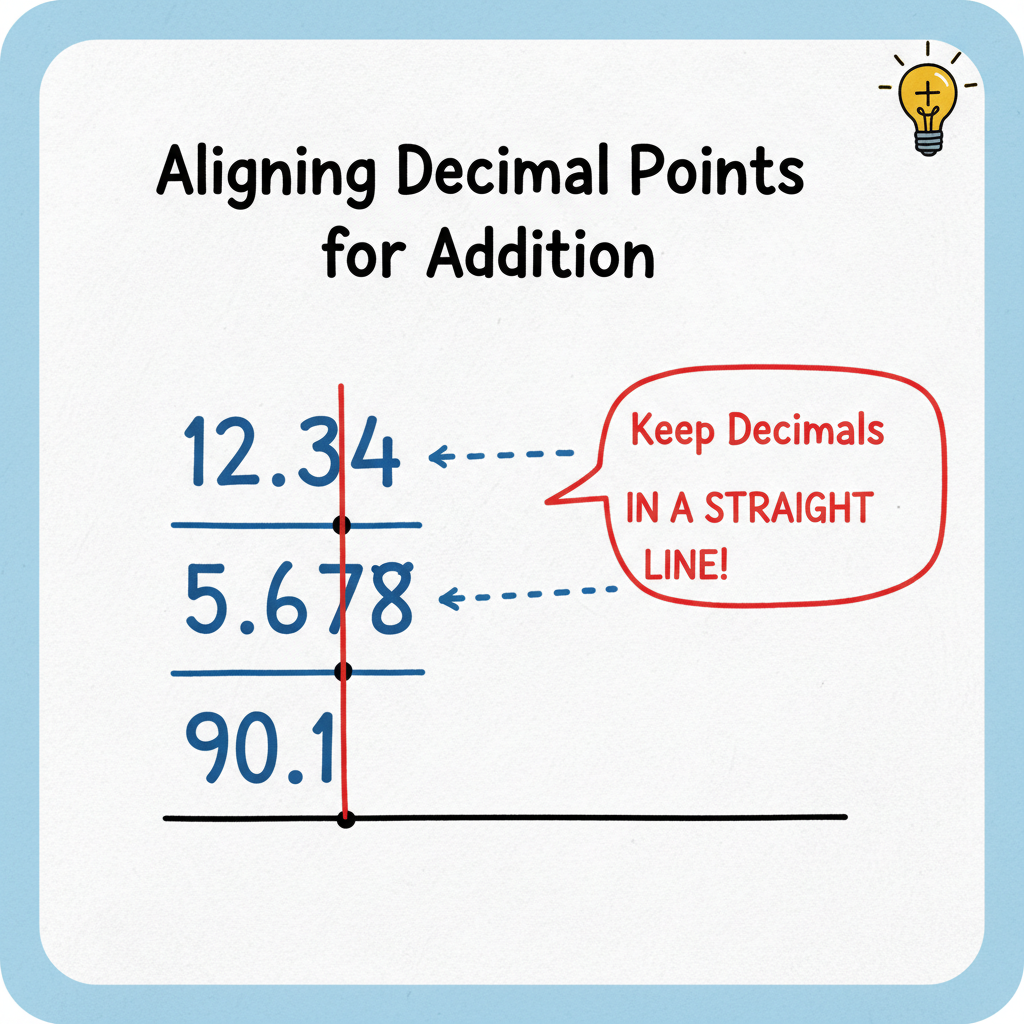
Adding decimals is a lot like adding whole numbers, but with one super important trick: you MUST line up the decimal points!
Think about stacking LEGO bricks. If you want to build a sturdy tower, you need to make sure the edges of each brick line up perfectly. The same goes for decimal points. They need to be in a straight, neat line, one above the other.
Let's add 5.67 and 2.34:
Step 1: Write the numbers vertically, making sure the decimal points are aligned.
  5.67
+ 2.34
------
Step 2: Add the digits in each column, starting from the right, just like you do with whole numbers. Carry over if needed.
  5.67
+ 2.34
------
     1  (7 + 4 = 11, write down 1, carry over 1)
  5.67
+ 2.34
------
    01  (1 (carry-over) + 6 + 3 = 10, write down 0, carry over 1)
5.67 + 2.34 ------ 7.01 (1 (carry-over) + 5 + 2 = 8, oops, mistake! Let's fix that. 1 (carry-over) + 5 + 2 = 8. Oh wait, it's 7. Let's retrace... 7+4=11, carry 1. 1+6+3=10, carry 1. 1+5+2 = 8. The answer should be 8.01. Let me re-calculate... Ah, yes, 7+4 is 11, write 1 carry 1. 1+6 is 7, plus 3 is 10, write 0 carry 1. 1+5 is 6, plus 2 is 8. The answer is 8.01. Let's try another example to be sure. Okay, let's try 1.2 + 3.45.Example 2: Add 1.2 and 3.45.
Sometimes, numbers don't have the same number of digits after the decimal point. That's okay! You can imagine filling in the empty spots with zeros. It's like adding empty boxes to your LEGO tower – they don't change the height, but they help keep things lined up.
Step 1: Line up the decimal points. Add zeros if needed to make the numbers have the same number of decimal places.
1.20 (We added a zero to 1.2 to match the two decimal places in 3.45) + 3.45 ------Step 2: Add column by column from right to left.
1.20 + 3.45 ------ 5 (0 + 5 = 5)1.20 + 3.45 ------ 65 (2 + 4 = 6)1.20 + 3.45 ------ 4.65 (1 + 3 = 4)So, 1.20 + 3.45 = 4.65. See? Lining up the decimal points is the key!
Subtracting Decimals: Taking Things Away
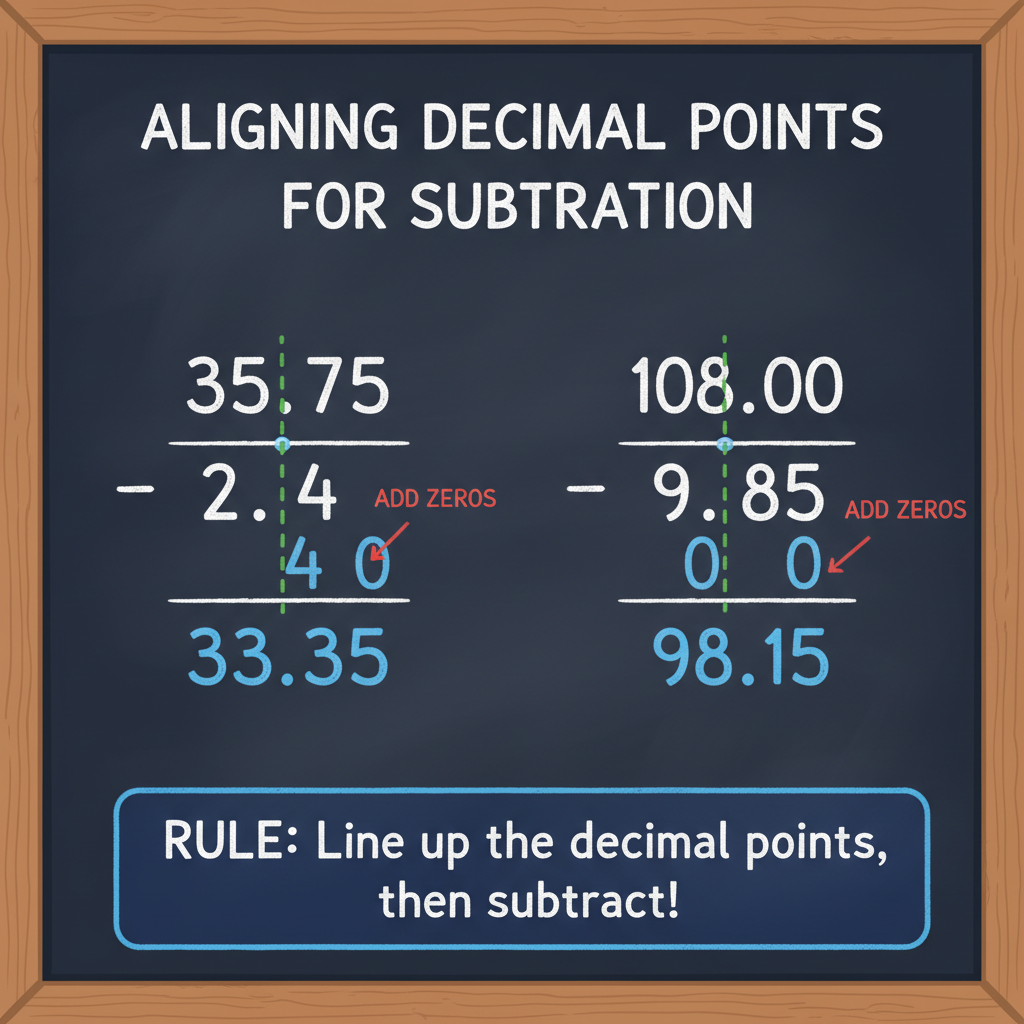
Subtracting decimals follows the exact same rule as adding them: line up the decimal points!
Think of subtracting as taking away toys from a toy box. You can only take away what's there, and you need to keep track of what you have left. Decimals work the same way.
Let's subtract 9.87 from 15.23:
Step 1: Write the numbers vertically, lining up the decimal points. The number you are subtracting from (the larger number) goes on top.
15.23 - 9.87 -------Step 2: Subtract column by column, starting from the right. You might need to borrow, just like with whole numbers.
15.23 - 9.87 ------- 6 (3 is smaller than 7. We need to borrow from the '2' in the tenths place. The '2' becomes '1', and the '3' becomes '13'. 13 - 7 = 6.)15.1(13) - 9.8 7 ------- 36 (Now we have 1 in the tenths place, which is smaller than 8. We need to borrow from the '5' in the ones place. The '5' becomes '4', and the '1' becomes '11'. 11 - 8 = 3.)14.(11)13 - 9. 8 7 ------- 5.36 (Now we have 4 in the ones place, which is smaller than 9. We need to borrow from the '1' in the tens place. The '1' becomes '0', and the '4' becomes '14'. 14 - 9 = 5.)So, 15.23 - 9.87 = 5.36.
Example 2: Subtract 4.5 from 7.12.
Again, if the numbers don't have the same number of decimal places, we can add zeros to make them match. This doesn't change the value of the number.
Step 1: Line up the decimal points and add a zero.
7.12 - 4.50 (We added a zero to 4.5 to match the two decimal places in 7.12) ------Step 2: Subtract column by column.
7.12 - 4.50 ------ 2 (2 - 0 = 2)7.1(12) - 4.5 0 ------ .62 (1 is smaller than 5. Borrow from the '7'. '7' becomes '6', and '1' becomes '11'. 11 - 5 = 6.)6.(11)12 - 4. 5 0 ------ 2.62 (6 - 4 = 2)So, 7.12 - 4.50 = 2.62.
Key Concepts to Remember:
- Decimal Point: The dot that separates the whole number part from the fractional part.
- Lining Up: Always, always, always line up the decimal points when adding or subtracting decimals.
- Adding Zeros: You can add zeros to the end of a decimal (after the decimal point) without changing its value. This helps with lining up numbers.
- Place Value: Understand that the digits to the right of the decimal point represent tenths, hundredths, thousandths, and so on.
Keep practicing, and you'll become a decimal whiz in no time! You've got this!
Keep learning, free
Create a free Syllabax account to unlock practice questions and games for this topic.
Visual Learning Enhanced! 🚀
To help you master this topic, we use Advanced Syllabax AI to generate detailed diagrams and visual models.
Note on Visuals: The AI sometimes makes spelling errors in image labels. Please refer to the lesson text for the correct terminology.