Special cases of binomial multiplication (Algebraic Expressions)
Watch this topic in 60 seconds
Free preview · Lesson 1
Understanding Special cases of binomial multiplication (Algebraic Expressions)
Mastering Special Cases of Binomial Multiplication (Algebraic Expressions)
Welcome, 8th graders, to an exciting journey into the world of algebraic expressions! Today, we're going to uncover some 'secret shortcuts' or 'special recipes' for multiplying binomials. Think of it like learning special moves in a video game – once you know them, you can solve problems faster and with more style!
What's a Binomial, Anyway? (And What Does 'Multiplication' Mean Here?)
Imagine you're building with LEGOs. An algebraic expression is like a structure made of numbers and letters (variables) connected by addition, subtraction, multiplication, or division signs. For example, 3x + 5 is an algebraic expression.
- A term is a single number, a single variable, or a product of numbers and variables. In
3x + 5,3xis one term and5is another term. - A binomial is simply an algebraic expression that has exactly two terms. Think 'bi' as in 'bicycle' (two wheels). So,
x + 7,2y - 3, ora + bare all binomials. They always have two 'pieces' joined by a plus or minus sign.
When we talk about 'multiplying binomials,' we mean taking one binomial and multiplying it by another. For example, (x + 2) * (x + 3). It's like combining two two-piece LEGO sets into one bigger, more complex structure.
Before We Dive In: A Quick Look at General Binomial Multiplication (The FOIL Method)
You might have already learned a general way to multiply two binomials called the FOIL method. FOIL stands for First, Outer, Inner, Last. It's a handy way to make sure you multiply every term in the first binomial by every term in the second binomial.
Let's quickly review with an example: Multiply (x + 2)(x + 3)
- First: Multiply the first terms in each binomial:
x * x = x² - Outer: Multiply the outer terms:
x * 3 = 3x - Inner: Multiply the inner terms:
2 * x = 2x - Last: Multiply the last terms:
2 * 3 = 6
Then, you add all these results together and combine any like terms:
x² + 3x + 2x + 6 = x² + 5x + 6
This method always works, but what if there were some quicker 'shortcuts' for specific types of binomial multiplications? That's exactly what our 'special cases' are!
Our Special Shortcuts (The 'Secret Recipes' of Binomial Multiplication)
Just like how a chef might have a quick recipe for a perfectly fried egg versus a complex stew, mathematicians have discovered shortcuts for certain types of binomial multiplication that appear very often. These shortcuts allow us to jump straight to the answer without always having to use the full FOIL method. There are three main 'secret recipes' we'll learn today:
- Squaring a Sum:
(a + b)² - Squaring a Difference:
(a - b)² - Product of a Sum and a Difference:
(a + b)(a - b)
Special Case 1: Squaring a Sum (The 'Perfect Square' Recipe for Addition)
This special case looks like this: (a + b)². What does it mean to 'square' something? It means to multiply it by itself. So, (a + b)² is just another way of writing (a + b) * (a + b).
The Formula: (a + b)² = a² + 2ab + b²
Analogy: The Square Garden
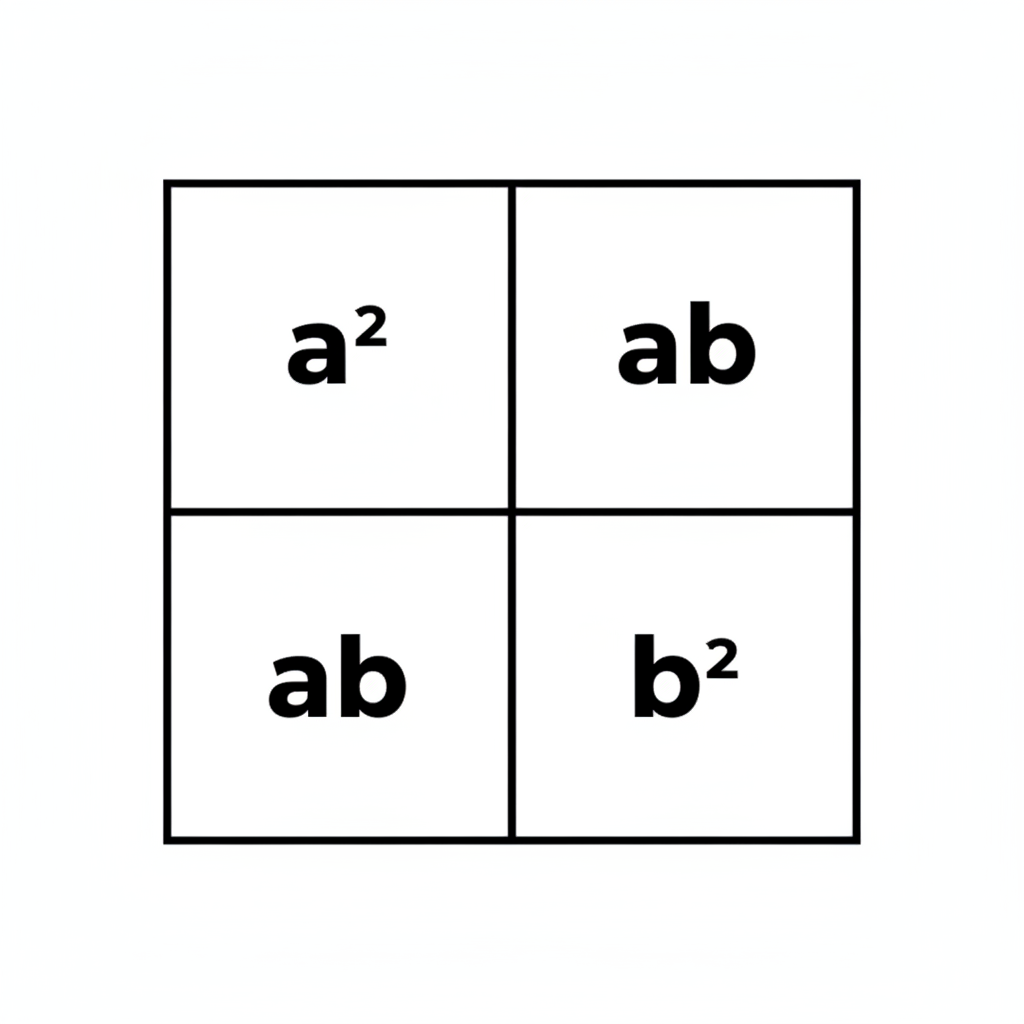
Imagine you have a square garden. One side of the garden has length 'a' plus an extra 'b' section. So, the total side length is (a + b). Since it's a square, both its length and width are (a + b).
To find the total area of this garden, you'd multiply length by width: (a + b) * (a + b). Let's divide this big square into smaller sections:
- There's a square section with side 'a', so its area is
a * a = a². - There's a rectangular section with side 'a' and 'b', so its area is
a * b = ab. - Another rectangular section with side 'b' and 'a', so its area is
b * a = ab. - Finally, a small square section with side 'b', so its area is
b * b = b².
If you add up all these smaller areas, you get a² + ab + ab + b², which simplifies to a² + 2ab + b². This visual shows you exactly why the formula works!
Let's Practice: Example 1
Expand (x + 5)²
- Identify 'a' and 'b'. Here,
a = xandb = 5. - Apply the formula:
a² + 2ab + b² - Substitute 'a' and 'b' into the formula:
a²becomesx²2abbecomes2 * x * 5 = 10xb²becomes5² = 25
- Combine them:
x² + 10x + 25
Voila! Much faster than FOIL once you know the pattern.
Special Case 2: Squaring a Difference (The 'Perfect Square' Recipe for Subtraction)
This case is very similar to squaring a sum, but with a minus sign: (a - b)². Again, it means (a - b) * (a - b).
The Formula: (a - b)² = a² - 2ab + b²
Analogy: The Tricky Twins
Think of this as the 'tricky twin' of the first case. It looks almost identical, but that minus sign changes one crucial part. If we use FOIL on (a - b)(a - b):
- First:
a * a = a² - Outer:
a * (-b) = -ab - Inner:
(-b) * a = -ab - Last:
(-b) * (-b) = +b²(Remember, a negative times a negative is a positive!)
Adding them up: a² - ab - ab + b² = a² - 2ab + b². See how the middle term became negative? That's the key difference!
Let's Practice: Example 2
Expand (y - 4)²
- Identify 'a' and 'b'. Here,
a = yandb = 4. (Be careful: we treat 'b' as the positive value '4', and the subtraction is handled by the formula itself.) - Apply the formula:
a² - 2ab + b² - Substitute 'a' and 'b' into the formula:
a²becomesy²-2abbecomes-2 * y * 4 = -8yb²becomes4² = 16
- Combine them:
y² - 8y + 16
Special Case 3: Product of a Sum and a Difference (The 'Difference of Squares' Recipe)
This is perhaps the most interesting and often used shortcut! It looks like this: (a + b)(a - b). Notice one binomial has a plus sign, and the other has a minus sign, but the 'a' and 'b' terms are the same.
The Formula: (a + b)(a - b) = a² - b²
Analogy: The Cancelling Forces
Imagine you have two teams playing tug-of-war. One team pulls with 'a' strength and adds 'b' extra power. The other team pulls with 'a' strength but loses 'b' power. When they meet, the 'extra b' and 'lost b' forces might cancel each other out, leaving only the primary 'a' forces squared.
Let's use FOIL to see this magic happen for (a + b)(a - b):
- First:
a * a = a² - Outer:
a * (-b) = -ab - Inner:
b * a = +ab - Last:
b * (-b) = -b²
Now, add them up: a² - ab + ab - b². What happens to -ab + ab? They cancel each other out and become 0! So, you're left with just a² - b².
This is called the 'Difference of Squares' because the answer is always a subtraction of two perfect squares!
Let's Practice: Example 3
Expand (2z + 3)(2z - 3)
- Identify 'a' and 'b'. Here,
a = 2zandb = 3. - Apply the formula:
a² - b² - Substitute 'a' and 'b' into the formula:
a²becomes(2z)² = 2² * z² = 4z²(Remember to square both the number and the variable!)b²becomes3² = 9
- Combine them:
4z² - 9
Why These Shortcuts Matter (Why Learn These 'Secret Recipes'?)
You might be thinking, 'Why can't I just use FOIL every time?' And you're right, FOIL will always give you the correct answer. However, these special cases are incredibly useful for several reasons:
- Speed: Once you recognize the pattern, you can write down the answer almost instantly, saving precious time on tests and homework.
- Accuracy: With fewer steps, there are fewer chances to make a mistake.
- Foundation for Future Math: These patterns appear constantly in higher-level algebra, geometry, and calculus. Recognizing them now will make future math much easier. It's like building strong foundations for a tall building!
Conclusion: You've Got the Power!
Congratulations! You've just learned three powerful shortcuts for multiplying binomials. These aren't just 'tricks'; they are fundamental patterns in algebra that will serve you well.
Here's a quick recap of our 'secret recipes':
- Squaring a Sum:
(a + b)² = a² + 2ab + b² - Squaring a Difference:
(a - b)² = a² - 2ab + b² - Product of a Sum and a Difference:
(a + b)(a - b) = a² - b²
Remember, practice is key to making these shortcuts second nature. The more you use them, the more natural they'll feel. Keep exploring the patterns in math – it's full of amazing discoveries!
Keep learning, free
Create a free Syllabax account to unlock practice questions and games for this topic.
Visual Learning Enhanced! 🚀
To help you master this topic, we use Advanced Syllabax AI to generate detailed diagrams and visual models.
Note on Visuals: The AI sometimes makes spelling errors in image labels. Please refer to the lesson text for the correct terminology.