Sphere (intro) (Surface Area)
Watch this topic in 60 seconds
Free preview · Lesson 1
Understanding Sphere (intro) (Surface Area)
Introduction to Spheres and Their Surface Area
Welcome to the wonderful world of spheres! Have you ever played with a basketball, admired a perfectly round marble, or looked at a globe? All these objects are examples of spheres. They are everywhere around us, from the tiniest dewdrop to the colossal planets in our solar system. Today, we're going to dive into what makes a sphere special and, more importantly, learn how to measure its 'skin' – what we call its Surface Area.
What is a Sphere? A 3D, Perfectly Round Friend!
Imagine you have a single point in the very center of a room. Now, imagine every single point that is exactly the same distance away from that center point. If you connect all those points, what do you get? A perfect sphere!
- Definition: A sphere is a perfectly round three-dimensional (3D) object, where every point on its surface is the same distance from its center.
Think of it like this: if a circle is a flat, 2D shape (like a pizza or a frisbee), then a sphere is its plump, full, 3D cousin (like a whole watermelon or a bowling ball). A circle only has length and width, but a sphere has length, width, and height, giving it volume and allowing it to be held or rolled.
Analogies for a Sphere:
- A Ball: Whether it's a soccer ball, a basketball, a tennis ball, or even a golf ball, these are classic examples of spheres.
- An Orange: When you peel an orange, you're revealing its beautifully spherical shape underneath.
- A Bubble: A soap bubble, floating delicately in the air, is a near-perfect example of a sphere.
- A Planet or Moon: Our Earth, the Moon, and all the other planets are (mostly) spherical!
Key Parts of a Sphere: The Heart and Its Reach
Just like a circle has a radius, a sphere also has one. It's super important!
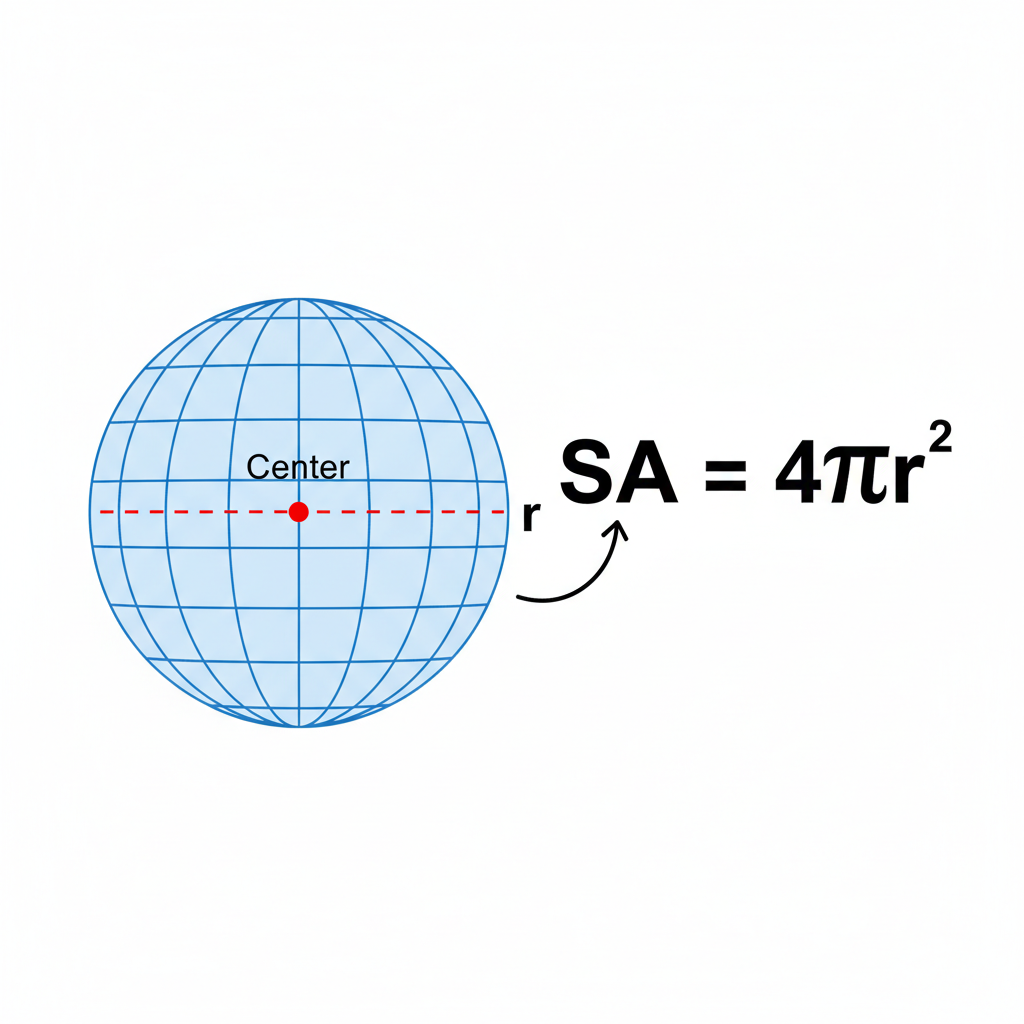
- Center: This is the exact middle point of the sphere, like the core of an apple or the dead center of a billiard ball.
- Radius (r): This is the distance from the very center of the sphere to any point on its outer surface. Imagine sticking a needle into the exact center of a basketball and pushing it straight out until it pokes through the rubber. The length of that needle, from the center to the outside, is the radius. It’s the same length no matter which direction you push it.
- Diameter (d): This is the distance across the sphere, passing directly through its center from one point on the surface to the opposite point. It's simply two radii put together in a straight line (d = 2r).
Understanding Surface Area: The 'Skin' of the Sphere
Now that we know what a sphere is, let's talk about its 'skin' or 'wrapper'. This is where Surface Area comes in!
- Definition: The Surface Area (SA) of a sphere is the total area of its outer surface. It's like measuring how much paint you would need to perfectly cover the entire ball, or how much wrapping paper you'd use to completely wrap a spherical gift without any overlaps or gaps.
Analogies for Surface Area:
- Peel of an Orange: If you could carefully peel an entire orange and then flatten its peel without tearing or stretching it, the total area of that flattened peel would be the orange's surface area.
- Wrapping Paper: Imagine you have a spherical gift. The amount of wrapping paper needed to cover its entire surface, with no part showing, is its surface area.
- Paint or Fabric: If you're painting a globe or sewing a cover for a beach ball, the amount of paint or fabric required to cover every inch of its surface is its surface area.
Why is surface area important? Well, knowing the surface area can help engineers design spherical fuel tanks, determine how much material is needed for a globe, or even understand how heat radiates from a spherical object like a star. It’s a practical measurement in many fields!
The Magic Formula for Surface Area of a Sphere!
For a sphere, there's a neat and surprisingly simple formula to find its surface area. It connects directly to its radius!
The formula for the Surface Area (SA) of a sphere is:
SA = 4πr²
Let's break down what each part of this formula means:
π (Pi): This is a very special mathematical constant, approximately equal to 3.14159. It's used whenever circles or curved shapes are involved. For most calculations at a foundational level, you might use 3.14 or even the π button on your calculator for more precision. Think of it as a universal ratio for circles.
r: This is the radius of the sphere, which we just discussed (the distance from the center to the surface).
r² (r-squared): This means 'r multiplied by r' (r * r). For example, if the radius is 5 units, then r² = 5 * 5 = 25 square units. Squaring the radius is a common step in area calculations.
4: This number might seem a bit mysterious! Here's a cool way to think about it: Imagine you have four flat circles, each with the exact same radius as your sphere. Amazingly, if you could somehow stretch and mold those four circles, they would perfectly cover the entire surface of that sphere! So, the surface area of a sphere is exactly equal to the area of four circles with the same radius as the sphere. Pretty neat, right?
Let's Do an Example: Calculate the Surface Area!
Let's say we have a bouncy ball with a radius (r) of 7 centimeters (cm). How much 'skin' does it have? Or, how much material would be needed to make its surface?
Step 1: Write down the formula.SA = 4πr²
Step 2: Identify the given radius.
r = 7 cm
Step 3: Substitute the value of 'r' into the formula.SA = 4 * π * (7 cm)²
Step 4: Calculate r².7 cm * 7 cm = 49 cm²
Now the formula looks like:SA = 4 * π * 49 cm²
Step 5: Multiply the numbers together (often leaving π for the end or using its approximation).
First, multiply the numeric values: 4 * 49 = 196
So, the surface area is:SA = 196π cm²
This is often called the answer 'in terms of π'. If your teacher asks for a numerical answer, you'll use an approximation for π.
If we use the approximation π ≈ 3.14:
SA = 196 * 3.14 cm²SA ≈ 615.44 cm²
So, the surface area of our bouncy ball is approximately 615.44 square centimeters. Notice the unit is 'square centimeters' (cm²). This is because we are measuring an area, which is always in square units, just like when you measure the area of a square or a rectangle. If the radius was in meters, the surface area would be in square meters (m²).
Key Takeaways: Recap Your Sphere Knowledge!
You've just learned some foundational concepts about spheres and their surface area. Great job! Here's a quick recap:
- A sphere is a perfectly round 3D object where all points on its surface are the same distance from its center. Think of a ball!
- The radius (r) is the distance from the center of the sphere to any point on its surface.
- Surface Area (SA) is the total area of the outer 'skin' of the sphere. It's how much space the outside surface covers.
- The formula for the Surface Area of a sphere is
SA = 4πr². - Surface area is always measured in square units (e.g., cm², m², ft²), because it's a two-dimensional measurement of an object's exterior.
Understanding spheres and their surface area is a key step in geometry and has countless applications in the real world. Keep practicing, and you'll master it in no time!
Keep learning, free
Create a free Syllabax account to unlock practice questions and games for this topic.
Visual Learning Enhanced! 🚀
To help you master this topic, we use Advanced Syllabax AI to generate detailed diagrams and visual models.
Note on Visuals: The AI sometimes makes spelling errors in image labels. Please refer to the lesson text for the correct terminology.