Earth’s Interior – Plate Tectonics -World Geography
Watch this topic in 60 seconds
Free preview · Lesson 1
Earth’s Interior – Plate Tectonics -World Geography (Foundational)
Earth's Interior, Plate Tectonics, and World Geography: A Foundational Overview
This lesson provides a basic introduction to the Earth's interior, plate tectonics, and their influence on world geography. We will explore the structure of the Earth, the theory of plate tectonics, and how these geological processes shape the Earth's surface.
Earth's Interior
The Earth is composed of several layers, each with distinct characteristics:
- Crust: The outermost layer, composed of solid rock. There are two types of crust: oceanic crust (thinner and denser) and continental crust (thicker and less dense).
- Mantle: The thickest layer, located beneath the crust. It is mostly solid but behaves like a very viscous fluid over long periods.
- Outer Core: A liquid layer composed primarily of iron and nickel.
- Inner Core: A solid sphere composed mainly of iron and nickel, located at the Earth's center.
Plate Tectonics
Plate tectonics is the theory that the Earth's lithosphere (the crust and the uppermost part of the mantle) is divided into several large and small plates that move and interact with each other. These plates "float" on the semi-molten asthenosphere.
Types of Plate Boundaries
The interactions between plates at their boundaries lead to various geological phenomena:
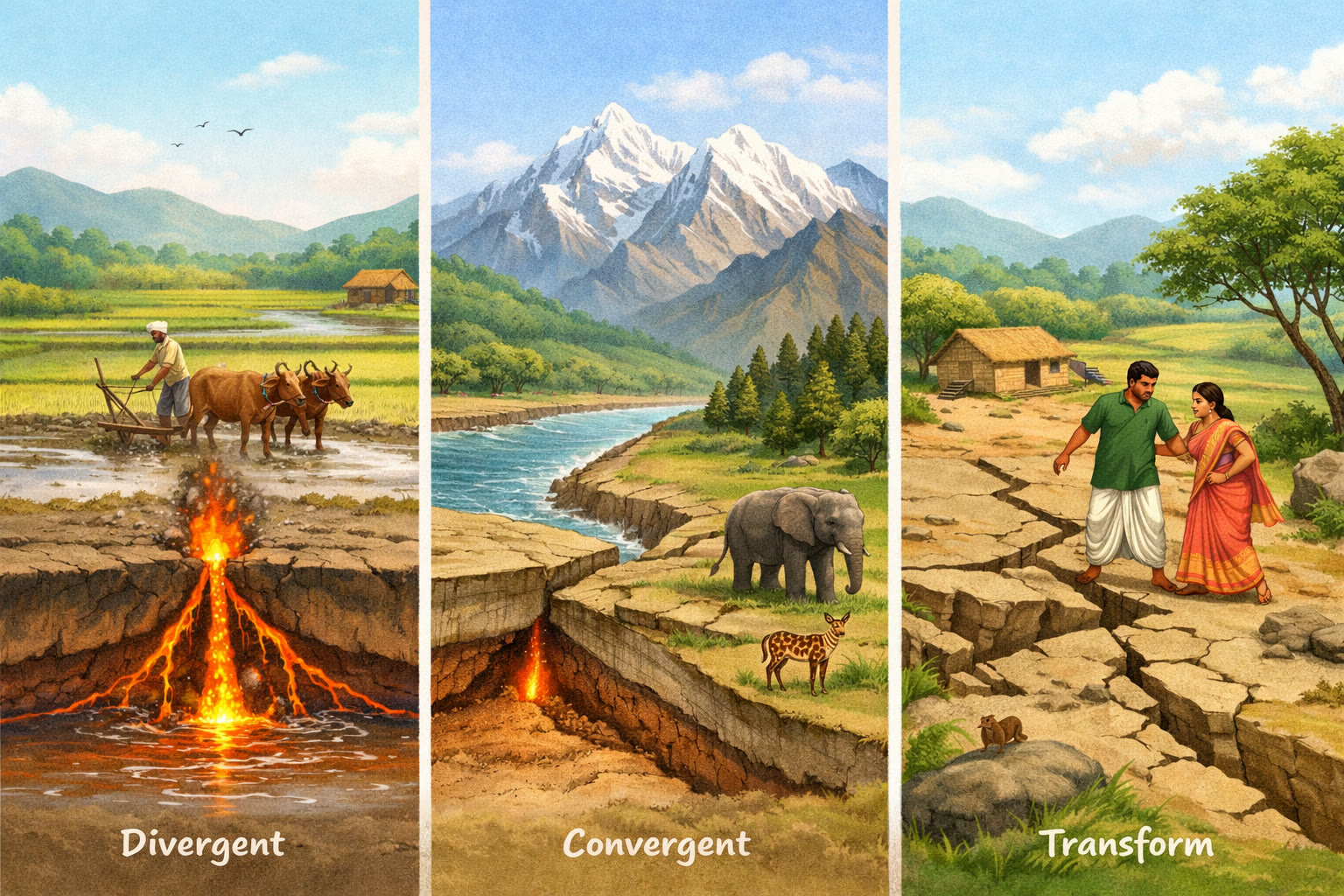
- Divergent Boundaries: Plates move apart, allowing magma to rise from the mantle, creating new crust. This process often forms mid-ocean ridges.
- Convergent Boundaries: Plates collide. This can result in subduction (one plate slides beneath another), mountain building, or the formation of deep-sea trenches.
- Transform Boundaries: Plates slide past each other horizontally. This often results in earthquakes.
World Geography and Plate Tectonics
Plate tectonics has a profound impact on the geography of the Earth:
- Mountain Ranges: Formed by the collision of continental plates (e.g., the Himalayas).
- Volcanoes and Earthquakes: Concentrated along plate boundaries.
- Ocean Trenches: Deep depressions in the ocean floor formed at subduction zones.
- Continental Drift: The slow movement of continents over geological time scales, leading to the present-day configuration of continents and oceans.
Keep learning, free
Create a free Syllabax account to unlock practice questions and games for this topic.
Visual Learning Enhanced! 🚀
To help you master this topic, we use Advanced Syllabax AI to generate detailed diagrams and visual models.
Note on Visuals: The AI sometimes makes spelling errors in image labels. Please refer to the lesson text for the correct terminology.