Number names (1–50) (Number Sense)
Watch this topic in 60 seconds
Free preview · Lesson 1
Understanding Number names (1–50) (Number Sense)
Learning About Number Names: 1 to 50
Welcome, young learners, to the wonderful world of numbers! Today, we're going on an exciting adventure to learn about the names of numbers from 1 all the way up to 50. Think of numbers as special words that tell us *how many* of something we have. Just like we have names for our friends, numbers have names too!
What are Number Names?
Imagine you have three yummy cookies. We can count them: one, two, three! The words 'one', 'two', and 'three' are the number names for those cookies. They help us talk about and understand amounts.
Numbers are everywhere! They are on the clock, on the pages of your books, and on the houses in your neighborhood. Learning their names helps you understand the world around you better.
Let's Meet the Numbers: 1 to 10
Let's start with the very first numbers. These are like the building blocks for all the other numbers!
- 1 is called one. Imagine having one shiny red apple.
- 2 is called two. Think of two playful puppies wagging their tails.
- 3 is called three. Picture three colorful balloons floating in the sky.
- 4 is called four. Imagine four wheels on a car.
- 5 is called five. Think of five fingers on your hand.
- 6 is called six. Like six dots on a domino.
- 7 is called seven. Imagine seven stars twinkling at night.
- 8 is called eight. Picture eight legs on a spider.
- 9 is called nine. Think of nine yummy candies.
- 10 is called ten. This is a very important number! It's like having two hands with all ten fingers.
Practice saying these names out loud: one, two, three, four, five, six, seven, eight, nine, ten!
Numbers from 11 to 20
After ten, the number names start to get a little more interesting. They have a special pattern!
- 11 is called eleven. It's like ten and one more.
- 12 is called twelve. It's like ten and two more. Think of twelve months in a year!
- 13 is called thirteen.
- 14 is called fourteen.
- 15 is called fifteen.
- 16 is called sixteen.
- 17 is called seventeen.
- 18 is called eighteen.
- 19 is called nineteen.
- 20 is called twenty. This is like two groups of ten (ten and ten again).
Notice how the numbers from 13 to 19 all end with 'teen'? That 'teen' part tells us it's more than ten!
Numbers from 21 to 30
Now we move into the 'twenties'. This means we have two groups of ten, and then we add the numbers from 1 to 9.
- 21 is called twenty-one. (Twenty and one more).
- 22 is called twenty-two. (Twenty and two more).
- 23 is called twenty-three.
- 24 is called twenty-four.
- 25 is called twenty-five. (Like 25 cents in a quarter!).
- 26 is called twenty-six.
- 27 is called twenty-seven.
- 28 is called twenty-eight.
- 29 is called twenty-nine.
- 30 is called thirty. This is like three groups of ten.
The pattern is: the first part tells us how many tens we have ('twenty' means two tens), and the second part tells us the extra ones.
Numbers from 31 to 40
We're now in the 'thirties'! This means we have three groups of ten, plus the numbers from 1 to 9.
- 31 is called thirty-one. (Thirty and one more).
- 32 is called thirty-two.
- 33 is called thirty-three.
- 34 is called thirty-four.
- 35 is called thirty-five.
- 36 is called thirty-six.
- 37 is called thirty-seven.
- 38 is called thirty-eight.
- 39 is called thirty-nine.
- 40 is called forty. This is like four groups of ten.
Say it with me: Thirty-one, thirty-two, thirty-three... all the way to forty!
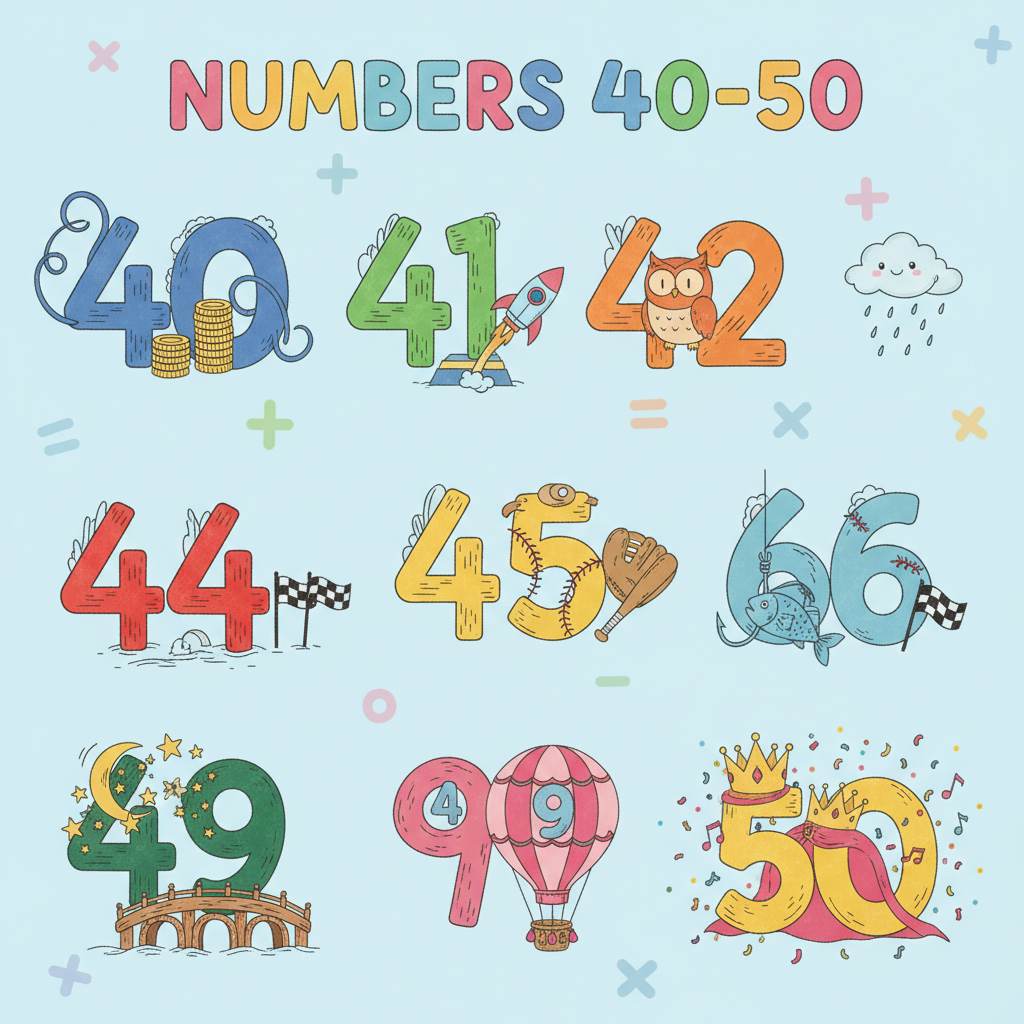
Numbers from 41 to 50
We're almost there! These are the 'forties'. We have four groups of ten, plus the numbers from 1 to 9.
- 41 is called forty-one. (Forty and one more).
- 42 is called forty-two.
- 43 is called forty-three.
- 44 is called forty-four.
- 45 is called forty-five.
- 46 is called forty-six.
- 47 is called forty-seven.
- 48 is called forty-eight.
- 49 is called forty-nine.
- 50 is called fifty. This is like five groups of ten!
You've done it! You've learned the names of numbers from 1 to 50!
Why is this important?
Knowing number names helps you:
- Count things accurately.
- Read numbers when you see them.
- Tell someone how many items you have.
- Understand math problems better.
- Follow instructions that use numbers (like 'take 5 steps').
Let's Recap!
Numbers have names, and these names help us talk about amounts. We learned the names for numbers 1 through 10. Then, we saw how numbers 11-19 have a 'teen' ending. We also discovered that numbers like 'twenty', 'thirty', 'forty', and 'fifty' tell us how many groups of ten we have. You've learned a super important skill today!
Keep learning, free
Create a free Syllabax account to unlock practice questions and games for this topic.
Visual Learning Enhanced! 🚀
To help you master this topic, we use Advanced Syllabax AI to generate detailed diagrams and visual models.
Note on Visuals: The AI sometimes makes spelling errors in image labels. Please refer to the lesson text for the correct terminology.