Learning Journey
Watch this topic in 60 seconds
Free preview · Lesson 1
Understanding Quick multiplication [Mental Arithmetic]
Mastering Quick Multiplication: Your Mental Math Superpower!
Welcome, young mathematicians! Get ready to unlock a secret superpower: quick multiplication using your amazing brain! We call this mental arithmetic, and it's like having a calculator right inside your head. Today, we're going to learn how to make multiplying numbers super fast and easy, especially with numbers like 10, 11, and even some bigger ones!
What is Multiplication?
Before we become mental math wizards, let's remember what multiplication is. Think of it as repeated addition. For example, 3 x 4 means adding 3 together 4 times (3 + 3 + 3 + 3), or adding 4 together 3 times (4 + 4 + 4). Both give you the answer 12. Multiplication is just a speedy way to do this!
Multiplying by 10: The Super Simple Trick!
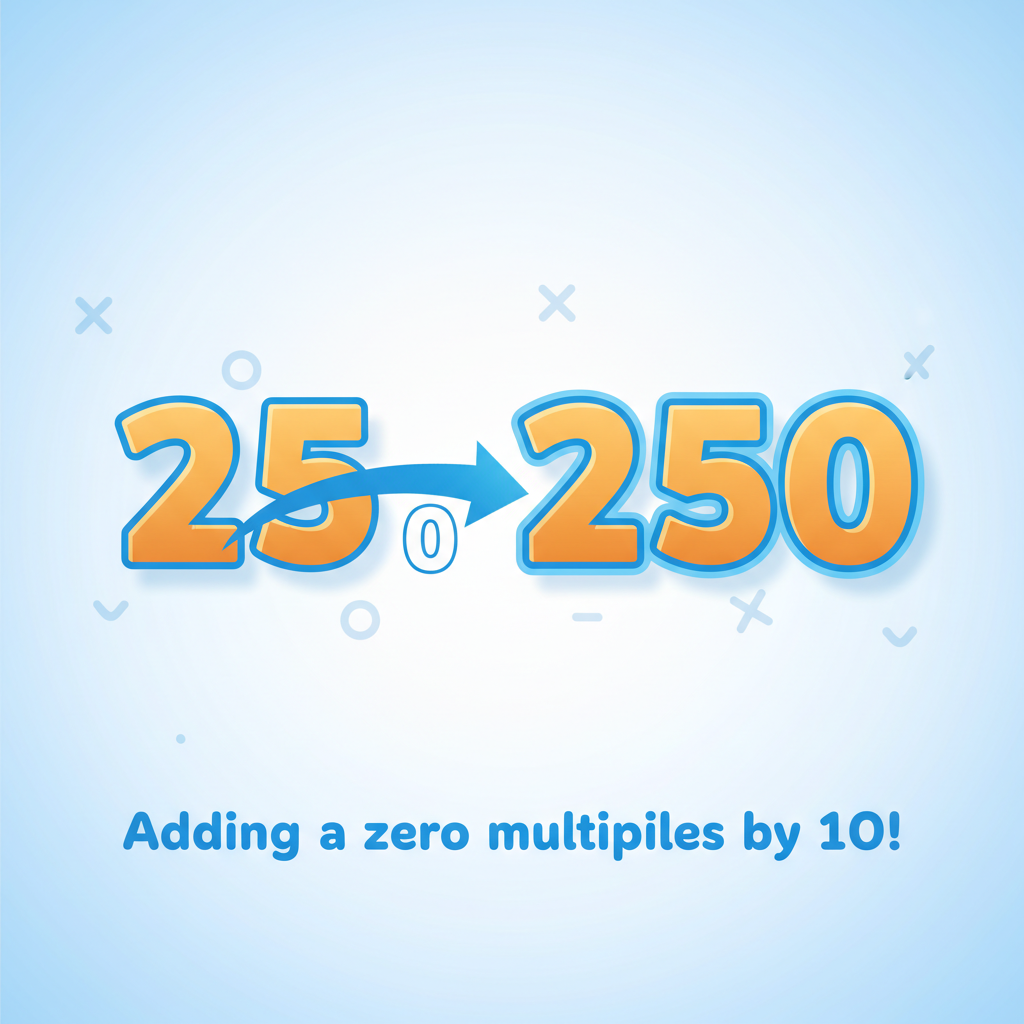
Multiplying any number by 10 is as easy as adding a little tail! Imagine you have a number, say 7. If you want to multiply it by 10 (7 x 10), all you do is add a zero to the end of the number. So, 7 becomes 70! It's like your number gets a little friend, a '0', to stand next to it.
Let's try another one: 25 x 10. Take the 25 and add a zero to the end: 250. See? Easy peasy!
Analogy: Think of multiplying by 10 like a super-fast conveyor belt. Each number you put on the belt is automatically moved one space to the left, and a zero fills in the empty space on the right. So, 5 becomes 50, 100 becomes 1000, and 123 becomes 1230.
Multiplying by 100 and 1000: More Zero Friends!
This trick gets even cooler! If you multiply by 100, you add TWO zeros to the end. If you multiply by 1000, you add THREE zeros!
- 6 x 100 = 600 (We added two zeros!)
- 42 x 100 = 4200 (Still adding two zeros!)
- 3 x 1000 = 3000 (We added three zeros!)
Analogy: Imagine you have a collection of LEGO bricks. Multiplying by 10 is like adding one extra shelf to your display case for every brick. Multiplying by 100 is like adding TWO extra shelves for every brick. Multiplying by 1000 is like adding THREE extra shelves! The number of bricks stays the same, but the space they take up (the zeros) increases.
 ⚠️ This picture may have spelling mistakes. Trust the words in the lesson.
Multiplying by 11: The Special Pattern!
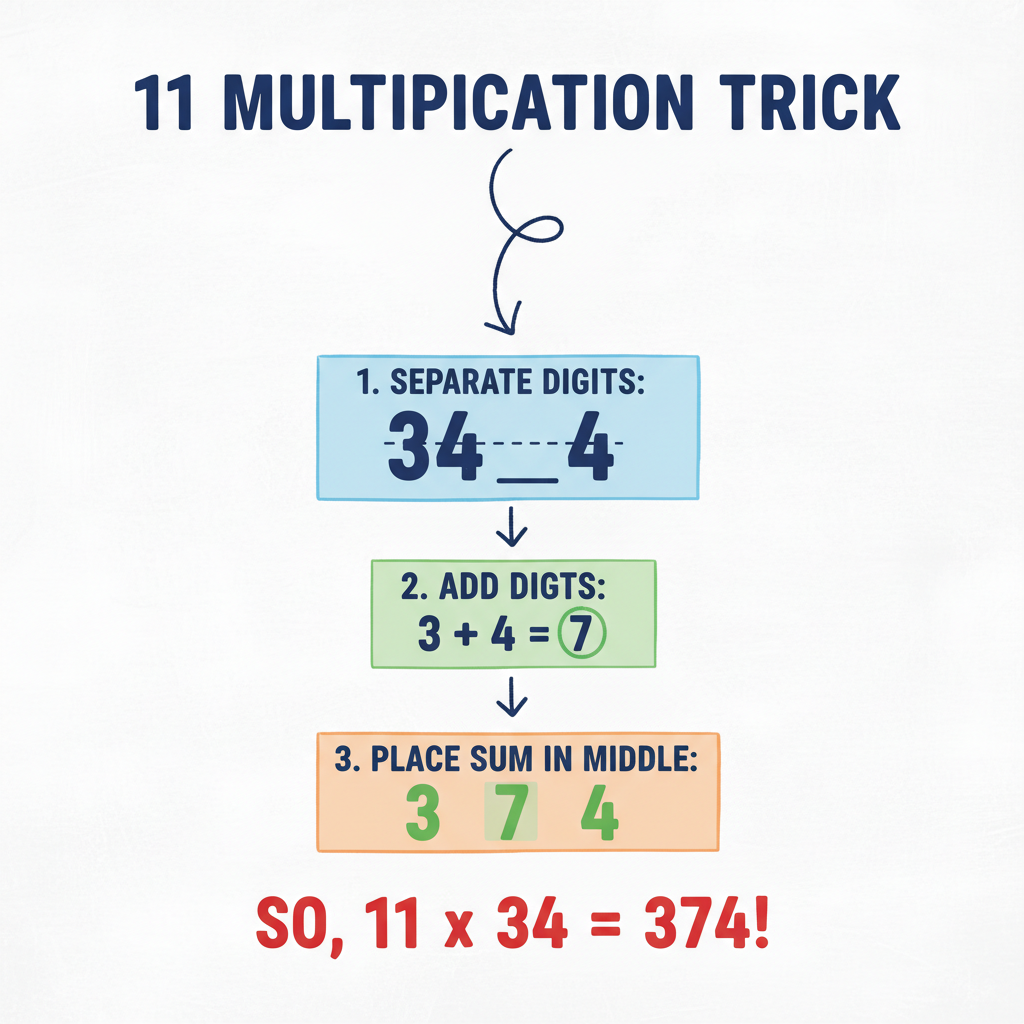
Multiplying by 11 is a bit like a magic trick, especially for two-digit numbers where the digits don't add up to 10 or more. Let's take the number 23 and multiply it by 11 (23 x 11).
- Step 1: Separate the Digits. Write down the first digit (2) and the second digit (3) with a space in between: 2 _ 3.
- Step 2: Add the Digits. Add the two digits together: 2 + 3 = 5.
- Step 3: Fill the Gap. Put the sum (5) into the space between the digits: 253. So, 23 x 11 = 253!
Let's try another one: 42 x 11.
- Separate: 4 _ 2
- Add: 4 + 2 = 6
- Fill: 462. So, 42 x 11 = 462!
What if the Digits Add Up to 10 or More?
This is where it gets extra exciting! Let's try 72 x 11.
- Separate: 7 _ 2
- Add: 7 + 2 = 9. This is fine, so 792.
Wait, what if we try 75 x 11?
- Separate: 7 _ 5
- Add: 7 + 5 = 12. Uh oh, this is a two-digit number!
- Carry Over: When the sum is 10 or more, you take the *second* digit of the sum (the '2' in 12) and put it in the middle space. You then *carry over* the *first* digit of the sum (the '1' in 12) and add it to the first digit of the original number.
Let's apply this to 75 x 11:
- Separate: 7 _ 5
- Add: 7 + 5 = 12.
- Take the '2' for the middle. Carry the '1' over to the first digit (7).
- Add the carried '1' to the first digit: 7 + 1 = 8.
- Put it all together: 825. So, 75 x 11 = 825!
Analogy: Multiplying by 11 is like a friendly handshake. The first and last digits are the hands. The middle digit is the hug. For simple numbers like 23 x 11, the hug is just one person (2+3=5), so you get 253. For numbers like 75 x 11, the hug is so big (7+5=12) that one person has to lean on the first digit's shoulder (carry over the 1), making the first digit bigger and the hug just the '2' part. So, the 7 gets help from the 1, becoming 8, and the hug is just 2, resulting in 825.
Quick Tricks for Other Numbers
Sometimes, you can break down bigger multiplication problems into smaller, easier ones. For example, to multiply by 5, you can multiply by 10 and then divide by 2 (since 5 is half of 10).
- Example: 16 x 5.
- Multiply by 10: 16 x 10 = 160.
- Divide by 2: 160 / 2 = 80. So, 16 x 5 = 80!
Analogy: Multiplying by 5 is like getting a double portion of food, but then sharing it with a friend. You get the full amount (multiply by 10), and then you split it evenly (divide by 2).
Why is Mental Math Important?
Practicing these quick multiplication tricks makes your brain stronger! It helps you solve problems faster in school, when playing games, and even when you're helping out at home. It's a skill that will help you your whole life!
Let's Practice!
Now it's time to put on your mental math superhero cape and try some problems!
Keep learning, free
Create a free Syllabax account to unlock practice questions and games for this topic.
Visual Learning Enhanced! 🚀
To help you master this topic, we use Advanced Syllabax AI to generate detailed diagrams and visual models.
Note on Visuals: The AI sometimes makes spelling errors in image labels. Please refer to the lesson text for the correct terminology.