Learning Journey
Watch this topic in 60 seconds
Free preview · Lesson 1
Understanding Experimental Probability
Exploring Experimental Probability: Learning by Doing!
Welcome, 8th graders, to the exciting world of probability! Sometimes, understanding how likely something is to happen feels like predicting the future. While we can't truly predict the future, we can use mathematics to make educated guesses. Today, we're going to dive into a special kind of probability called Experimental Probability. It's all about learning from what actually happens when we try things out!
What is Probability, Anyway?
Before we jump into 'experimental,' let's remember what probability is at its core. Probability is simply a way to measure the chance of something happening. Think of it like a likelihood meter: it tells you if something is very likely, somewhat likely, or very unlikely to occur. We usually express probability as a fraction, a decimal, or a percentage.
Introducing Experimental Probability: Learning by Doing
Imagine you have a brand new coin. If you've learned about probability before, you might know that the theoretical probability of flipping heads is 1/2 (or 50%), because there are two sides and one of them is heads. But what if you actually flip the coin 10 times? Do you always get exactly 5 heads and 5 tails? Not necessarily, right? Sometimes you might get 6 heads, sometimes 4, or maybe even 7! This is where experimental probability comes in.
Experimental Probability is the probability based on actual experiments, trials, and observations. It's what actually happens when you 'do' the math!
The Simple Formula for Experimental Probability
It's super straightforward! You just need to count two things:
Experimental Probability = (Number of times an event happened) / (Total number of trials)
Let's break down those terms:
-
Trial: A single attempt or observation in an experiment. Think of it as one 'go.' If you flip a coin, one flip is one trial. If you roll a dice, one roll is one trial.
Analogy: If you're trying to bake a cake, one 'trial' might be baking one cake. If you bake 5 cakes, you've done 5 trials. -
Event: The specific outcome you are interested in. For example, if you're flipping a coin, 'getting heads' is an event. If you're rolling a die, 'rolling a 6' is an event.
Analogy: In your cake baking, an 'event' could be baking a cake that tastes delicious, or baking a cake that rises perfectly. -
Outcome: Any possible result of a trial. When you flip a coin, the outcomes are 'heads' or 'tails.' When you roll a die, the outcomes are 1, 2, 3, 4, 5, or 6.
Analogy: For the cake, outcomes could be 'delicious,' 'okay,' or 'burnt.' -
Experiment: The entire process of conducting trials and observing events. It's everything you do from start to finish.
Analogy: Your entire process of trying different recipes, baking multiple cakes, and tasting them all would be your 'experiment.'
Let's Do an Example: Rolling a Die
Imagine you have a standard six-sided die. The theoretical probability of rolling a '1' is 1/6. But let's conduct an experiment!
You roll the die 20 times, and here are the results:
- Roll a 1: 3 times
- Roll a 2: 4 times
- Roll a 3: 2 times
- Roll a 4: 5 times
- Roll a 5: 3 times
- Roll a 6: 3 times
Let's calculate the experimental probability for different events:
-
What is the experimental probability of rolling a '1'?
Number of times a '1' occurred = 3
Total number of trials = 20
Experimental P(rolling a 1) = 3/20 -
What is the experimental probability of rolling an 'even number'?
Even numbers are 2, 4, 6. Let's count how many times they occurred:
Roll a 2: 4 times
Roll a 4: 5 times
Roll a 6: 3 times
Total times an even number occurred = 4 + 5 + 3 = 12
Total number of trials = 20
Experimental P(rolling an even number) = 12/20 = 3/5
See how it's based purely on what *actually happened* in your experiment?
Why is it 'Experimental'? The Difference from Theoretical
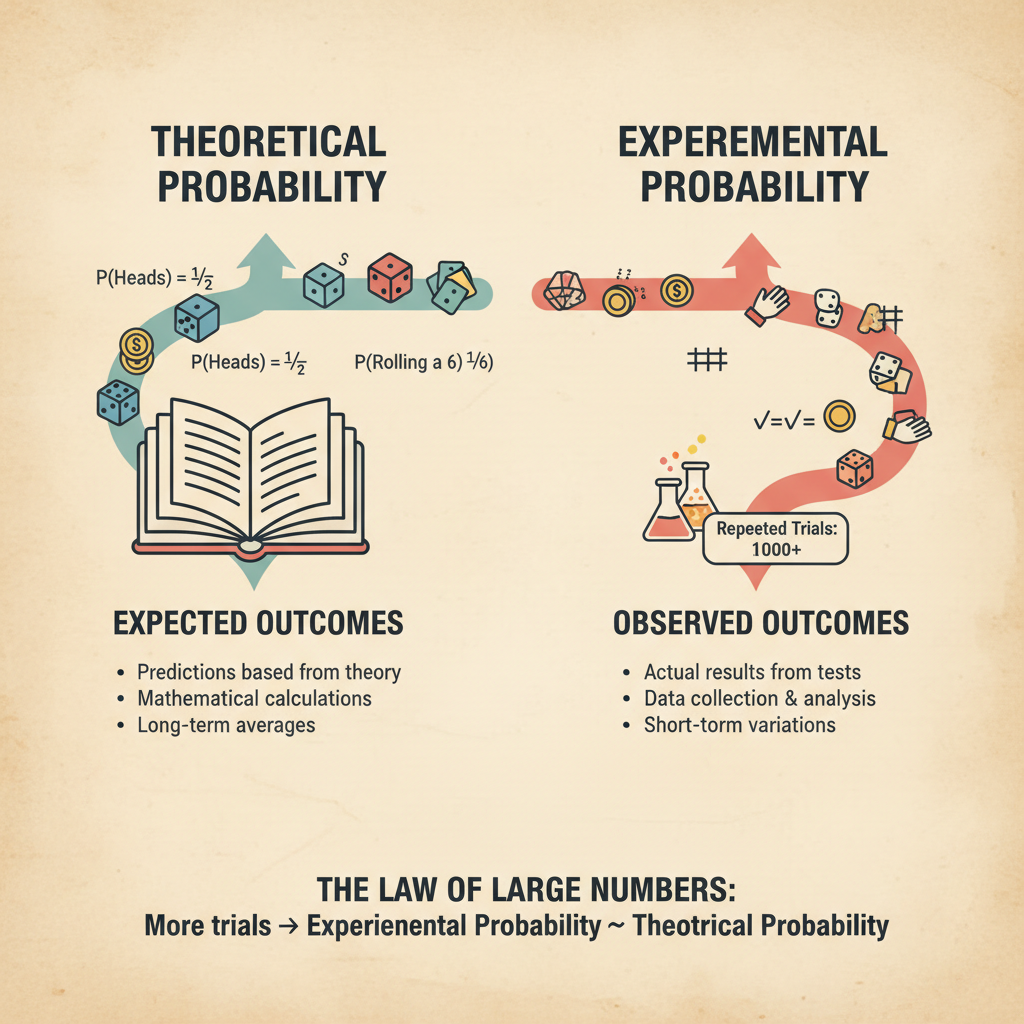
This is a super important point! Remember our coin flip example? The theoretical probability of getting heads is 1/2. This is what we expect to happen based on the coin's design (two sides, one head). It's calculated without doing any actual flips.
Experimental probability, however, is what you get when you actually perform the flips. It might be 6/10 for heads, or 4/10. It comes from 'experimenting' or 'doing' the activity.
 ⚠️ This picture may have spelling mistakes. Trust the words in the lesson.
The Law of Large Numbers (Simplified)
Here's a cool idea: if you do an experiment many, many, many times, your experimental probability will start to get very, very close to the theoretical probability. This is called the Law of Large Numbers. If you flipped that coin 1,000 times, you'd probably get very close to 500 heads and 500 tails. If you flipped it 10,000 times, you'd be even closer to 5,000 heads!
Analogy: Imagine trying to figure out the average height of students in your school. If you only measure 5 students, your average might be way off. But if you measure 500 students, your average will be much closer to the true average height of the entire school. The more data you collect, the more accurate your picture becomes!
Real-World Uses of Experimental Probability
Experimental probability isn't just for coins and dice; it's used everywhere!
- Weather Forecasting: When a meteorologist says there's a 70% chance of rain, they're not just guessing! They're often looking at past weather patterns when similar conditions were present. If, out of 100 days with similar conditions, it rained on 70 of them, then the experimental probability of rain is 70/100, or 70%.
- Sports Statistics: When a basketball player has a 'free throw percentage' of 85%, it means they've made 85 out of every 100 free throws they've attempted. This is their experimental probability of making a free throw.
- Manufacturing and Quality Control: A company making light bulbs might test a batch. If they test 1,000 bulbs and find 10 are faulty, the experimental probability of a bulb being faulty is 10/1000 = 1/100, or 1%. They can then use this to estimate how many faulty bulbs might be in the entire production run.
Putting it All Together
Experimental probability is a powerful tool because it lets us understand the likelihood of events based on real-world data. It's about getting our hands dirty, performing experiments, and seeing what actually happens. Remember, the more trials you conduct, the more reliable your experimental probability will become!
So next time you're wondering about the chances of something happening, think about how you could set up an experiment to find out!
Keep learning, free
Create a free Syllabax account to unlock practice questions and games for this topic.
Visual Learning Enhanced! 🚀
To help you master this topic, we use Advanced Syllabax AI to generate detailed diagrams and visual models.
Note on Visuals: The AI sometimes makes spelling errors in image labels. Please refer to the lesson text for the correct terminology.