Learning Journey
Free preview · Lesson 1
Understanding Congruency criteria (SSS, SAS, ASA, RHS) (Triangle)
Unlocking the Secrets of Congruent Triangles: SSS, SAS, ASA, and RHS
Welcome, future geometers! Have you ever seen two objects that look absolutely, perfectly identical? Maybe two identical copies of the same book, or two cars fresh off the assembly line of the exact same model and color? In math, when two shapes are exact copies of each other – meaning they have the exact same size and the exact same shape – we call them congruent.
What Does 'Congruent' Really Mean?
Imagine you have a cookie cutter, and you make two cookies using that same cutter. Those two cookies are congruent! If you could pick one up and place it directly on top of the other, they would match up perfectly, every single edge and every single point. There would be no part of one sticking out from under the other.
For triangles, this means that if two triangles are congruent, then:
- All three corresponding sides are equal in length.
- All three corresponding angles are equal in measure.
Think of it like having two identical LEGO bricks. They have the same dimensions, the same number of studs, everything is identical. If you can superimpose one triangle perfectly onto another, they are congruent.
Why Do We Care About Congruent Triangles?
That's a great question! In geometry, proving that two triangles are congruent is super powerful. Once you know two triangles are congruent, you automatically know that *all* their corresponding sides and *all* their corresponding angles are equal. This helps us solve many problems in construction, engineering, art, and even computer graphics. It's like finding a perfect blueprint for two identical parts!
Now, here's the cool part: Do we have to measure ALL three sides and ALL three angles of two triangles to prove they are congruent? Thankfully, no! Just like you don't need to check every single strand of hair to know if two identical twins are, well, identical, we have some clever shortcuts, or 'criteria', for triangles. These criteria allow us to prove congruence by checking only some specific parts of the triangles. Let's explore these amazing shortcuts!
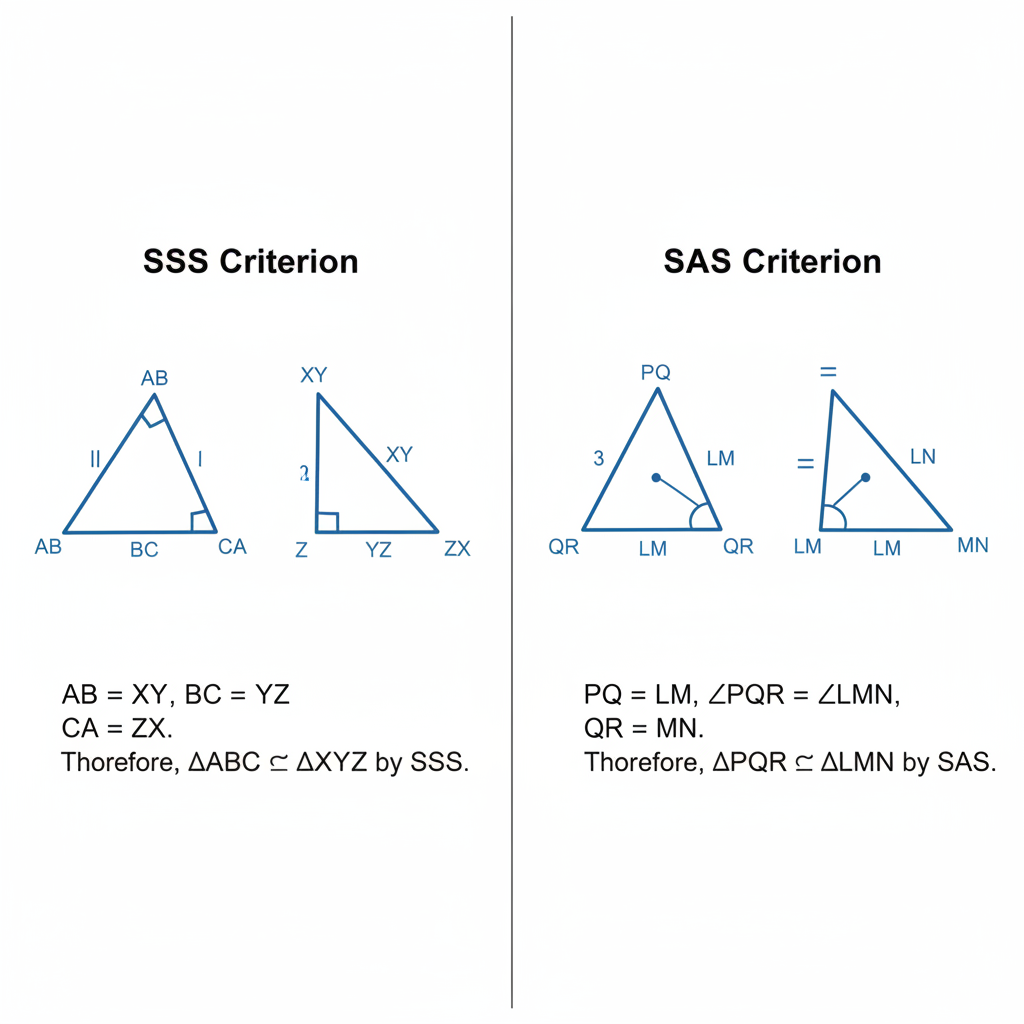 ⚠️ This picture may have spelling mistakes. Trust the words in the lesson.
The Four Main Congruence Criteria for Triangles: Your Super Shortcuts!
1. SSS (Side-Side-Side) Congruence Criterion
This is perhaps the most straightforward one to understand. Imagine you have three sticks of specific lengths. Can you arrange them to form more than one unique triangle? No! There's only one way to connect those three specific sticks to make a triangle. The shape is fixed.
Definition: If the three sides of one triangle are equal in length to the three corresponding sides of another triangle, then the two triangles are congruent.
Analogy: Think of it like a triangle made out of three fixed-length pieces of wood, joined at hinges. Once the lengths of all three sides are set, the shape of the triangle is completely determined. You can't make a different shaped triangle with those exact same three side lengths.
How to use it: If you can show that:
- Side AB = Side DE
- Side BC = Side EF
- Side CA = Side FD
...then, by SSS, triangle ABC is congruent to triangle DEF.
2. SAS (Side-Angle-Side) Congruence Criterion
This one is a bit more specific. Here, the 'Angle' part must be included between the two 'Sides'.
Definition: If two sides and the included angle (the angle formed by those two sides) of one triangle are equal to two corresponding sides and the included angle of another triangle, then the two triangles are congruent.
Analogy: Imagine you're building a fence. If you fix the length of two fence posts (sides) and you know the exact angle at which they should meet (the included angle), the distance between the ends of those two posts (the third side) is automatically determined. You can't make a different triangle if those two sides and the angle between them are fixed.
Crucial Point: The angle must be between the two sides you are comparing. If the angle is not between the two sides, this criterion doesn't work!
How to use it: If you can show that:
- Side AB = Side DE
- Angle B = Angle E (and Angle B is between sides AB and BC, and Angle E is between sides DE and EF)
- Side BC = Side EF
...then, by SAS, triangle ABC is congruent to triangle DEF.
3. ASA (Angle-Side-Angle) Congruence Criterion
Similar to SAS, this criterion also requires the 'Side' part to be included between the two 'Angles'.
Definition: If two angles and the included side (the side connecting the vertices of those two angles) of one triangle are equal to two corresponding angles and the included side of another triangle, then the two triangles are congruent.
Analogy: Picture drawing a line segment (your included side). Now, at each end of that segment, you draw a ray (a line extending infinitely in one direction) at a specific angle. Those two rays will meet at exactly one point, forming a unique triangle. It's like setting two corners of a room and the wall that connects them; the rest of the room's shape is then fixed.
Crucial Point: The side must be between the two angles you are comparing.
How to use it: If you can show that:
- Angle A = Angle D
- Side AB = Side DE (and Side AB is between Angle A and Angle B, and Side DE is between Angle D and Angle E)
- Angle B = Angle E
...then, by ASA, triangle ABC is congruent to triangle DEF.
4. RHS (Right-angle-Hypotenuse-Side) Congruence Criterion
This is a special criterion that only works for right-angled triangles. Remember, a right-angled triangle has one angle that measures exactly 90 degrees.
Definition: If the hypotenuse (the side opposite the right angle) and one leg (a side adjacent to the right angle) of a right-angled triangle are equal to the hypotenuse and one corresponding leg of another right-angled triangle, then the two triangles are congruent.
Analogy: Imagine leaning a ladder against a perfectly vertical wall, forming a right angle with the ground. If you know the length of the ladder (hypotenuse) and how far its base is from the wall (one leg), then the height it reaches on the wall (the other leg) is automatically determined. You can't change the height without changing the ladder length or the distance from the wall.
Crucial Points:
- Both triangles MUST be right-angled.
- You MUST compare the hypotenuses (the longest side, opposite the 90-degree angle).
- You MUST compare one other corresponding side (a 'leg').
How to use it: If you have two right-angled triangles, say ABC (with Angle B = 90°) and DEF (with Angle E = 90°), and you can show that:
- Hypotenuse AC = Hypotenuse DF
- Side AB = Side DE (or Side BC = Side EF)
...then, by RHS, triangle ABC is congruent to triangle DEF.
Putting It All Together: A Quick Review
Remember these powerful shortcuts:
- SSS: All three sides match.
- SAS: Two sides and the angle *between* them match.
- ASA: Two angles and the side *between* them match.
- RHS: For right triangles, the hypotenuse and one leg match.
By understanding and applying these criteria, you can determine if two triangles are identical copies of each other without having to measure every single part! This skill is a cornerstone of geometry and will help you tackle more complex shapes and problems in the future. Keep practicing, and you'll become a congruence master in no time!
Keep learning, free
Create a free Syllabax account to unlock practice questions and games for this topic.
Visual Learning Enhanced! 🚀
To help you master this topic, we use Advanced Syllabax AI to generate detailed diagrams and visual models.
Note on Visuals: The AI sometimes makes spelling errors in image labels. Please refer to the lesson text for the correct terminology.