Learning Journey
Watch this topic in 60 seconds
Free preview · Lesson 1
Figure Series – Non – Verbal Reasoning (Diagrammatic) (Foundational)
Welcome to the World of Figure Series!
Hey there, young detectives! Are you ready to train your brain to spot patterns and solve visual puzzles? Today, we're going to explore something super fun called Figure Series – Non-Verbal Reasoning. Don't let the big words scare you; it's all about looking at pictures and finding the hidden rules!
What is Non-Verbal Reasoning?
Imagine trying to understand someone without them saying a single word – maybe they point, or draw a picture. That's a bit like non-verbal reasoning! It's about solving problems using pictures, shapes, and diagrams instead of words or numbers. It helps you think visually and notice small details.
What is a Figure Series?
Think of a comic strip or a flipbook. Each picture changes just a little bit from the last one, telling a story. A Figure Series is very similar! It's a sequence (a line) of pictures or shapes, and each picture changes in a specific way to follow a hidden rule or pattern. Your job is to figure out what that rule is and predict what the next picture in the series should look like!
It's like a visual puzzle where you need to be a pattern-spotting superstar!
How Do We Solve a Figure Series?
Solving a figure series is like being a super-sleuth! Here are the steps:
- Observe Carefully (Look Closely!):
- Look at ALL the figures in the series, from the very first to the last one given.
- What do you see? Are they shapes? Lines? Dots? Are there multiple objects?
- Find the Pattern (What's Changing?):
- This is the most important step! Ask yourself:
- Is the shape moving? (Up, down, left, right, diagonally, or around a path?)
- Is the shape turning or rotating? (Clockwise, anti-clockwise, by how much?)
- Is something being added or removed? (A line, a dot, another shape?)
- Is the shape changing its type or size? (A circle becoming a square, small becoming large?)
- Is the shading or color changing? (White to black, striped to solid?)
- Focus on one small change at a time. If there are multiple elements, observe how each one changes.
- This is the most important step! Ask yourself:
- Predict the Next Figure (Apply the Rule!):
- Once you've found the rule that connects all the given figures, apply that exact same rule to the very last figure in the series.
- This will help you imagine what the next figure should look like!
Let's Look at Some Common Patterns (Foundational Level):
1. Movement or Position Change
Sometimes, an object simply moves from one spot to another within a boundary. It might move step-by-step or jump around.
Example: Imagine a small ball moving clockwise around a square box's corners.
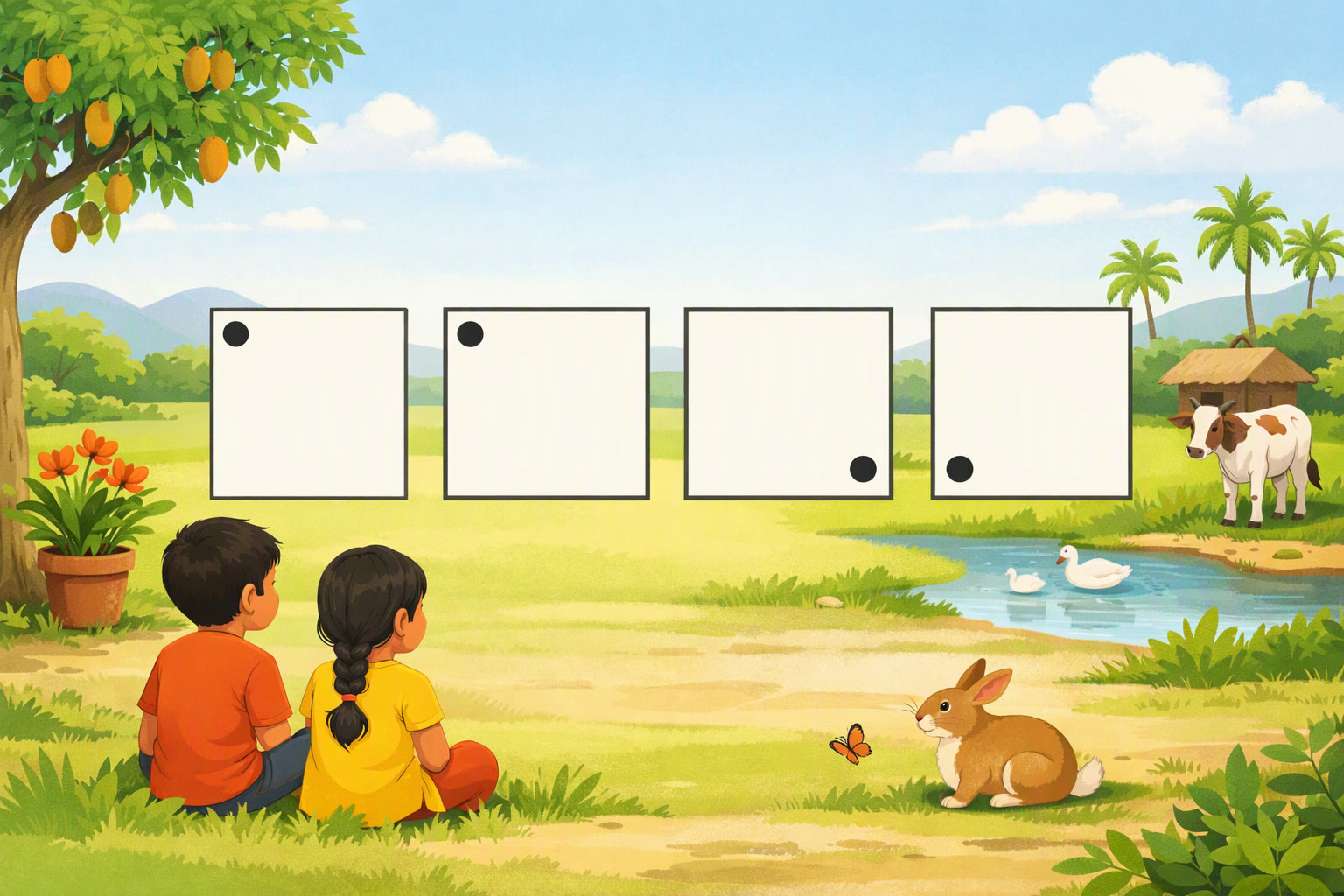
Explanation: The dot moves one step clockwise to the next corner in each figure.
2. Rotation
This is when a shape turns around a central point. Think of a clock's hands turning!
- Clockwise: Turning in the same direction as a clock's hands.
- Anti-clockwise (or Counter-clockwise): Turning in the opposite direction.
Shapes can rotate by 90 degrees (a quarter turn), 45 degrees, or other amounts.
Example: An arrow turning clockwise by 90 degrees.

Explanation: The arrow rotates 90 degrees clockwise in each step.
3. Addition or Removal of Elements
In some series, parts are added to the figure, or parts are taken away, following a rule.
Example: Adding one line segment at a time to form a shape.
- Figure 1: (One vertical line) |
- Figure 2: (Two lines forming an 'L' shape) L
- Figure 3: (Three lines forming an incomplete square)

Explanation: A line segment is added in a clockwise direction with each step.
4. Change in Shape or Size
Sometimes the entire shape might transform, or it might just get bigger or smaller.
Example: A small circle becomes a medium circle, then a large circle.
- Figure 1: (small circle) ○
- Figure 2: (medium circle) ●
- Figure 3: (large circle) ●
Explanation: The circle is growing in size with each step.
Putting It All Together!
Remember, the key is to look for the rule! Once you find it, you're ready to predict the next awesome picture in the series. It’s like being a code-breaker for pictures!
Keep practicing, and you'll become a master of figure series in no time!
Keep learning, free
Create a free Syllabax account to unlock practice questions and games for this topic.
Visual Learning Enhanced! 🚀
To help you master this topic, we use Advanced Syllabax AI to generate detailed diagrams and visual models.
Note on Visuals: The AI sometimes makes spelling errors in image labels. Please refer to the lesson text for the correct terminology.