Nervous system[BIOLOGY]
Watch this topic in 60 seconds
Free preview · Lesson 1
Understanding Nervous system[BIOLOGY]
The Nervous System: Your Body's Supercomputer and Communication Network
Imagine your body as a massive, bustling city. How does everything get done? How do the police know about a crime? How do the engineers know when to fix a broken bridge? How does the city mayor make decisions based on all this information? The answer is a sophisticated communication system. In your body, this incredible system is called the Nervous System.
At its core, the nervous system is responsible for everything you do, feel, and think. It allows you to see, hear, taste, touch, and smell. It helps you move your muscles, learn new things, feel emotions, and even keeps your heart beating and your lungs breathing without you having to consciously think about it.
Main Parts of the Nervous System
The nervous system is generally divided into two main parts:
- Central Nervous System (CNS)
- Peripheral Nervous System (PNS)
1. The Central Nervous System (CNS)
The CNS is the ultimate command center of your body. It's like the main office building where all the important decisions are made and all critical information is stored. It consists of two major components: the brain and the spinal cord.
a. The Brain
Your brain is an incredibly complex organ, safely housed inside your skull. It's the most powerful computer known, capable of processing vast amounts of information, controlling your movements, thoughts, emotions, and memories.
The brain has different specialized areas for different tasks, like seeing, hearing, speaking, and moving. For example, one part helps you understand language, while another controls your balance.
b. The Spinal Cord
The spinal cord is a long, tube-like structure that extends from the base of your brain down your back, protected by your backbone (vertebrae). It acts as the main information superhighway, carrying messages back and forth between your brain and the rest of your body.
2. The Peripheral Nervous System (PNS)
The PNS includes all the nerves that branch out from the brain and spinal cord to every other part of your body. Think of it as all the smaller roads, side streets, and local telephone lines that connect the main highway (spinal cord) and city hall (brain) to every single building, house, and lamppost in the city.
The PNS is further divided into two main systems:
- Somatic Nervous System: Controls voluntary movements, like kicking a ball or writing. It's what you consciously control.
- Autonomic Nervous System: Controls involuntary actions, like your heartbeat, digestion, and breathing. These happen automatically without you thinking about them.
The Basic Unit: The Neuron (Nerve Cell)
The entire nervous system, both CNS and PNS, is made up of billions of tiny specialized cells called neurons, also known as nerve cells. These are the fundamental building blocks and the actual messengers of the nervous system.
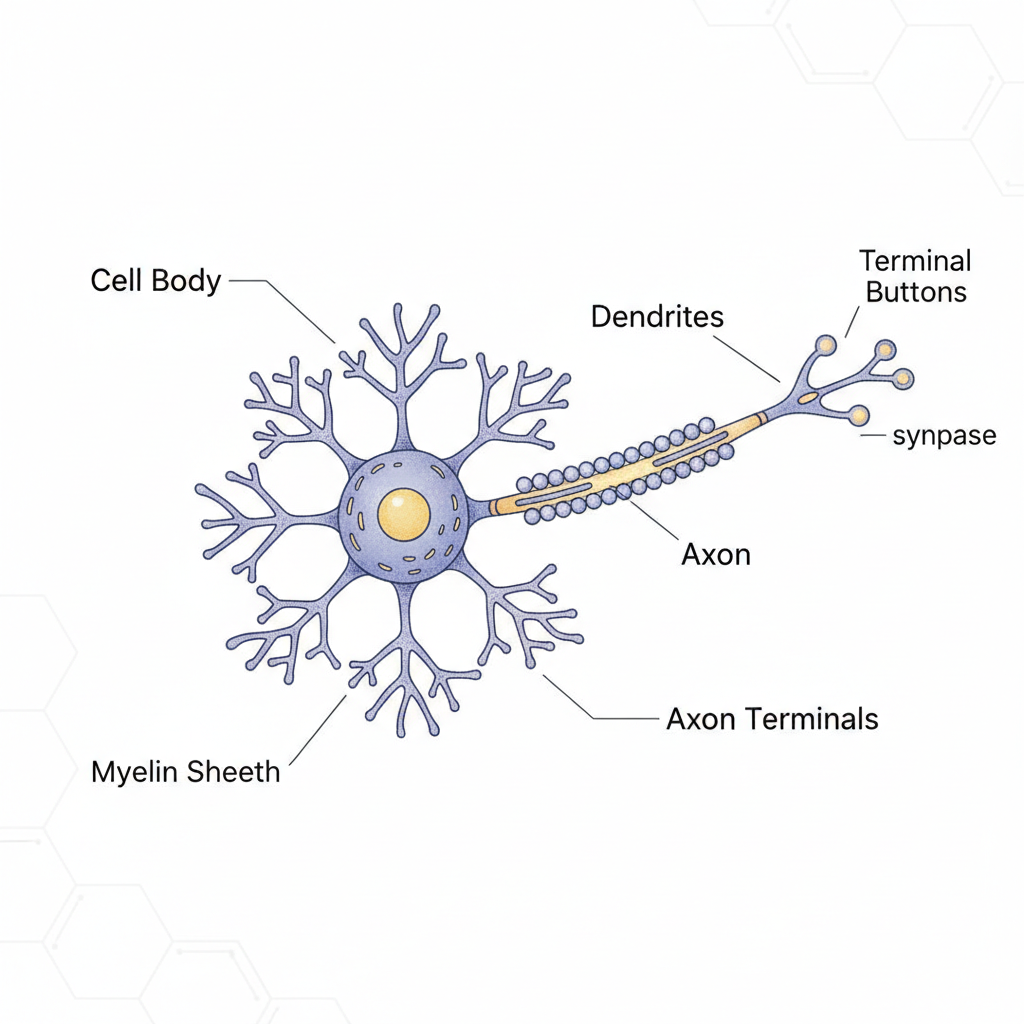 ⚠️ This picture may have spelling mistakes. Trust the words in the lesson.
Structure of a Neuron:
Every neuron typically has three main parts:
- Cell Body (Soma): This is the main part of the neuron, containing the nucleus and other organelles. It's like the neuron's 'control center' or 'factory floor'.
- Dendrites: These are short, branching extensions that look like tree branches coming off the cell body. Their job is to receive signals (messages) from other neurons.
Analogy: Dendrites are like the antennas or receivers on a walkie-talkie. They pick up incoming signals from other walkie-talkies (neurons).
- Axon: This is a long, slender projection that extends away from the cell body. Its job is to transmit signals to other neurons, muscles, or glands.
Analogy: The axon is like the long transmission cable that carries the signal away from the walkie-talkie to be sent to another location.
Many axons are covered in a fatty layer called the myelin sheath. This sheath acts like insulation on an electrical wire, allowing nerve signals (electrical impulses) to travel much faster and more efficiently along the axon.
How Neurons Communicate: The Synapse
Neurons don't actually touch each other. There's a tiny gap between the end of one neuron's axon and the dendrite (or cell body) of the next neuron. This tiny gap is called a synapse.
When an electrical signal reaches the end of an axon, it triggers the release of special chemical messengers called neurotransmitters into the synapse. These neurotransmitters then float across the gap and bind to receptors on the next neuron, causing a new electrical signal to start in that neuron. This is how messages are passed from neuron to neuron, creating a complex chain of communication.
Types of Neurons
Just like there are different types of workers in a city's communication network, there are different types of neurons:
- Sensory Neurons (Afferent Neurons): These neurons carry information from your sensory organs (eyes, ears, skin, nose, tongue) and internal organs (like your stomach) to the central nervous system. They are the 'reporters' or 'spies'.
Analogy: Sensory neurons are like the reporters on the street who gather information about what's happening (heat, cold, light, sound) and send it back to City Hall (CNS).
- Motor Neurons (Efferent Neurons): These neurons carry commands from the central nervous system to your muscles and glands, telling them what to do. They are the 'action commanders'.
Analogy: Motor neurons are like the commanders in City Hall who receive orders from the Mayor (brain) and then send out instructions to the workers (muscles and glands) to carry out an action, like moving your arm or digesting food.
- Interneurons: These are found mostly in the brain and spinal cord. They act as bridges, connecting sensory and motor neurons, and also communicate with other interneurons. They are the 'middle managers' or 'translators'.
Analogy: Interneurons are like the interpreters or middle managers in City Hall. They receive reports from sensory neurons, translate and process the information, and then pass it on to the motor neurons for action. They help the brain make sense of everything and decide what to do.
Functions of the Nervous System in Action
Let's put it all together. Imagine you accidentally touch a hot stove:
- Sensing: Sensory neurons in your fingertip detect the intense heat and pain. They quickly convert this information into an electrical signal and send it up the nerves of your arm, through the spinal cord, and towards the brain.
- Processing: As the signal reaches the spinal cord, interneurons immediately process it and, in a quick reflex, send a command directly to motor neurons in your arm muscles to pull your hand away – even before your brain fully registers the pain! Meanwhile, the signal continues to the brain, where other interneurons process it, making you feel the pain and realize what happened.
- Responding: Motor neurons receive the command (both from the spinal cord for the reflex and then from the brain for conscious action) and tell the muscles in your arm to contract, pulling your hand away from the stove. Your brain also might send signals to your mouth to say "Ouch!" or to your glands to release stress hormones.
Autonomic Nervous System: Automatic Control
We mentioned the autonomic nervous system earlier, which handles involuntary actions. It has two opposing but complementary branches:
- Sympathetic Nervous System: This is your body's 'fight or flight' response system. It gets you ready for action in stressful or dangerous situations. It increases your heart rate, dilates your pupils, speeds up breathing, and directs blood to your muscles.
Analogy: The sympathetic system is like the emergency response team of the city. When there's a fire or a threat, it kicks into high gear, getting everything ready for an immediate response.
- Parasympathetic Nervous System: This is your body's 'rest and digest' system. It calms your body down after stress, conserves energy, slows your heart rate, constricts pupils, and promotes digestion.
Analogy: The parasympathetic system is like the city's maintenance and relaxation crew. After an emergency, or during normal peaceful times, it cleans up, repairs, and ensures everything is running smoothly and efficiently for long-term health.
These two systems work together to keep your body in a balanced state, constantly adjusting to your environment and internal needs.
Conclusion
The nervous system is a truly remarkable and complex network that orchestrates every single function of your body. From the simplest reflex to the most profound thought, it's all thanks to the intricate communication pathways of billions of neurons working in harmony. Understanding its basic structure and function is key to appreciating how your body works and interacts with the world.
Keep learning, free
Create a free Syllabax account to unlock practice questions and games for this topic.
Visual Learning Enhanced! 🚀
To help you master this topic, we use Advanced Syllabax AI to generate detailed diagrams and visual models.
Note on Visuals: The AI sometimes makes spelling errors in image labels. Please refer to the lesson text for the correct terminology.