Triangles (types) [Polygons & 2D Shapes]
Watch this topic in 60 seconds
Free preview · Lesson 1
Understanding Triangles (types) [Polygons & 2D Shapes]
Discovering Triangles: Shapes with Three Sides!
Welcome, super math explorers! Today, we're going on an exciting adventure into the world of shapes. We've met squares, rectangles, and circles, but now it's time to meet a very special shape: the triangle!
What is a Triangle?
Imagine you have three sticks. If you connect them at their ends to make a closed shape, what do you get? A triangle! That's right, a triangle is a polygon with exactly three sides and three corners (we call these corners 'vertices'). Think of a slice of pizza – it's usually a triangle! Or the roof of a house – that triangular shape helps keep the rain off!
Key features of a triangle:
- 3 Sides: No more, no less!
- 3 Vertices (Corners): Where the sides meet.
- Closed Shape: The sides connect to form an enclosed area.
Triangles are everywhere! Look around your classroom, your home, or even outside. You'll find them in signs, buildings, sandwiches, and so much more!
Different Kinds of Triangles: A Shape for Every Job!
Just like there are different kinds of animals or different kinds of foods, there are also different kinds of triangles! We can tell them apart by looking at their sides and their angles (the corners).
Classifying Triangles by Their Sides
Let's imagine we have three different types of triangle-making kits. Each kit has sticks of different lengths.
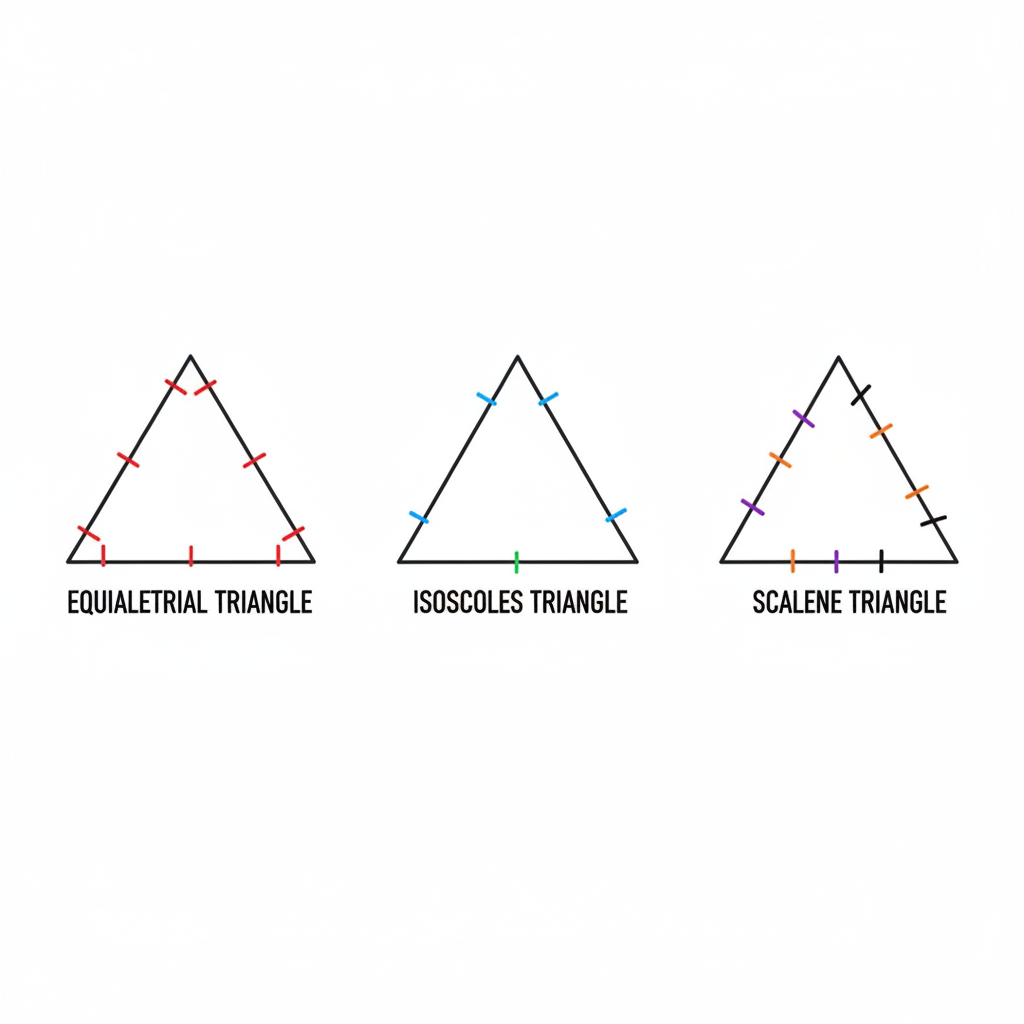
- Equilateral Triangles: The Perfectly Balanced Triangles
Imagine a triangle where all three sticks you use are exactly the same length. That's an equilateral triangle! Every side is equal, and every corner is the same size.
Analogy: Think of a perfectly balanced three-legged stool. All the legs are the same length, making it stable and symmetrical. Or a stop sign in some countries (though most are octagons, a special triangle shape exists!).
In simple terms: All 3 sides are the same length.
- Isosceles Triangles: The Two-Sided Twins
Now, imagine a triangle where two of the sticks are the same length, but the third stick is a different length. This is an isosceles triangle! It has two equal sides and two equal angles (corners).
Analogy: Think of an ice cream cone! The sloping sides of the cone are usually the same length, while the base might be a little different. Or the roof of a simple shed – often two sides are the same length.
In simple terms: Exactly 2 sides are the same length.
- Scalene Triangles: The Unique Triangles
Finally, imagine a triangle where all three sticks you use are different lengths. This is a scalene triangle! All three sides are different lengths, and all three angles (corners) are different sizes.
Analogy: Think of a slice of irregular-shaped cheese. Each side might be a different length, and the corners are all different. Or a boomerang – they often have unique shapes with unequal sides!
In simple terms: All 3 sides are different lengths.
Here’s a little visual to help remember:
 ⚠️ This picture may have spelling mistakes. Trust the words in the lesson.
Classifying Triangles by Their Angles
Angles are like the 'sharpness' or 'openness' of the corners of a triangle. We measure angles, but for now, we'll think about them as small, medium, or big.
Remember that a right angle is like the corner of a square or a book – it's perfectly square!
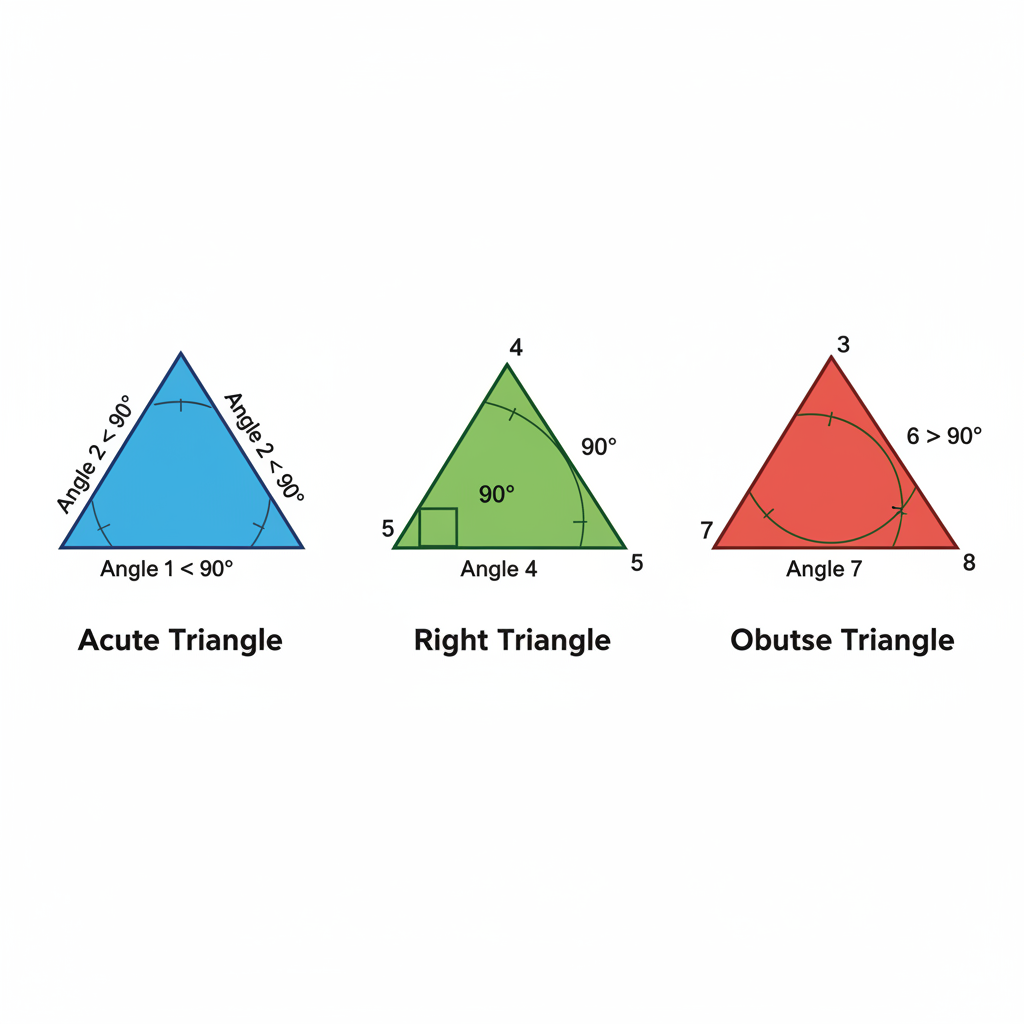
- Acute Triangles: The Sharp & Speedy Triangles
An acute triangle is a triangle where all three angles (corners) are acute angles. An acute angle is an angle that is smaller than a right angle. Think of a very sharp pencil tip – that's an acute angle!
Analogy: Imagine a very pointy slice of cake that's cut from the very center. All its corners are quite sharp.
In simple terms: All 3 angles are smaller than a right angle.
- Right Triangles: The Square-Cornered Triangles
A right triangle is a triangle that has exactly one right angle. Remember, a right angle is a perfect 90-degree corner, like the corner of a book or a piece of paper.
Analogy: Think of the corner of a room where two walls meet the floor. That's a right angle! Many ramps are built in a right triangle shape.
In simple terms: Exactly 1 angle is a right angle (a perfect square corner).
- Obtuse Triangles: The Wide & Wobbly Triangles
An obtuse triangle is a triangle that has one obtuse angle. An obtuse angle is an angle that is larger than a right angle, but not a straight line. Think of opening a door wide – that's an obtuse angle!
Analogy: Imagine a pizza slice that's cut very close to the crust, making one of the angles very wide and open. Or a reclining chair – the angle of the back is obtuse.
In simple terms: Exactly 1 angle is larger than a right angle.
Here's another visual to help:
 ⚠️ This picture may have spelling mistakes. Trust the words in the lesson.
Putting It All Together: Naming Our Triangles!
We can name triangles using both their sides and their angles! For example, a triangle with two equal sides and one right angle is an isosceles right triangle.
Don't worry if it seems like a lot at first! The more you practice, the easier it will become. Triangles are fascinating shapes that are fundamental to geometry and found all around us!
Keep learning, free
Create a free Syllabax account to unlock practice questions and games for this topic.
Visual Learning Enhanced! 🚀
To help you master this topic, we use Advanced Syllabax AI to generate detailed diagrams and visual models.
Note on Visuals: The AI sometimes makes spelling errors in image labels. Please refer to the lesson text for the correct terminology.