Vibrations and sound[PHYSICS]
Watch this topic in 60 seconds
Free preview · Lesson 1
Understanding Vibrations and sound[PHYSICS]
Vibrations and Sound: The Music of the World Around Us!
Imagine a world without sound. No music, no laughter, no birds singing, not even the sound of your own voice! Sound is a fundamental part of our lives, and it all starts with something called vibrations. In this lesson, we'll explore what vibrations are, how they create sound, and how sound travels to our ears.
What is a Vibration?
Think about when you pluck a guitar string. What do you see? The string wiggles back and forth really fast, right? That rapid back-and-forth movement is a vibration. It's like a tiny, speedy dance that an object does.
Analogy: The Playground Swing
Imagine a child on a playground swing. When you push them, they swing forward and then back to where they started. This to-and-fro motion is very similar to a vibration. The string of the guitar, the surface of a drum, or even the air itself can vibrate.
Anything that makes a sound is usually vibrating. When you clap your hands, your hands move quickly back and forth. When a bell rings, the metal of the bell shakes. When you speak, your vocal cords in your throat vibrate!
How Vibrations Make Sound
So, how does this wiggling and shaking create the sounds we hear? Vibrations are like tiny waves that spread out from the vibrating object. These waves travel through a medium (like air, water, or solids) and eventually reach our ears.
Analogy: Ripples in a Pond
Imagine dropping a pebble into a calm pond. What happens? You see ripples spreading out from where the pebble hit the water. These ripples are waves. Vibrations work in a similar way, but instead of water, they usually travel through the air.
When an object vibrates, it pushes and pulls on the air particles around it. Imagine a tiny push toy. When it moves forward, it squishes the air particles in front of it. When it moves backward, it pulls the air particles apart.
These squishes (called compressions) and pulls (called rarefactions) travel through the air as sound waves. Our ears are designed to detect these tiny changes in air pressure caused by the sound waves.
How Sound Travels
Sound needs something to travel through. This 'something' is called a medium. The most common medium for sound is air. But sound can also travel through water and solids!
Analogy: Dominoes Falling
Think about setting up a line of dominoes. When you push the first one, it falls and knocks over the next one, and so on. The 'push' travels along the line of dominoes, even though the dominoes themselves only move a little bit.
Sound waves travel through the air in a similar way. One air particle bumps into the next, which bumps into the next, and so on, passing the energy of the sound along. This is why you can't hear anything in outer space – there's no air (or medium) for the sound to travel through!
Sound in Different Materials
Sound travels at different speeds through different materials. It generally travels:
- Fastest through solids (like a table or a wall)
- Slower through liquids (like water)
- Slowest through gases (like air)
Analogy: A Game of Telephone
Imagine playing the game of Telephone. If you whisper a message to someone standing right next to you, they'll hear it clearly. If you try to whisper it across a large room filled with air, it might get a bit mixed up. Now imagine you're trying to pass a message through a long, solid metal pipe. The message would travel much faster and more clearly!
This is why, if you put your ear to a long wooden table and someone taps on the other end, you can hear the tap much better and sooner than if you were just listening through the air.
What Makes Sounds Different?
Not all sounds are the same, right? Some sounds are loud, some are soft. Some sounds are high-pitched (like a whistle), and some are low-pitched (like a tuba). These differences are due to how the vibrations happen.
Loudness
The loudness of a sound is determined by the amplitude of the vibration. Amplitude is how big the back-and-forth movement is. A big, strong vibration creates a loud sound. A small, gentle vibration creates a soft sound.
Analogy: A Bouncing Ball
Imagine bouncing a ball. If you drop it from a low height, it bounces gently – a small amplitude. If you throw it down hard from a high height, it bounces high – a large amplitude. Loud sounds have vibrations with a large amplitude, like the hard-thrown ball.
Pitch
The pitch of a sound is determined by the frequency of the vibration. Frequency is how fast the object vibrates. A fast vibration creates a high-pitched sound. A slow vibration creates a low-pitched sound.
Analogy: A Spinning Top
Think about a spinning top. If it spins very, very fast, it makes a high-pitched whirring sound. If it spins slowly, it makes a low-pitched sound. The faster the spin (frequency), the higher the pitch.
On a guitar, thicker strings vibrate more slowly and produce lower notes, while thinner strings vibrate faster and produce higher notes. This is all about frequency!
Your Ears and Sound
Our ears are amazing tools for hearing! When sound waves reach our ears, they cause a tiny part called the eardrum to vibrate. These vibrations are then sent to our brain, which interprets them as sound.
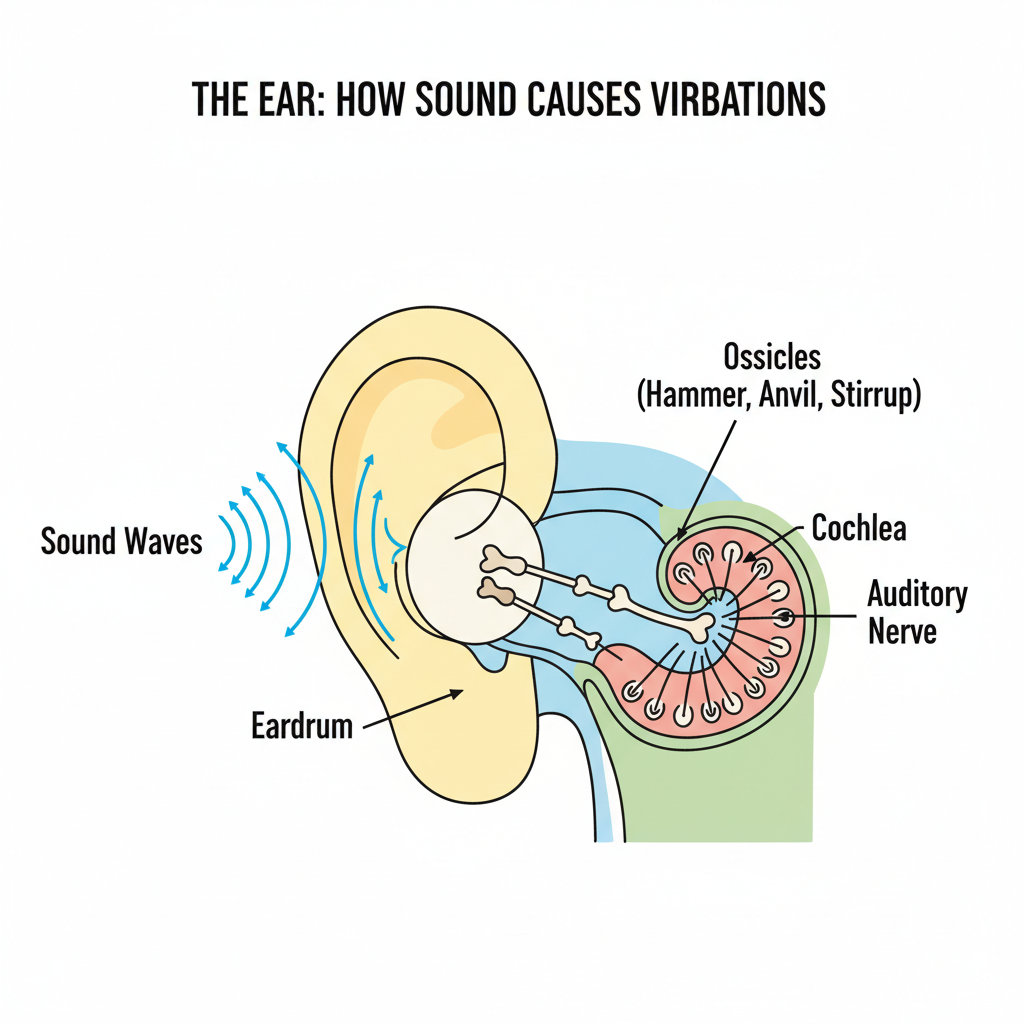
So, the next time you hear a beautiful song, the chirping of a bird, or the sound of your friend's voice, remember that it all starts with tiny, invisible vibrations dancing through the air!
Keep learning, free
Create a free Syllabax account to unlock practice questions and games for this topic.
Visual Learning Enhanced! 🚀
To help you master this topic, we use Advanced Syllabax AI to generate detailed diagrams and visual models.
Note on Visuals: The AI sometimes makes spelling errors in image labels. Please refer to the lesson text for the correct terminology.