Learning Journey
Watch this topic in 60 seconds
Free preview · Lesson 1
Understanding Images formed by mirrors[PHYSICS]
Understanding Images Formed by Mirrors
Have you ever looked in a mirror and seen yourself staring back? That's an image! Mirrors are everywhere, from the bathroom mirror you use to check your hair to the shiny surfaces on cars and even in telescopes. Today, we're going to explore how these mirrors create images, focusing on the most common types: flat mirrors and curved mirrors.
What is an Image?
In physics, an image is a representation of an object formed by light. Think of it like a shadow, but instead of being dark and fuzzy, it's a clear picture of the object. When light rays from an object hit a mirror, they bounce off (reflect) and travel to our eyes. Our brains then interpret these rays as coming from a specific location, and that's where we see the image.
Types of Mirrors
Mirrors can be broadly categorized into two main types based on their shape:
- Plane Mirrors: These are flat mirrors, like the ones you see in most bathrooms or on walls.
- Curved Mirrors: These mirrors have a curved surface. They can be curved inwards (concave) or outwards (convex).
Images Formed by Plane Mirrors
Plane mirrors are the simplest. Let's imagine you're standing in front of one.
Characteristics of Images in Plane Mirrors:
- Virtual Image: The image you see in a plane mirror is virtual. This means the light rays don't actually meet at the location of the image; they only appear to come from there. It's like looking at a ghost – it looks real, but you can't touch it. You can't project a virtual image onto a screen.
- Upright: The image is oriented the same way as the object. If you raise your right hand, the image in the mirror raises its left hand (from its perspective), but the image itself is still standing upright.
- Same Size: The image formed by a plane mirror is exactly the same size as the object. If you're 5 feet tall, your image in the mirror will also appear to be 5 feet tall.
- Laterally Inverted: This is a fancy way of saying the image is flipped left-to-right. Your right hand appears as the mirror image's left hand. Think of it like unzipping a jacket – the zipper starts on one side for you and on the opposite side for the mirror image.
- Image Distance = Object Distance: The distance of the image behind the mirror is equal to the distance of the object in front of the mirror. If you stand 2 feet away from the mirror, your image will appear to be 2 feet behind the mirror's surface. This makes the total distance between you and your image seem like 4 feet!
Analogy: Imagine a perfectly still lake. When you look at the reflection of a tree in the lake, the reflection appears to be the same distance behind the water's surface as the tree is in front of it. The reflection is also upright and the same size, but it's flipped left-to-right if you think about the intricate details.
Images Formed by Curved Mirrors
Curved mirrors are a bit more interesting because they can magnify or shrink images, and the images can be real or virtual. There are two types:
1. Concave Mirrors (Converging Mirrors)
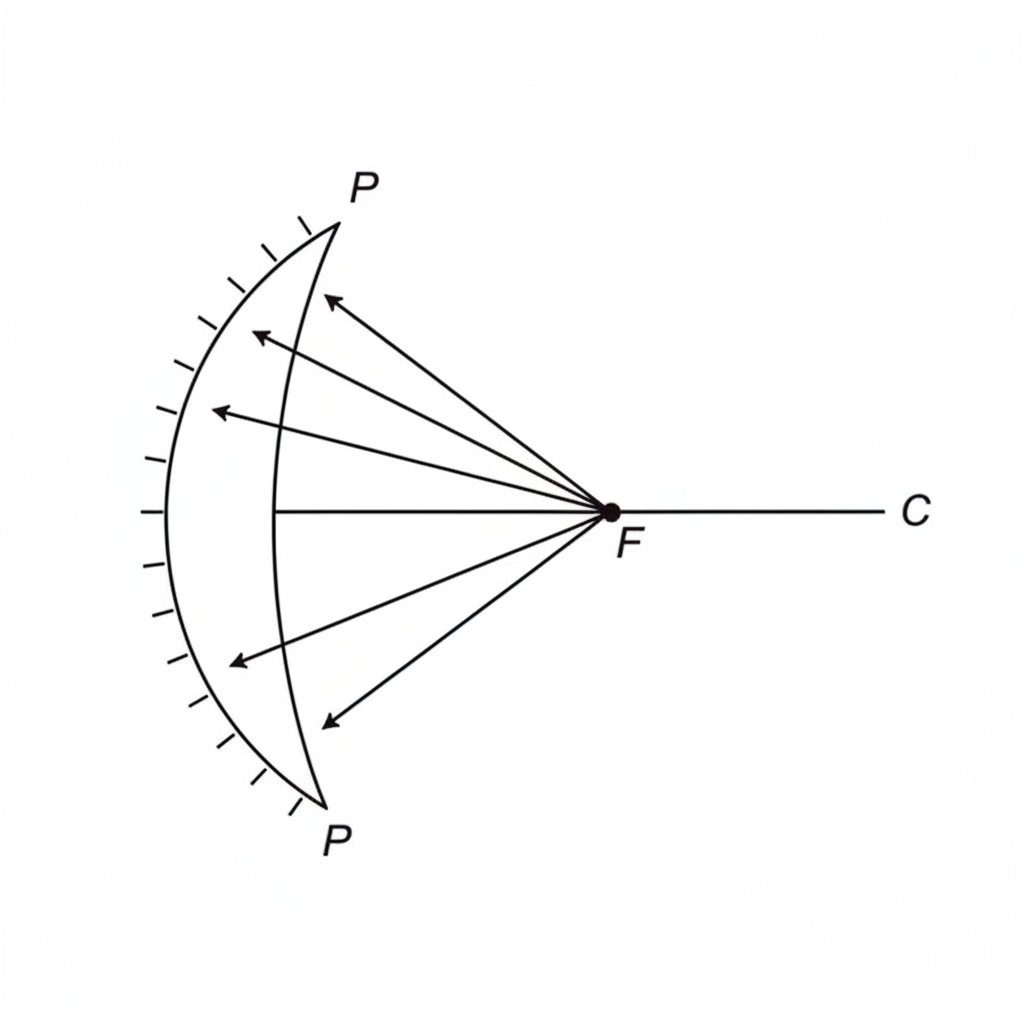
A concave mirror is shaped like the inside of a spoon. It curves inward. These mirrors are called converging mirrors because they can bring parallel light rays together at a single point.
Key Terms for Curved Mirrors:
- Center of Curvature (C): The center of the sphere from which the mirror is a part.
- Radius of Curvature (R): The distance from the mirror to the center of curvature.
- Principal Axis: An imaginary line passing through the center of the mirror, perpendicular to its surface.
- Focal Point (F): The point on the principal axis where parallel light rays converge after reflecting off the mirror. For a concave mirror, the focal point is in front of the mirror.
- Focal Length (f): The distance from the mirror to the focal point. For a concave mirror,
f = R/2.
Images formed by Concave Mirrors: The type of image formed depends on where the object is placed relative to the mirror.
- Object far away (beyond C): Forms a real, inverted, and diminished (smaller) image between F and C. A real image can be projected onto a screen. Think of a projector screen – it uses a lens (similar to a concave mirror in how it converges light) to form a real image.
- Object at C: Forms a real, inverted, and same size image at C.
- Object between F and C: Forms a real, inverted, and magnified (larger) image beyond C. This is how a magnifying mirror (like those used for makeup or shaving) works when you hold the object close.
- Object at F: If the object is exactly at the focal point, the reflected rays become parallel, and no clear image is formed (or it forms at infinity).
- Object between the mirror and F: Forms a virtual, upright, and magnified image behind the mirror. This is how a dentist uses a small mirror to see inside your mouth more clearly – the image is magnified and upright.
Analogy: Think of a satellite dish. Its concave shape collects and focuses incoming signals (like light rays) to a single point, the focal point. Or, imagine shining a flashlight into a concave mirror; the light rays bounce back and focus together.
2. Convex Mirrors (Diverging Mirrors)
A convex mirror is shaped like the outside of a spoon. It curves outward. These mirrors are called diverging mirrors because they spread out parallel light rays.
Key Terms for Convex Mirrors:
- Center of Curvature (C), Radius of Curvature (R), Principal Axis: Similar definitions to concave mirrors, but C and R are behind the mirror.
- Focal Point (F): The point from which reflected parallel light rays appear to diverge. For a convex mirror, the focal point is behind the mirror.
- Focal Length (f): The distance from the mirror to the focal point. For a convex mirror, the focal length is considered negative (
f = -R/2) because the focal point is behind the mirror.
Images formed by Convex Mirrors: No matter where you place the object in front of a convex mirror, it will always form the same type of image.
- Virtual: The image is always virtual, appearing behind the mirror.
- Upright: The image is always upright.
- Diminished: The image is always smaller than the object.
Analogy: Think of the security mirrors you see in shops or at the end of hallways. They curve outwards, allowing you to see a much wider area than a flat mirror would. This is why the image is smaller – it has to fit a larger scene into a smaller representation. They make everything look like it's further away and smaller.
Summary Table
| Mirror Type | Image Characteristics (Generally) | Image Location | Can be Projected? |
|---|---|---|---|
| Plane | Virtual, Upright, Same Size, Laterally Inverted | Behind mirror (same distance as object) | No |
| Concave | Varies: Real/Virtual, Inverted/Upright, Diminished/Same Size/Magnified | In front or behind mirror, depends on object position | Yes (if Real) / No (if Virtual) |
| Convex | Virtual, Upright, Diminished | Behind mirror | No |
Understanding how mirrors form images helps us appreciate the science behind everyday objects and advanced technologies. Keep exploring!
Keep learning, free
Create a free Syllabax account to unlock practice questions and games for this topic.
Visual Learning Enhanced! 🚀
To help you master this topic, we use Advanced Syllabax AI to generate detailed diagrams and visual models.
Note on Visuals: The AI sometimes makes spelling errors in image labels. Please refer to the lesson text for the correct terminology.