Learning Journey
Watch this topic in 60 seconds
Free preview · Lesson 1
Understanding Comparing and ordering numbers (Understanding Numbers)
Comparing and Ordering Numbers: Understanding Our Number World!
Welcome, young mathematicians, to a super exciting adventure into the world of numbers! Today, we're going to learn how to compare numbers, which is like figuring out who has more toys or who is taller. We'll also learn how to order them, which is like lining up your favorite books from shortest to tallest or your best drawings from your most favorite to least favorite. Get ready to become number detectives!
What Does It Mean to Compare Numbers?
Comparing numbers means we look at two or more numbers and decide which one is bigger, which one is smaller, or if they are the same. Think about it like this:
- More than: Imagine you have 5 yummy cookies, and your friend has 3 yummy cookies. You have more than your friend!
- Less than: If your friend has 7 colorful stickers, and you have 4 colorful stickers, your friend has more than you, and you have less than your friend.
- Equal to: If you and your sibling both have 6 shiny marbles, then you both have the same amount. Your amount is equal to your sibling's amount.
We have special symbols to help us show these comparisons:
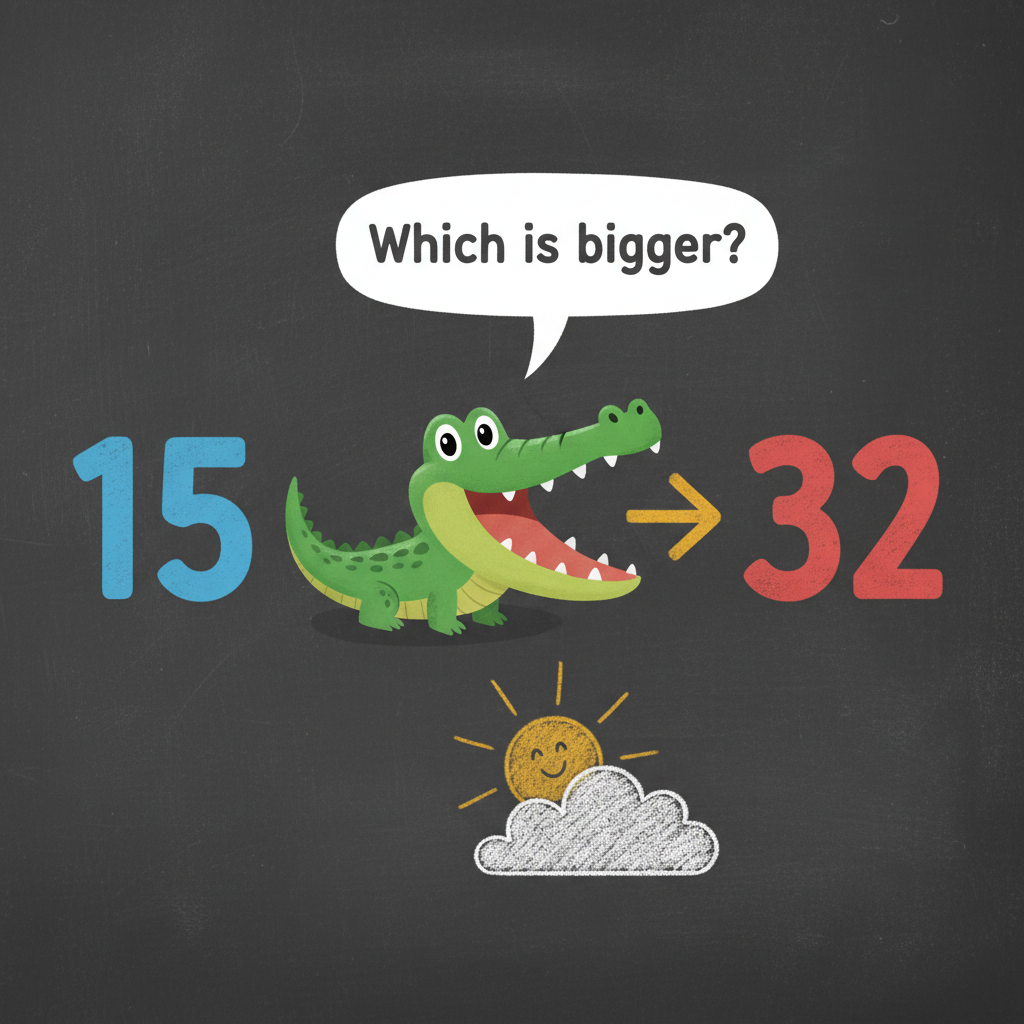
- > This symbol means "greater than" or "more than". Think of it like an alligator's mouth that is always hungry for the bigger number!
- < This symbol means "less than" or "smaller than". This is the opposite of the alligator mouth.
- = This symbol means "equal to" or "the same as".
How Do We Compare Numbers? Let's Use Our Place Value Superpowers!
The easiest way to compare numbers is to look at their place value. Remember place value? It's all about where a digit sits in a number! We have ones, tens, hundreds, and so on. When we compare, we start from the biggest place value and move our way down.
Example 1: Comparing 52 and 38
1. Look at the tens place: The number 52 has a 5 in the tens place. The number 38 has a 3 in the tens place.
2. Compare the tens digits: Is 5 bigger or smaller than 3? 5 is bigger than 3!
3. Conclusion: Since 5 is greater than 3 in the tens place, the number 52 is greater than the number 38. We write this as 52 > 38.
Example 2: Comparing 147 and 162
1. Look at the hundreds place: Both numbers have a 1 in the hundreds place. They are the same!
2. Look at the tens place: The number 147 has a 4 in the tens place. The number 162 has a 6 in the tens place.
3. Compare the tens digits: Is 4 bigger or smaller than 6? 4 is less than 6.
4. Conclusion: Since 4 is less than 6 in the tens place, the number 147 is less than the number 162. We write this as 147 < 162.
Example 3: Comparing 255 and 259
1. Hundreds place: Both numbers have a 2. Same!
2. Tens place: Both numbers have a 5. Same!
3. Ones place: The number 255 has a 5 in the ones place. The number 259 has a 9 in the ones place.
4. Compare the ones digits: Is 5 bigger or smaller than 9? 5 is less than 9.
5. Conclusion: Since 5 is less than 9 in the ones place, the number 255 is less than the number 259. We write this as 255 < 259.
What if the numbers have different amounts of digits?
This is super easy! The number with more digits is always the bigger number (unless it starts with a 0, which we usually don't write). Think about it: a 3-digit number like 100 is way bigger than any 2-digit number, like 99.
Example 4: Comparing 89 and 315
1. Count the digits: 89 has two digits. 315 has three digits.
2. Conclusion: The number with more digits (315) is bigger. So, 89 < 315.
What Does It Mean to Order Numbers?
Ordering numbers means arranging them in a specific sequence. We usually order them in two main ways:
- Ascending Order: This means going from the smallest number to the biggest number. Think of climbing up a staircase, step by step.
- Descending Order: This means going from the biggest number to the smallest number. Think of sliding down a slide, starting from the top.
How Do We Order Numbers? Let's Practice!
Ordering is just comparing a group of numbers one by one. You can use your place value superpowers again!
Example 5: Order these numbers in ascending order: 75, 23, 98, 41
1. Find the smallest number: We look at the tens place. We have 7, 2, 9, and 4. The smallest tens digit is 2. So, 23 is the smallest number.
2. Find the next smallest: Now we look at the remaining numbers: 75, 98, 41. The tens digits are 7, 9, and 4. The smallest of these is 4. So, 41 is the next smallest.
3. Find the next smallest: Remaining numbers are 75 and 98. Tens digits are 7 and 9. 7 is smaller than 9. So, 75 is the next smallest.
4. The last number is the biggest: The last number is 98.
5. Put them in order: 23, 41, 75, 98. This is ascending order!
Example 6: Order these numbers in descending order: 512, 152, 87, 305
1. Find the biggest number: We have 512, 152, 87, and 305. First, look at the number of digits. 87 has two digits, while the others have three. So, 87 is the smallest, and we know it won't be the biggest.
2. Compare the three-digit numbers: 512, 152, 305. Look at the hundreds place: 5, 1, and 3. The biggest hundreds digit is 5. So, 512 is the biggest number.
3. Find the next biggest: Remaining numbers are 152 and 305. Hundreds digits are 1 and 3. 3 is bigger than 1. So, 305 is the next biggest.
4. The next number is smaller: The last three-digit number is 152.
5. The smallest number: We already found 87 is the smallest.
6. Put them in order: 512, 305, 152, 87. This is descending order!
Why Is Comparing and Ordering Numbers Important?
Understanding how numbers relate to each other helps us in so many ways every day!
- Shopping: When you go to the store, you compare prices to see what costs more or less.
- Measurement: If you're measuring how tall things are, you compare heights.
- Time: Comparing times helps you know if you're early or late.
- Games: In many games, you compare scores to see who is winning!
Keep practicing your number superpowers, and you'll become a number-ordering master in no time!
Keep learning, free
Create a free Syllabax account to unlock practice questions and games for this topic.
Visual Learning Enhanced! 🚀
To help you master this topic, we use Advanced Syllabax AI to generate detailed diagrams and visual models.
Note on Visuals: The AI sometimes makes spelling errors in image labels. Please refer to the lesson text for the correct terminology.