Learning Journey
Free preview · Lesson 1
Understanding Cube & cuboid (Volume & Surface Area)
Understanding Cubes and Cuboids: Volume and Surface Area
Welcome, future mathematicians! Today, we're going on an exciting journey into the world of three-dimensional (3D) shapes, specifically focusing on two very common ones: the cube and the cuboid. You see these shapes everywhere around you – from the dice you roll in a board game to the shoebox in your closet. We'll learn how to measure two important things about them: how much space they take up (their Volume) and how much 'skin' they have on the outside (their Surface Area).
What are 3D Shapes?
Imagine drawing a square on a piece of paper. That's a flat, two-dimensional (2D) shape. It only has length and width. Now, imagine taking that square and giving it some 'thickness' or 'height'. Voila! You now have a 3D shape. 3D shapes don't just have length and width; they also have depth or height, meaning they occupy space in the real world.
Think of it like this: A drawing of a house is 2D. A real house you can walk into is 3D.
Meet the Cube!
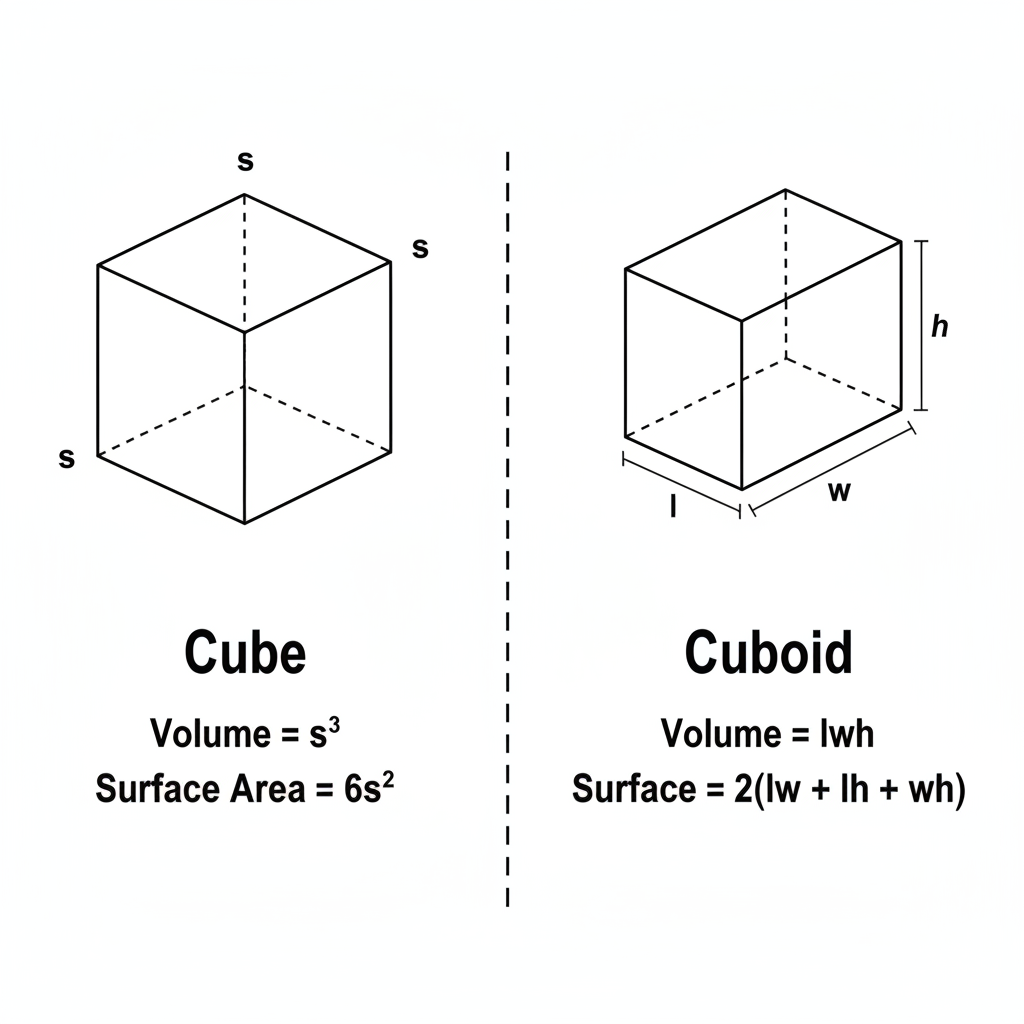
A cube is a special kind of 3D shape. It's like a perfectly symmetrical box. Here are its key features:
- Faces: It has 6 flat surfaces, and every single one of them is a perfect square.
- Edges: It has 12 straight lines where the faces meet. All these edges are exactly the same length.
- Vertices: It has 8 corners, where three edges meet.
Analogy: Think of a standard dice, a Rubik's Cube, or a sugar cube. All sides are equal, making it perfectly balanced.
Meet the Cuboid!
A cuboid is very similar to a cube, but it's a bit more flexible. While a cube has all square faces, a cuboid can have rectangular faces.
- Faces: It also has 6 flat surfaces, but these are rectangles. Opposite faces are always identical.
- Edges: It has 12 edges. Unlike a cube, these edges might not all be the same length. They come in sets of four equal lengths (length, width, height).
- Vertices: Just like a cube, it has 8 corners.
Analogy: Imagine a shoebox, a brick, a cereal box, or even your school textbook. These are all cuboids! They have different lengths, widths, and heights.
Understanding Volume: How Much Space Does It Hold?
Have you ever wondered how much water fits into a fish tank, or how much sand you can put into a sandpit? This is where Volume comes in! Volume is the amount of three-dimensional space an object occupies or contains.
Analogy: Think of volume as the 'stuffing' inside a cushion or the amount of juice in a carton. It tells you how much can fit inside.
Units of Volume: Since we're measuring space in three dimensions (length, width, height), the units for volume are 'cubic' units. For example, cubic centimeters (cm³), cubic meters (m³), or cubic inches (in³).
Calculating the Volume of a Cuboid
To find the volume of a cuboid, you simply multiply its three dimensions: length, width, and height.
Formula: Volume (V) = Length × Width × Height
Let's say a shoebox is 30 cm long, 20 cm wide, and 10 cm high.
V = 30 cm × 20 cm × 10 cm
V = 6000 cm³
So, the shoebox can hold 6000 cubic centimeters of 'stuff'.
Calculating the Volume of a Cube
A cube is a special type of cuboid where all sides (length, width, and height) are equal. So, if we call the length of one side 's', then the width is also 's', and the height is also 's'.
Formula: Volume (V) = Side × Side × Side or V = s³
If a Rubik's Cube has sides that are 5 cm long:
V = 5 cm × 5 cm × 5 cm
V = 125 cm³
The Rubik's Cube occupies 125 cubic centimeters of space.
Understanding Surface Area: How Much 'Skin' Does It Have?
Now, let's think about something different. What if you wanted to wrap a present in a gift box? Or paint a storage locker? You wouldn't care about what's *inside* the box; you'd care about the total area of all its outer surfaces. This is what Surface Area measures.
Analogy: Think of surface area as the amount of wrapping paper you'd need for a present, the amount of paint to cover all walls and the ceiling of a rectangular room, or the 'skin' of an orange. It's the total area of all the faces on the outside.
Units of Surface Area: Since we're measuring an area (like the area of a square or rectangle), the units for surface area are 'square' units. For example, square centimeters (cm²), square meters (m²), or square inches (in²).
Calculating the Surface Area of a Cuboid
A cuboid has 6 faces: a top and a bottom, a front and a back, and a left and a right side. Each pair of opposite faces is identical. To find the total surface area, we find the area of each face and add them all up.
- Area of Top & Bottom faces: Length × Width (two of these: 2lw)
- Area of Front & Back faces: Length × Height (two of these: 2lh)
- Area of Left & Right faces: Width × Height (two of these: 2wh)
Formula: Surface Area (SA) = 2(Length × Width + Length × Height + Width × Height)
Using our shoebox example (30 cm long, 20 cm wide, 10 cm high):
Area of Top & Bottom = 2 × (30 cm × 20 cm) = 2 × 600 cm² = 1200 cm²
Area of Front & Back = 2 × (30 cm × 10 cm) = 2 × 300 cm² = 600 cm²
Area of Left & Right = 2 × (20 cm × 10 cm) = 2 × 200 cm² = 400 cm²
Total Surface Area = 1200 cm² + 600 cm² + 400 cm² = 2200 cm²
So, you would need 2200 square centimeters of wrapping paper to cover the shoebox.
Calculating the Surface Area of a Cube
Since a cube has 6 identical square faces, finding its surface area is simpler. First, find the area of one face (Side × Side). Then, multiply that by 6.
Formula: Surface Area (SA) = 6 × Side × Side or SA = 6s²
Using our Rubik's Cube example (side = 5 cm):
Area of one face = 5 cm × 5 cm = 25 cm²
Total Surface Area = 6 × 25 cm² = 150 cm²
You would need 150 square centimeters of paint to cover all sides of the Rubik's Cube.
Volume vs. Surface Area: A Quick Recap
- Volume: Measures the space inside a 3D object. Think of how much liquid a bottle can hold. Units are cubic (cm³, m³).
- Surface Area: Measures the total area of all the faces on the outside of a 3D object. Think of the amount of gift wrap needed. Units are square (cm², m²).
Understanding these concepts is super helpful in many real-world situations, from building houses to packaging products. Keep practicing, and you'll master them in no time!
Keep learning, free
Create a free Syllabax account to unlock practice questions and games for this topic.
Visual Learning Enhanced! 🚀
To help you master this topic, we use Advanced Syllabax AI to generate detailed diagrams and visual models.
Note on Visuals: The AI sometimes makes spelling errors in image labels. Please refer to the lesson text for the correct terminology.