nth term (Arithmetic Progressions)
Watch this topic in 60 seconds
Free preview · Lesson 1
Understanding nth term (Arithmetic Progressions)
Understanding the Nth Term: Your Foundational Guide to Arithmetic Progressions (Grade 10)
Have you ever noticed patterns in numbers? Like the ticking of a clock, the rungs of a ladder, or the way money grows in a savings account with a regular deposit? Mathematics is full of such patterns, and one of the most common and useful is called an Arithmetic Progression (AP).
Imagine you're climbing a set of stairs. Each step is the same height, right? If the first step is 10 cm off the ground, the second is 20 cm, the third is 30 cm, and so on. This consistent 'jump' from one step to the next is the heart of an Arithmetic Progression. Today, we're going to unlock the secret of finding ANY step's height without having to count all the way up – this is what we call the 'nth term'.
What is a Sequence? (The 'List' of Numbers)
Before we dive into APs, let's talk about sequences. A sequence is simply a list of numbers that follow a specific order or rule. Think of it like a line of ducks, each duck is a number, and they're all marching in a particular formation.
- Example: 2, 4, 6, 8, 10, ... (What's the rule here? Adding 2 each time!)
- Example: 10, 20, 30, 40, ... (What's the rule? Adding 10 each time!)
- Example: 5, 10, 15, 20, ... (What's the rule? Adding 5 each time!)
What is an Arithmetic Progression (AP)? (The 'Consistent Jump' Rule)
An Arithmetic Progression (AP) is a special type of sequence where the difference between consecutive terms is constant. This 'constant difference' is super important and has a special name: the common difference.
Let's go back to our stairs analogy. If each step adds exactly 10 cm to your height, then 10 cm is your common difference. If you save
Key Ingredients of an AP:
-
The First Term (a₁): Your Starting Point!
This is simply the very first number in your sequence. It's where your journey begins.Analogy: If you're building a tower with LEGO blocks, the first block you place is your 'first term'. If you're counting the rings on a tree, the first ring is your 'first term'.
-
The Common Difference (d): Your Consistent Jump!
This is the fixed amount that you add (or subtract) to get from one term to the next. It's consistent throughout the entire progression.To find 'd', you just subtract any term from the term that comes immediately after it:
d = a₂ - a₁ord = a₃ - a₂, etc.- If
dis positive, the numbers in the sequence will increase (e.g., 2, 4, 6, 8...). - If
dis negative, the numbers in the sequence will decrease (e.g., 10, 7, 4, 1...). - If
dis zero, all numbers will be the same (e.g., 5, 5, 5, 5...).
Analogy: In our stair example, the common difference 'd' is the consistent height of each step. If you get a raise of
- If
-
The Position of a Term (n): Which Spot Are We Talking About?
This simply tells us where a term is located in the sequence. Is it the 1st term, the 5th term, or the 100th term? 'n' is always a positive whole number (1, 2, 3, ...).Analogy: If you're looking for a book on a shelf, 'n' tells you which position on the shelf the book is in (e.g., the 3rd book, the 10th book).
-
The Nth Term (aₙ): The Value at That Specific Spot!
This is the actual value of the term at a particular position 'n'. For example, if 'n' is 5, then 'a₅' is the value of the 5th term. This is what we ultimately want to find with our formula!Analogy: If 'n' is the 5th step, 'a₅' is the actual height of the 5th step from the ground. If 'n' is the 7th day of saving, 'a₇' is the total money you have saved by the 7th day.
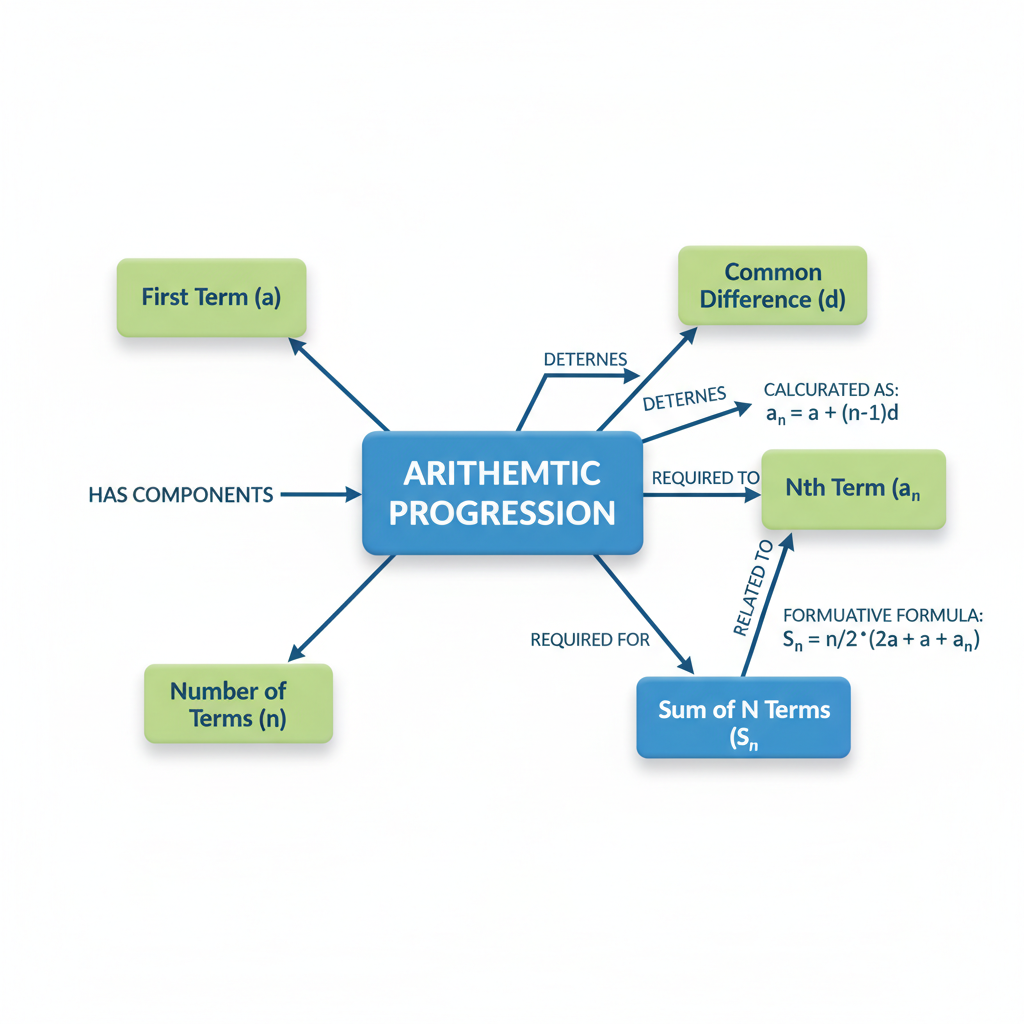 ⚠️ This picture may have spelling mistakes. Trust the words in the lesson.
Building the Formula for the Nth Term (aₙ): Our Magic Key!
Let's see how the terms in an AP relate to each other:
- The 1st term is
a₁ - The 2nd term (
a₂) isa₁ + d(You added 'd' once) - The 3rd term (
a₃) isa₂ + d, which is(a₁ + d) + d = a₁ + 2d(You added 'd' twice) - The 4th term (
a₄) isa₃ + d, which is(a₁ + 2d) + d = a₁ + 3d(You added 'd' three times)
Do you see a pattern emerging? The number of times 'd' is added is always one less than the term's position ('n').
- For the 2nd term (n=2), we add 'd' (2-1)=1 time.
- For the 3rd term (n=3), we add 'd' (3-1)=2 times.
- For the 4th term (n=4), we add 'd' (4-1)=3 times.
Aha! This leads us to our powerful formula:
The Nth Term Formula: aₙ = a₁ + (n - 1)d
Let's break down this formula one more time:
aₙ: This is the term you want to find (the value at the 'nth' position).a₁: This is the very first term of your sequence.n: This is the position of the term you're looking for (e.g., 5th, 10th, 50th).d: This is the common difference between consecutive terms.
Analogy: Think of this formula as a recipe. You put in the starting ingredient (a₁), how many 'jumps' you need to make (n-1), and the size of each jump (d), and out comes the final value (aₙ).
Let's Put the Formula to Work! (Examples)
Example 1: Finding a Specific Term
Problem: Find the 7th term of the Arithmetic Progression: 3, 7, 11, 15, ...
Step-by-step Solution:
-
Identify a₁ (First Term): The first number in the sequence is 3. So,
a₁ = 3.Analogy: Your starting point is 3.
-
Identify d (Common Difference): Subtract any term from its successor.
7 - 3 = 411 - 7 = 415 - 11 = 4The common difference is 4. So,d = 4.Analogy: Each 'jump' adds 4.
-
Identify n (Position of the Term): We want the 7th term. So,
n = 7.Analogy: We want to know the value at the 7th position.
-
Apply the Formula:
aₙ = a₁ + (n - 1)dSubstitute the values:a₇ = 3 + (7 - 1) * 4 -
Calculate:
a₇ = 3 + (6) * 4a₇ = 3 + 24a₇ = 27
So, the 7th term of the AP is 27.
Example 2: Finding the Position of a Term
Problem: Which term in the AP: 5, 8, 11, 14, ... is 32?
Step-by-step Solution:
-
Identify a₁:
a₁ = 5. -
Identify d:
8 - 5 = 3. So,d = 3. -
Identify aₙ: We are given that the term is 32. So,
aₙ = 32. -
Apply the Formula:
aₙ = a₁ + (n - 1)dSubstitute the values:32 = 5 + (n - 1) * 3 -
Solve for n:
32 - 5 = (n - 1) * 327 = (n - 1) * 3Divide both sides by 3:27 / 3 = n - 19 = n - 1Add 1 to both sides:n = 9 + 1n = 10
So, 32 is the 10th term of this AP.
Summary: Your Toolkit for APs
Remember, an Arithmetic Progression is all about consistent change. Just like a clock keeps ticking at regular intervals or a stack of plates grows by the same height with each new plate, APs follow a simple, predictable pattern. The 'nth term' formula is your superpower to navigate these patterns, letting you find any term you need, no matter how far along the sequence it is, without having to list them all out!
Keep practicing with these concepts, and you'll find Arithmetic Progressions become incredibly intuitive and useful in solving many real-world problems.
Keep learning, free
Create a free Syllabax account to unlock practice questions and games for this topic.
Visual Learning Enhanced! 🚀
To help you master this topic, we use Advanced Syllabax AI to generate detailed diagrams and visual models.
Note on Visuals: The AI sometimes makes spelling errors in image labels. Please refer to the lesson text for the correct terminology.