Climate Systems: Cyclones, Anticyclones, Jet Streams -World Geography
Watch this topic in 60 seconds
Free preview · Lesson 1
Climate Systems: Cyclones, Anticyclones, Jet Streams -World Geography (Foundational)
Climate Systems: Cyclones, Anticyclones, and Jet Streams
Welcome to a foundational lesson on three important climate systems: cyclones, anticyclones, and jet streams. Understanding these systems helps us understand weather patterns around the world.
Cyclones: Spinning Storms
A cyclone is a large-scale air mass that rotates around a strong center of low atmospheric pressure. Air spirals inwards towards the center. In the Northern Hemisphere, cyclones rotate counter-clockwise; in the Southern Hemisphere, they rotate clockwise. Cyclones are often associated with bad weather, including strong winds, heavy rain, and thunderstorms.
Think of a drain in a sink. As the water goes down the drain, it spirals. A cyclone is like that, but much bigger and in the air! The 'drain' is the area of low pressure.
Anticyclones: Areas of High Pressure
An anticyclone is the opposite of a cyclone. It is a large-scale air mass that rotates around a center of high atmospheric pressure. Air spirals outwards away from the center. In the Northern Hemisphere, anticyclones rotate clockwise; in the Southern Hemisphere, they rotate counter-clockwise. Anticyclones are usually associated with calm, clear weather.
Imagine a hill. Air is flowing *down* the hill and spreading out. This is similar to how air moves away from the high pressure in an anticyclone, leading to stable weather conditions.
Jet Streams: Rivers of Air
Jet streams are fast-flowing, narrow, meandering air currents in the atmosphere. They are found at high altitudes, usually between 30,000 and 50,000 feet. Jet streams are caused by the temperature difference between the poles and the equator. They play a significant role in determining weather patterns because they can push air masses around.
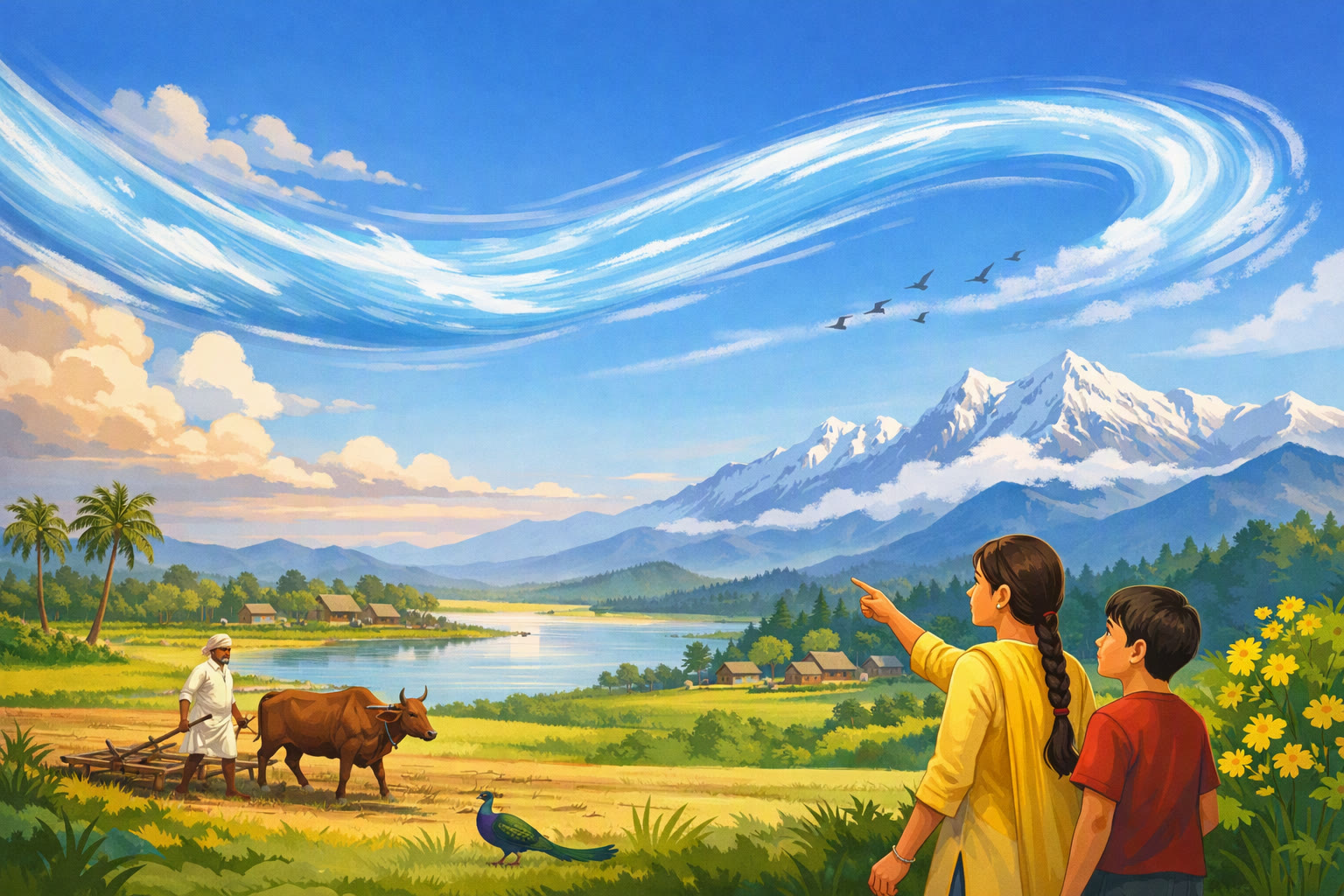
Think of a river flowing high in the sky. That's a jet stream! This 'river' of air pushes weather systems (like cyclones and anticyclones) around, affecting the weather we experience on the ground.
Keep learning, free
Create a free Syllabax account to unlock practice questions and games for this topic.
Visual Learning Enhanced! 🚀
To help you master this topic, we use Advanced Syllabax AI to generate detailed diagrams and visual models.
Note on Visuals: The AI sometimes makes spelling errors in image labels. Please refer to the lesson text for the correct terminology.