Formation of shadows (Light & Shadow)
Watch this topic in 60 seconds
Free preview · Lesson 1
Understanding Formation of shadows (Light & Shadow)
Understanding Shadows: Light's Playful Hide-and-Seek!
Hello, young explorers! Have you ever noticed that mysterious dark shape that follows you around on a sunny day? Or perhaps you've seen the funny, stretched-out shape of a tree on the ground? Those mysterious shapes are called shadows! Today, we're going on an exciting adventure to discover how these cool, dark outlines are formed. It's like solving a fun puzzle with light!
What is Light? Our Invisible Helper!
Before we can understand shadows, we first need to understand their best friend (and sometimes, their 'bossy' friend!): Light. Imagine light as tiny, super-fast messengers or invisible energy bullets that zoom everywhere! Light is a form of energy that helps us see the world around us. Without light, everything would be completely dark, and we wouldn't be able to see colors, shapes, or even our own hands!
- Where does light come from? Light comes from 'light sources.' The biggest and most important light source for Earth is our Sun! But we also have light sources like lamps, flashlights, candles, and even tiny fireflies.
- How does light travel? This is super important for shadows! Light doesn't wiggle or curve like a snake. Instead, it travels in a perfectly straight line, like a laser beam or a superhero flying directly to its destination. It doesn't bend around corners unless something makes it!
Meet the Objects: Light Blockers!
Now that we know about light, let's talk about the things that interact with light – objects. An object is anything that takes up space, like you, your desk, a ball, or a tree. When light meets an object, one of three things usually happens:
- Transparent Objects: These are like clear windows or clean eyeglasses. Light can pass right through them, almost as if they aren't even there! You can see clearly through transparent objects.
- Translucent Objects: Imagine a frosted bathroom window or a thin piece of tracing paper. Light can pass through these, but it gets scattered or blurred. You can see light, but not clear shapes, through translucent objects.
- Opaque Objects: Ah, these are the stars of our shadow story! An opaque object is like a thick brick wall, a book, or your own body. Light cannot pass through opaque objects at all. They block the light completely!
Analogy Time: Think of light as tiny water droplets from a shower head. Transparent objects are like a clear shower curtain – the water goes right through. Translucent objects are like a slightly foggy shower curtain – some water gets through, but it's not clear. Opaque objects are like a solid wall – no water gets through at all!
The Big Secret: How Shadows Are Formed!
Ready for the magic trick? Shadows are formed when an opaque object blocks the path of light. Remember how light travels in straight lines? Well, when those straight lines of light hit an opaque object, they can't go through it. It's like a traffic jam for light!
Because the light can't pass through the opaque object, there's a space behind the object where the light can't reach. This 'no-light zone' is what we see as a shadow! The shadow is simply the absence of light on a surface behind the object.
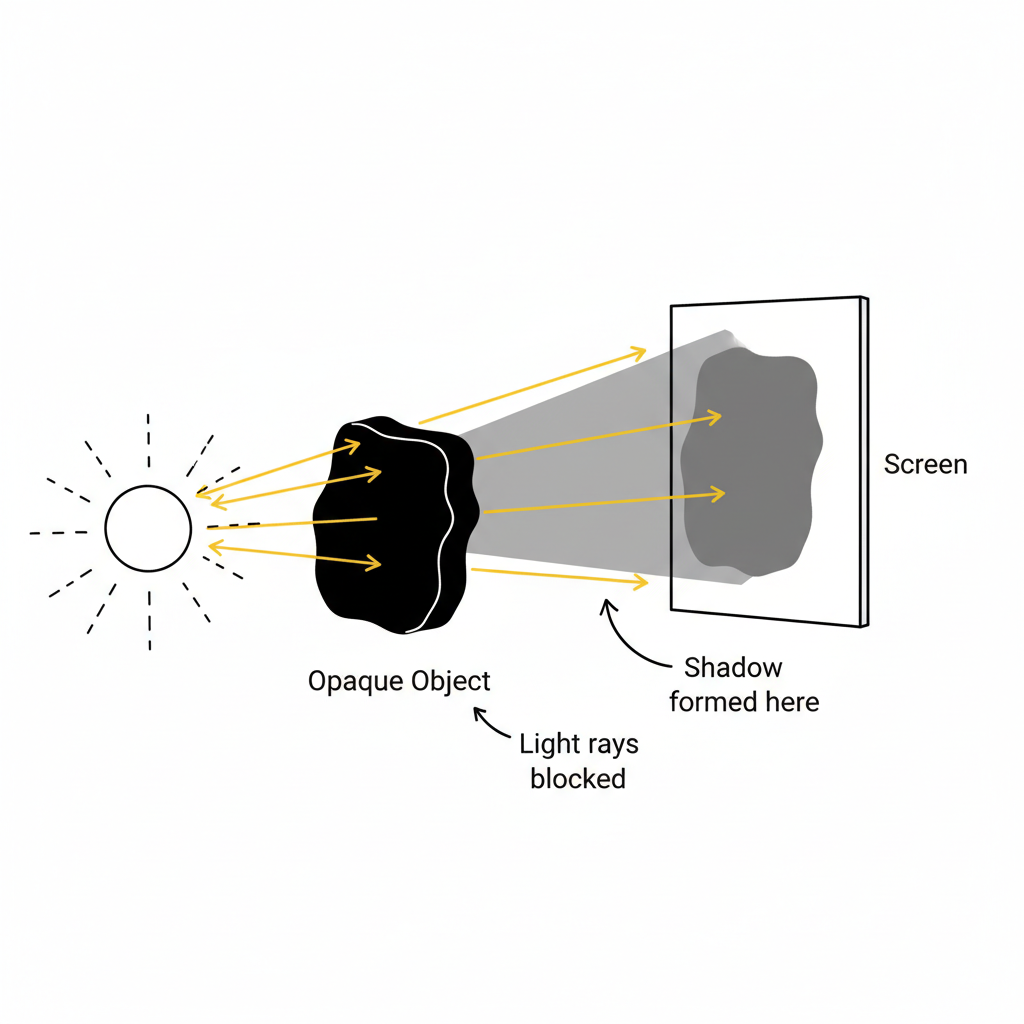
The Three Must-Haves for a Shadow:
To make a shadow, you always need three things, like ingredients for a special recipe:
- A Source of Light: You need light to begin with! (e.g., the Sun, a flashlight, a lamp)
- An Opaque Object: You need something to block the light. (e.g., your hand, a tree, a book)
- A Surface (or Screen): You need somewhere for the shadow to appear. This could be the ground, a wall, or a piece of paper.
If you take away any one of these, you won't have a shadow!
Shadow's Shape and Size: A Changing Mystery!
Have you noticed that shadows can change? They don't always stay the same size or shape!
-
Shadow Shape: A shadow usually looks like the shape of the object that is blocking the light. If you hold up your hand, your shadow looks like your hand! But it can look a bit stretched or squashed depending on the angle of the light.
-
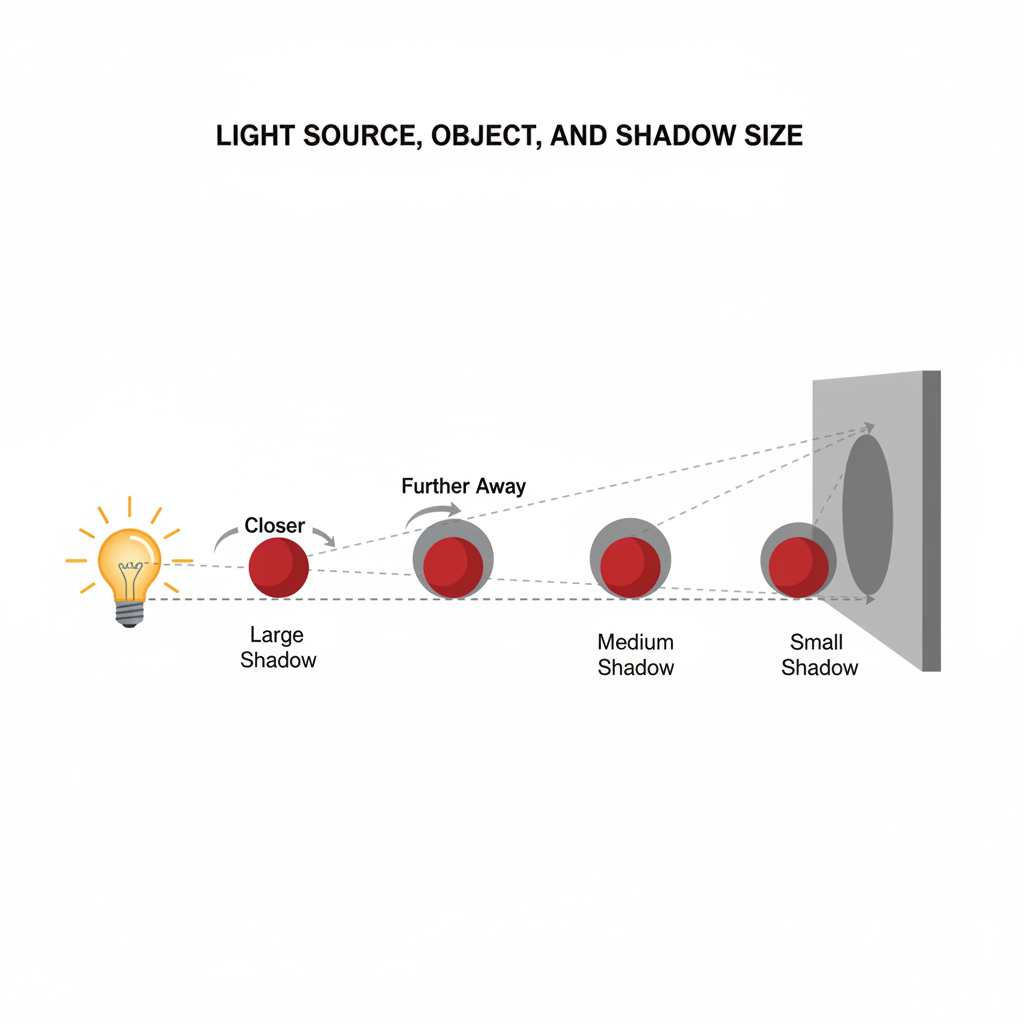
Shadow Size: This is where it gets really interesting! The size of a shadow depends on two main things:
- How close the object is to the light source: If you move an object closer to the light source, its shadow gets BIGGER. If you move it further away from the light source, its shadow gets SMALLER.
- How close the object is to the surface (screen): If the object is closer to the surface where the shadow appears, the shadow will be SHARPER and a bit smaller. If the object is further from the surface, the shadow will be bigger and a bit blurrier.
Analogy Time: Think about making hand puppets with a flashlight on a wall! When you move your hand closer to the flashlight, the shadow puppet on the wall gets huge! When you move your hand closer to the wall, the shadow gets smaller and sharper.
Shadows All Around Us!
Now that you know the secret, you'll start seeing shadows everywhere! Look for your own shadow when you walk outside on a sunny day. Watch how it changes length as the Sun moves across the sky. See the shadows of trees, buildings, and cars. Shadows are a natural and fun part of our world, always reminding us about the amazing way light travels and interacts with objects!
So, the next time you see a shadow, you'll know it's not a mysterious monster following you, but just light playing hide-and-seek with an opaque object!
Keep learning, free
Create a free Syllabax account to unlock practice questions and games for this topic.
Visual Learning Enhanced! 🚀
To help you master this topic, we use Advanced Syllabax AI to generate detailed diagrams and visual models.
Note on Visuals: The AI sometimes makes spelling errors in image labels. Please refer to the lesson text for the correct terminology.