Digestive system[BIOLOGY]
Watch this topic in 60 seconds
Free preview · Lesson 1
Understanding Digestive system[BIOLOGY]
The Amazing Journey of Food: Understanding Your Digestive System
Imagine your body as a busy factory, and the food you eat as the raw materials that keep it running smoothly. The digestive system is like the factory's processing plant, breaking down these raw materials into tiny, usable parts so your body can get the energy and nutrients it needs to grow, play, and learn. Let's embark on this incredible journey!
What is Digestion?
Digestion is the process of breaking down the food we eat into smaller molecules that our body can absorb and use for energy, growth, and repair. Think of it like taking a big Lego castle and breaking it down into individual Lego bricks. Each brick is small enough to be used to build something new!
The Digestive Tract: A Long and Winding Road
The digestive tract, also called the gastrointestinal (GI) tract, is a series of hollow organs that form a continuous tube from your mouth to your anus. It's like a long waterslide for your food! Along this waterslide, different stations perform important jobs.
1. The Mouth: The Starting Gate
Your digestive journey begins the moment you take a bite of food.
- Teeth: These are like little hammers, breaking down the food into smaller pieces. This is called mechanical digestion.
- Saliva: This watery liquid, produced by your salivary glands, acts like a lubricant, making the food easier to swallow. It also contains special chemicals (enzymes) that start to break down some of the food, especially carbohydrates (like bread or pasta). This is chemical digestion. Think of saliva as a gentle pre-wash cycle.
2. The Esophagus: The Food Chute
Once you swallow, the food travels down a muscular tube called the esophagus. It's like a flexible pipe that pushes the food down towards your stomach. This pushing action is called peristalsis, and it happens even if you're upside down!
3. The Stomach: The Mixing Bowl
The stomach is a J-shaped organ that acts like a powerful blender. It churns the food with strong muscles and mixes it with digestive juices. These juices are very acidic, like strong cleaning agents, and they help to break down proteins (found in meat, beans, and eggs). The food stays here for a few hours, turning into a thick, soupy mixture called chyme.
4. The Small Intestine: The Nutrient Absorber
This is where the real magic happens! The small intestine is a long, coiled tube (about 20 feet long in adults – that’s longer than a school bus!). Here, the chyme from the stomach is mixed with more digestive juices from the pancreas and liver. These juices break down fats, carbohydrates, and proteins into the smallest possible units.
Imagine the small intestine's inner walls are covered with tiny fingers called villi. These villi are like sponges, soaking up all the good nutrients from the digested food into your bloodstream. Your blood then carries these nutrients to all the cells in your body.
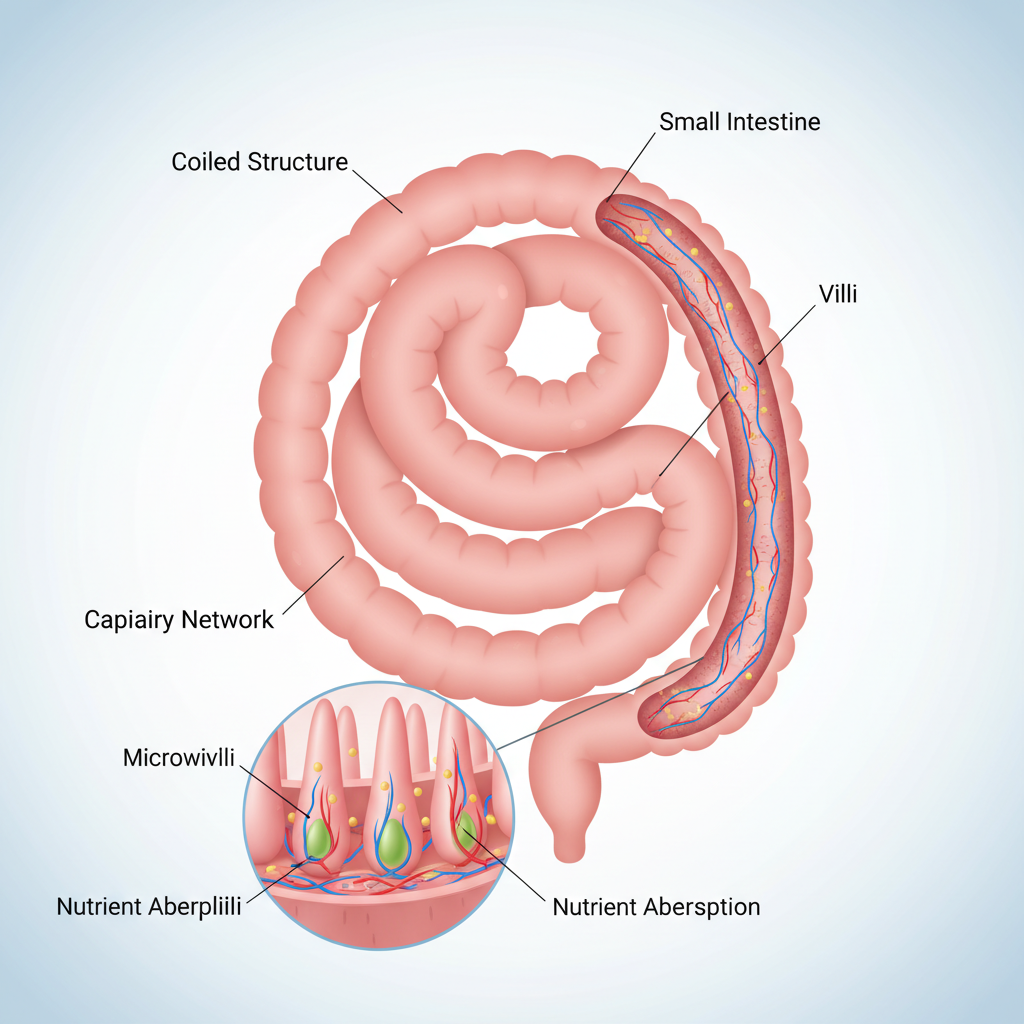 ⚠️ This picture may have spelling mistakes. Trust the words in the lesson.
5. The Large Intestine: The Water Recycler
Whatever food wasn't digested or absorbed in the small intestine moves into the large intestine. Its main job is to absorb water from the leftover material. Think of it as a water filter, reclaiming valuable water for your body. The remaining waste material, called feces, is then formed.
6. The Rectum and Anus: The Exit Door
The rectum is the final section of the large intestine, where feces are stored until they are eliminated from the body through the anus.
Accessory Organs: The Helpful Friends
While not part of the tube itself, these organs play a crucial role in digestion:
- Liver: Produces bile, a liquid that helps break down fats. Think of bile as dish soap that cuts through grease!
- Gallbladder: Stores bile and releases it into the small intestine when needed. It's like a small bile reservoir.
- Pancreas: Produces digestive enzymes that break down carbohydrates, proteins, and fats, and also makes important hormones like insulin. It's like a multi-tool for digestion.
Why is Digestion Important?
Without digestion, your body wouldn't be able to get the energy it needs to run, jump, think, and grow. It wouldn't get the building blocks (nutrients) to repair itself or make new cells. So, the next time you eat, remember the amazing journey your food is taking inside you!
Keep learning, free
Create a free Syllabax account to unlock practice questions and games for this topic.
Visual Learning Enhanced! 🚀
To help you master this topic, we use Advanced Syllabax AI to generate detailed diagrams and visual models.
Note on Visuals: The AI sometimes makes spelling errors in image labels. Please refer to the lesson text for the correct terminology.