Pythagoras theorem & converse (Triangle)
Watch this topic in 60 seconds
Free preview · Lesson 1
Understanding Pythagoras theorem & converse (Triangle)
The Magical Math of Right-Angled Triangles: Pythagoras Theorem & Its Converse!
Welcome, Young Architects and Detectives! Ever wondered how builders ensure corners are perfectly square, or how people calculate distances they can't directly measure? Today, we're diving into one of the oldest and most useful secrets of geometry: the Pythagoras Theorem and its amazing converse! Think of it as a special rulebook for a very specific type of triangle. This foundational concept will unlock a new way of seeing shapes and spaces around you.
Part 1: Meeting the Right-Angled Triangle
Before we jump into the theorem, let's make sure we're best friends with our star player: the right-angled triangle. Imagine the perfect corner of a square room or the intersection of a vertical wall and a flat floor – that's a 90-degree angle. A right-angled triangle is simply a triangle that contains one of these exact 90-degree angles.
Key Players (The Sides of a Right-Angled Triangle):
- The Hypotenuse (pronounced: hy-POT-uh-noose): This is the superstar of the triangle! It's always the longest side, and it's always positioned directly opposite the 90-degree angle. Think of it like the longest slide at a playground; you'd always find it stretching away from the main structure (the right angle). We often label this side 'c'.
- The Legs (or Cathetus): These are the two shorter sides that meet to form the 90-degree angle. They're like the two walls that perfectly meet at the corner of a room. We usually label these sides 'a' and 'b'.
Analogy: Picture a ladder leaning against a straight wall on flat ground. The ground, the wall, and the ladder form a right-angled triangle! The ground and the wall are the 'legs', and the ladder itself is the 'hypotenuse' – always the longest path connecting the top of the wall to the base on the ground.
Part 2: Unveiling the Pythagoras Theorem (The Special Rule for Right Triangles)
This theorem, named after the ancient Greek mathematician Pythagoras, gives us a powerful relationship between the lengths of the sides of any right-angled triangle.
The Big Idea:
The theorem states that in any right-angled triangle, the square of the length of the hypotenuse (c) is equal to the sum of the squares of the lengths of the other two sides (a and b).
The Magical Formula:
a² + b² = c²
Let's break down what a² (read as "a squared") means: It simply means a * a (the number 'a' multiplied by itself). If 'a' is 3 units long, then a² is 9 (3 * 3). Think of a² as the area of a perfect square whose side length is 'a'.
Analogy: Imagine you build a perfect square on each side of a right-angled triangle. The area of the square built on the hypotenuse will exactly equal the combined areas of the squares built on the two shorter sides! It's like having two small square pizzas (representing the areas of a² and b²) that perfectly combine to make one big square pizza (representing the area of c²)!
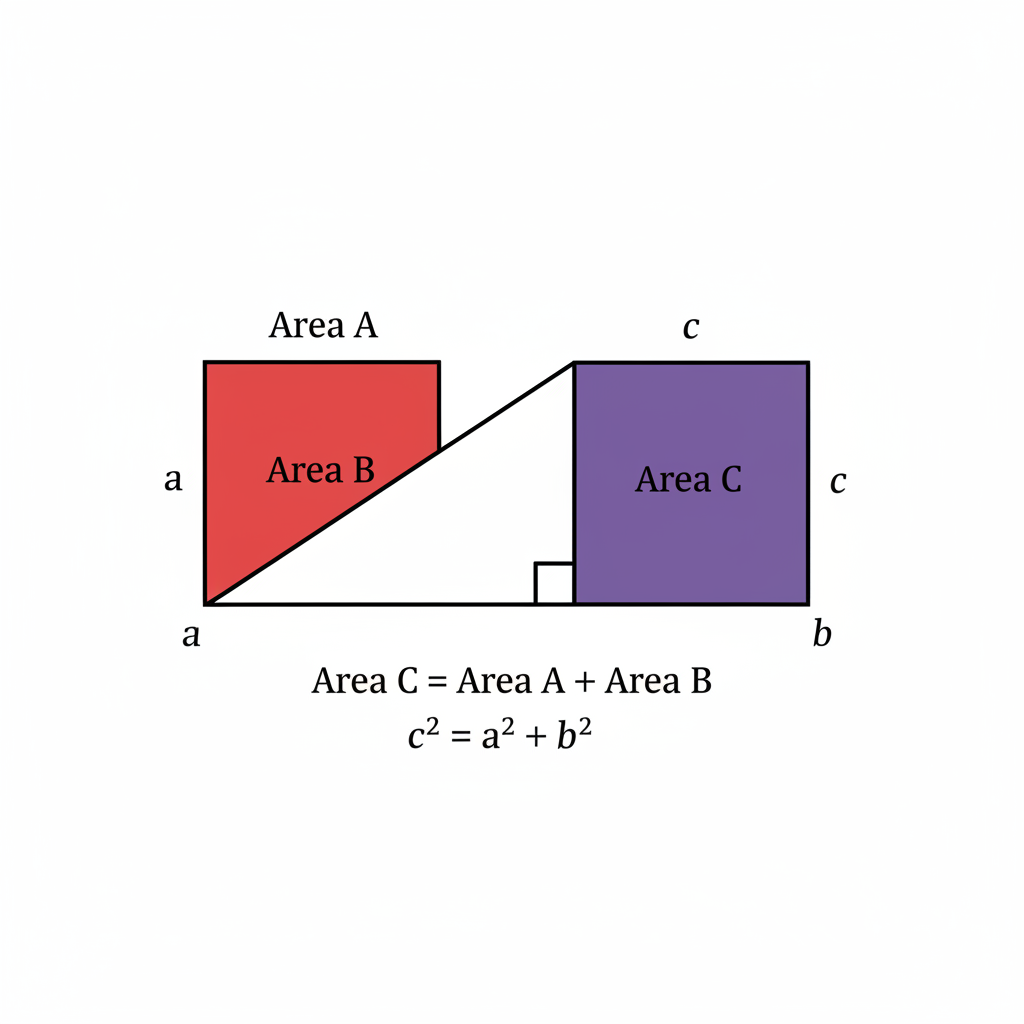 ⚠️ This picture may have spelling mistakes. Trust the words in the lesson.
How to Use It (Finding a Missing Side):
The Pythagoras Theorem is your go-to tool when you know two sides of a right-angled triangle and need to find the third.
Example 1: Finding the Hypotenuse
You have a right-angled triangle. One leg (a) is 3 cm, and the other leg (b) is 4 cm. What is the length of the hypotenuse (c)?
- Write down the formula:
a² + b² = c² - Substitute the known values:
3² + 4² = c² - Calculate the squares:
9 + 16 = c² - Add them up:
25 = c² - To find 'c', take the square root of 25:
c = √25 - Result:
c = 5cm.
Analogy: If you walk 3 blocks east and then 4 blocks north, the straight-line distance (the 'as-the-crow-flies' path) from your starting point to your ending point is exactly 5 blocks!
Example 2: Finding a Leg
You know the hypotenuse (c) of a right-angled triangle is 10 cm and one leg (a) is 6 cm. What is the length of the other leg (b)?
- Write down the formula:
a² + b² = c² - Substitute the known values:
6² + b² = 10² - Calculate the squares:
36 + b² = 100 - Isolate b² by subtracting 36 from both sides:
b² = 100 - 36 - Simplify:
b² = 64 - To find 'b', take the square root of 64:
b = √64 - Result:
b = 8cm.
Part 3: The Clever Converse of Pythagoras Theorem (Being a Triangle Detective!)
The original Pythagoras Theorem *starts* with a right-angled triangle and *tells you* about its sides. The Converse of Pythagoras Theorem works in reverse! It *starts* with the side lengths of any triangle and *helps you find out* if it's a right-angled triangle! It's like being a detective, looking at the clues (the side lengths) to deduce the truth about the triangle's angles.
The Idea:
If, in any triangle, the square of the longest side is equal to the sum of the squares of the other two sides, then the triangle must be a right-angled triangle. The angle opposite the longest side will be the 90-degree angle.
The Rule:
If for a triangle with sides a, b, and c (where c is the longest side), the equation a² + b² = c² holds true, then the triangle is a right-angled triangle. If it doesn't hold true, then it's not a right-angled triangle.
Analogy: Imagine you're given three sticks of specific lengths. You arrange them to form a triangle. How can you tell if it makes a perfect square corner without using a protractor? Just check if the square of the longest stick's length equals the sum of the squares of the other two! If it does, voilà, you've got a hidden right angle! If not, it's just a regular triangle that doesn't have a 90-degree corner.
How to Use It (Checking for a Right Angle):
Example 1: Is it a Right-Angled Triangle?
You have a triangle with sides 7 cm, 24 cm, and 25 cm. Is it a right-angled triangle?
- Identify the longest side: 25 cm (This will be 'c' if it's a right triangle).
- Identify the other two sides: 7 cm ('a') and 24 cm ('b').
- Check if
a² + b² = c²: - Calculate `a² + b²`:
7² + 24² = 49 + 576 = 625 - Calculate `c²`:
25² = 625 - Compare the results: Since
625 = 625, the equation holds true! - Conclusion: YES, this is a right-angled triangle! The 90-degree angle is opposite the 25 cm side.
Example 2: Is it NOT a Right-Angled Triangle?
A triangle has sides 6 cm, 8 cm, and 9 cm. Is it a right-angled triangle?
- Identify the longest side: 9 cm (This is our 'c' candidate).
- Identify the other two sides: 6 cm ('a') and 8 cm ('b').
- Check if
a² + b² = c²: - Calculate `a² + b²`:
6² + 8² = 36 + 64 = 100 - Calculate `c²`:
9² = 81 - Compare the results: Since
100 ≠ 81(100 is not equal to 81), the equation does not hold true. - Conclusion: NO, this is NOT a right-angled triangle. It might be an acute or obtuse triangle, but certainly not a right-angled one.
Part 4: Real-World Superpowers of Pythagoras!
The Pythagoras Theorem isn't just a math concept in a textbook; it's a fundamental principle used every day in countless professions and situations:
- Construction & Architecture: Carpenters and engineers use it constantly to ensure walls are perfectly vertical, corners are square, and roofs have the correct pitch. Imagine building a house with crooked corners – a nightmare!
- Navigation: Sailors and pilots use Pythagorean calculations to determine distances, plot courses, and calculate positions, especially when dealing with two-dimensional movement.
- Art and Design: Artists and designers use it for perspective, creating balanced compositions, and scaling images accurately.
- Sports: Ever wondered how a baseball player calculates the throw from the outfield to home plate, or how a snooker player plans their shots? The underlying geometry often involves right triangles.
- Surveying: Land surveyors use it to measure distances between points that are difficult to access directly, like across a lake or through dense forest.
Analogy: Pythagoras theorem is like a fundamental building block, a secret tool in the toolkit of anyone who needs precision in shapes and measurements. It helps us understand the structure of the world around us, from the smallest diagram to the largest building.
Conclusion
You've now mastered the Pythagoras Theorem and its Converse! You can find missing sides in right-angled triangles and even determine if a triangle *is* a right-angled triangle just by looking at its side lengths. This powerful knowledge will serve you well in future math courses, science, and many real-world applications. Keep practicing, and you'll soon be a geometry wizard, spotting right triangles everywhere you go!
Keep learning, free
Create a free Syllabax account to unlock practice questions and games for this topic.
Visual Learning Enhanced! 🚀
To help you master this topic, we use Advanced Syllabax AI to generate detailed diagrams and visual models.
Note on Visuals: The AI sometimes makes spelling errors in image labels. Please refer to the lesson text for the correct terminology.