Learning Journey
Watch this topic in 60 seconds
Free preview · Lesson 1
Understanding Diffusion, evaporation, sublimation[CHEMISTRY]
Diffusion, Evaporation, and Sublimation: The Invisible Movers
Welcome to the fascinating world of tiny particles and their constant motion! Today, we're going to explore three important processes that happen all around us, even when we can't see them: diffusion, evaporation, and sublimation. These processes are all about how matter changes and moves, driven by the energy of molecules.
What are Molecules and Why Do They Move?
Everything you see, touch, and even breathe is made up of incredibly small building blocks called molecules. Think of molecules like tiny, energetic LEGO bricks that make up everything in the universe. These LEGO bricks are never still; they are always jiggling, bouncing, and moving around. This constant movement is called kinetic energy.
The higher the temperature, the more energy these molecules have, and the faster they move. Imagine a room full of hyperactive kids – the hotter it is (like after a sugar rush!), the more they'll run around. The cooler it is, the more they'll huddle together and move slowly.
Diffusion: Spreading Out Like Perfume
Diffusion is the process where molecules spread out from an area where they are highly concentrated (lots of them) to an area where they are less concentrated (fewer of them). Think of it as molecules trying to find more space to wiggle and jiggle.
Analogy 1: The Popcorn Party
Imagine you pop a bag of popcorn in one corner of a large room. At first, all the yummy popcorn smell is concentrated in that one corner. But after a little while, the smell starts to spread throughout the entire room. The tiny particles that make up the popcorn smell are like our molecules, and they are diffusing from where there are many of them (near the popcorn) to where there are fewer of them (all over the room).
Analogy 2: Sugar in Tea
If you put a sugar cube into a cup of hot tea and don't stir it, the sugar doesn't disappear instantly. However, over time, the sugar molecules will slowly dissolve and spread out through the tea until the whole cup of tea tastes sweet. The sugar molecules are diffusing from the concentrated cube into the less concentrated water.
Key Features of Diffusion:
- It happens in gases, liquids, and even solids (though much slower in solids).
- It's a passive process – it doesn't require any extra energy input from us. The molecules' own kinetic energy drives it.
- It continues until the molecules are evenly spread out, reaching a state of equilibrium.
Evaporation: From Liquid to Gas, Like Drying Clothes
Evaporation is the process where a liquid turns into a gas (also called vapor). This happens when the molecules in a liquid gain enough energy to break free from their neighbors and float away into the air.
Analogy 1: Drying Laundry Outside
When you hang wet clothes on a clothesline on a sunny day, they eventually dry. The water in the clothes is turning into water vapor and mixing with the air. The sun provides the energy (heat) to make the water molecules move faster, allowing them to escape the liquid and become a gas.
Analogy 2: Puddles Disappearing After Rain
After it rains, you often see puddles on the ground. If it's not raining anymore, these puddles will eventually disappear. The water molecules at the surface of the puddle are absorbing energy from the sun or the air, speeding up, and escaping into the atmosphere as water vapor.
Key Features of Evaporation:
- It's a surface phenomenon – it only happens at the surface of the liquid.
- It can happen at any temperature below the boiling point, but it happens faster when it's warmer, windier, or there's less humidity (dry air).
- It causes cooling. As the most energetic molecules escape, the remaining liquid has less average kinetic energy, making it feel cooler. Think about how sweat cools you down!
Difference from Boiling: While both evaporation and boiling turn a liquid into a gas, evaporation happens at the surface at any temperature, whereas boiling happens throughout the entire liquid when it reaches a specific temperature (the boiling point).
Sublimation: The Solid That Becomes a Gas, Like Dry Ice
Sublimation is a bit like magic! It's the process where a solid turns directly into a gas, without becoming a liquid first.
Analogy 1: Dry Ice at a Party
Have you ever seen “fog” coming from a spooky Halloween decoration or a special effect at a concert? That fog is often made from dry ice, which is solid carbon dioxide. Dry ice doesn't melt into a puddle of liquid; instead, it turns straight into invisible carbon dioxide gas.
Analogy 2: Frost on a Cold Day
On a very cold, dry day, you might notice that frost on the ground or on a window seems to get thinner and eventually disappear, even if the temperature never gets above freezing. The ice crystals (solid water) are sublimating directly into water vapor (gas).
Analogy 3: Mothballs
Old-fashioned mothballs are made of a solid chemical that slowly turns into a gas, which repels moths. This gas then spreads through the air via diffusion.
Key Features of Sublimation:
- It skips the liquid phase.
- It requires energy to happen, similar to evaporation.
- Substances like dry ice (solid CO2) and iodine are well-known for sublimating.
Putting It All Together
These three processes – diffusion, evaporation, and sublimation – are all about molecules moving and changing their state. They are fundamental to many natural phenomena and everyday experiences, from the way smells travel to how puddles dry up.
Think of it this way:
- Diffusion is about spreading out.
- Evaporation is about liquid turning into gas.
- Sublimation is about solid turning directly into gas.
Understanding these concepts helps us appreciate the dynamic nature of matter around us!
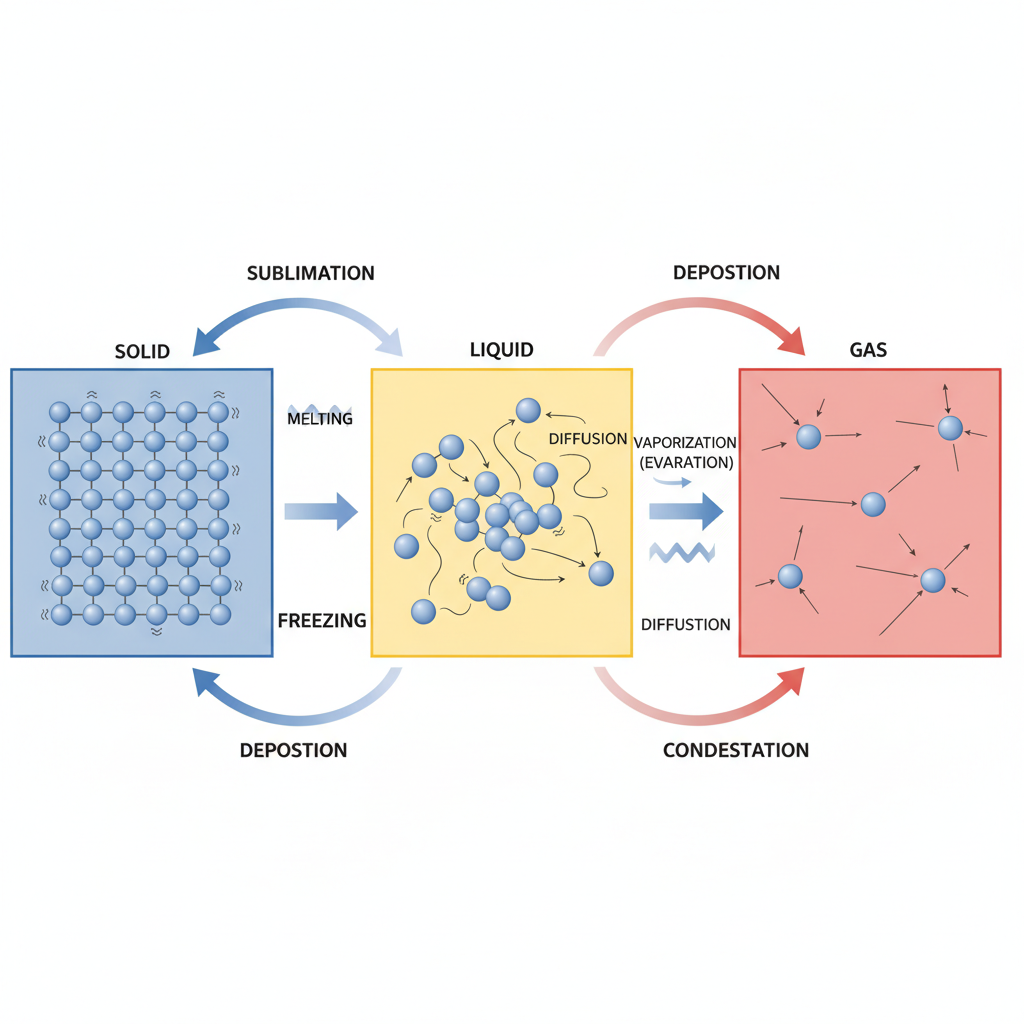 ⚠️ This picture may have spelling mistakes. Trust the words in the lesson.
Keep learning, free
Create a free Syllabax account to unlock practice questions and games for this topic.
Visual Learning Enhanced! 🚀
To help you master this topic, we use Advanced Syllabax AI to generate detailed diagrams and visual models.
Note on Visuals: The AI sometimes makes spelling errors in image labels. Please refer to the lesson text for the correct terminology.