Multi-digit addition & subtraction (Addition & Subtraction)
Watch this topic in 60 seconds
Free preview · Lesson 1
Understanding Multi-digit addition & subtraction (Addition & Subtraction)
Adding and Subtracting Big Numbers: A Super Fun Adventure!
Welcome, amazing mathematicians, to a thrilling adventure where we'll learn all about adding and subtracting big numbers! Think of numbers as collections of treasures. Addition is like putting your treasures together, and subtraction is like giving some of your treasures away. We're going to become super-duper number detectives!
What are Multi-Digit Numbers?
You've already met small numbers like 1, 2, 3, or even 10! Multi-digit numbers are just numbers that have more than one digit. For example, 12 has two digits (1 and 2), 123 has three digits (1, 2, and 3), and even bigger numbers like 5,487 have four digits!
Imagine numbers as building blocks. A single digit is like one small block. A multi-digit number is like a tower made of many blocks stacked neatly. Each block (digit) has its own special place, and this place is super important!
Understanding Place Value: The Secret Code of Numbers
Every digit in a multi-digit number has a special 'address' called its place value. This tells us how much that digit is worth. Let's look at the number 345:
- The 5 is in the ones place. It's worth 5 ones (like 5 individual candies).
- The 4 is in the tens place. It's worth 4 tens (like 4 groups of 10 candies, so 40 candies in total).
- The 3 is in the hundreds place. It's worth 3 hundreds (like 3 groups of 100 candies, so 300 candies in total).
So, 345 is really 300 + 40 + 5. Place value is like a secret code that tells us the true value of each digit.
Analogy: The Toy Box! Imagine you have a huge toy box. You can't just dump all your toys in one big pile. Instead, you have different sections: one for cars, one for dolls, one for building blocks. Place value works the same way! The ones place is for individual toys, the tens place is for bags of 10 toys, and the hundreds place is for boxes of 100 toys. This helps us organize and count our 'number toys'!
Adding Big Numbers: Putting Our Treasures Together!
Adding is like combining two piles of treasures. When we add multi-digit numbers, we use place value to help us. The most important rule is to line up the numbers so that the ones are under the ones, the tens are under the tens, and so on. This is like making sure all the cars are with the cars, and all the dolls are with the dolls, before you count them!
Adding Without Regrouping (The Easy Way!)
Let's add 23 + 14:
- Line them up:
23 + 14 ---- - Add the ones place: 3 + 4 = 7. Write 7 in the ones place below the line.
23 + 14 ---- 7 - Add the tens place: 2 + 1 = 3. Write 3 in the tens place below the line.
      23
    + 14
    ----
      37
So, 23 + 14 = 37! See? Easy peasy!
Adding With Regrouping (When We Have Too Many!)
Sometimes, when we add the digits in a place value column, we get a number that is 10 or more. This is like having 10 candies in your 'ones' bag – you need to trade them for one bag of 10!
Let's add 48 + 35:
- Line them up:
48 + 35 ---- - Add the ones place: 8 + 5 = 13. Uh oh! 13 is more than 9. We can't put '13' in the ones place. So, we take the '10' part of 13 (which is really 1 ten) and 'regroup' it, or carry it over, to the tens place. We write the '3' (the ones part of 13) below the line in the ones place.
1 <-- This is our carried-over ten 48 + 35 ---- 3 - Add the tens place (including the carried-over one): 1 (carried) + 4 + 3 = 8. Write 8 in the tens place.
       1
      48
    + 35
    ----
      83
So, 48 + 35 = 83! We regrouped the 13 ones into 1 ten and 3 ones.
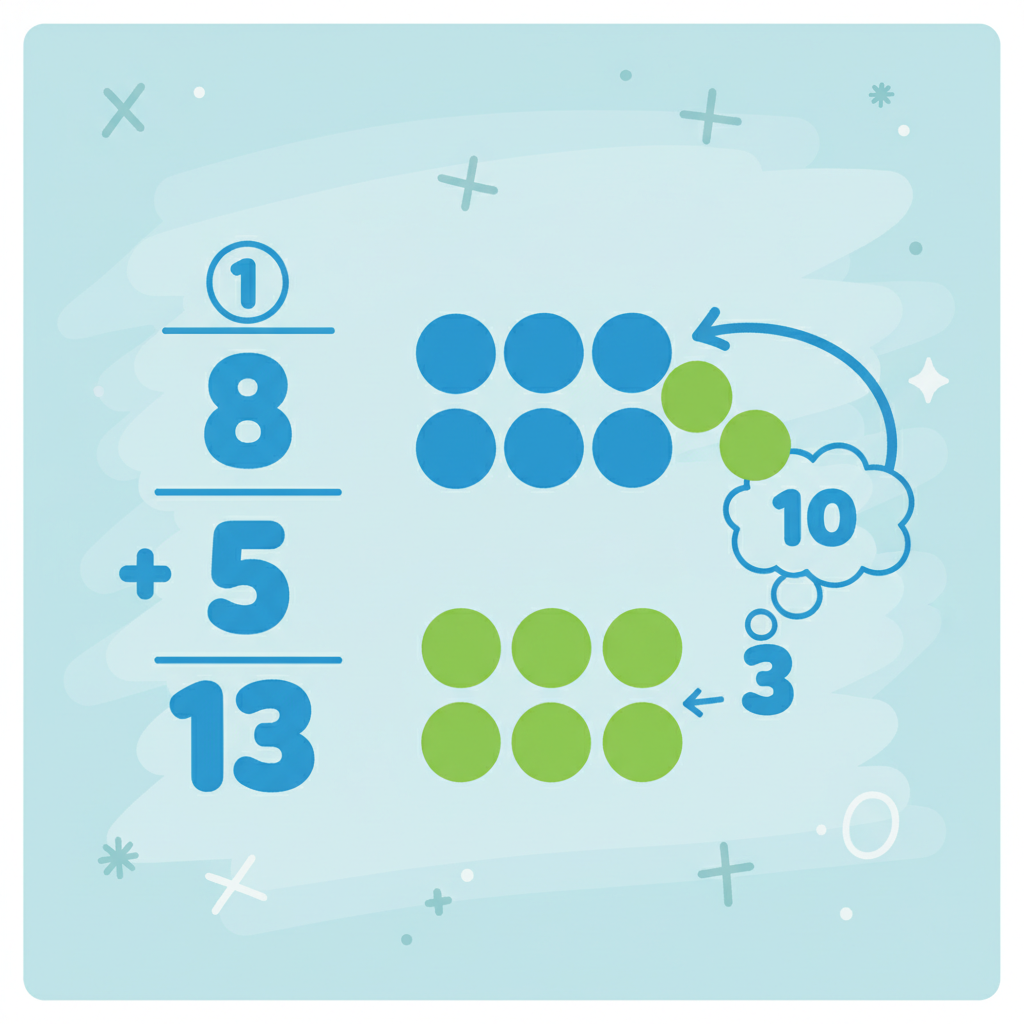
Analogy: The Candy Store! Imagine you have 8 red candies and 5 blue candies. You want to put them in bags of 10. When you put them together (8 + 5 = 13), you have enough for one full bag of 10, and 3 candies left over. You put the 3 candies in the 'ones' pile and take the full bag of 10 to the 'tens' pile. That's regrouping!
Subtracting Big Numbers: Sharing Our Treasures!
Subtraction is like taking some treasures away from a pile. Just like addition, we line up our numbers by place value. The bigger number usually goes on top.
Subtracting Without Borrowing (The Simple Way!)
Let's subtract 57 - 23:
- Line them up:
57 - 23 ---- - Subtract the ones place: 7 - 3 = 4. Write 4 in the ones place.
57 - 23 ---- 4 - Subtract the tens place: 5 - 2 = 3. Write 3 in the tens place.
      57
    - 23
    ----
      34
So, 57 - 23 = 34!
Subtracting With Borrowing (When We Don't Have Enough!)
Sometimes, the digit on top in a place value column is smaller than the digit on the bottom. This is like trying to give away 3 cookies when you only have 2! You need to 'borrow' from the next place value to get enough.
Let's subtract 72 - 45:
- Line them up:
72 - 45 ---- - Subtract the ones place: Can we subtract 5 from 2? No! We don't have enough. So, we need to borrow from the tens place. We go to the '7' in the tens place and 'borrow' 1 ten from it. This 'borrowed' ten becomes 10 ones. So, our top number's ones place changes from 2 to 12 (the original 2 plus the 10 we borrowed). The tens place on top changes from 7 to 6 (because we took 1 ten away).
6 12 <-- Our new top numbers after borrowing 7 2 - 4 5 ------- - Now subtract the ones place: 12 - 5 = 7. Write 7 in the ones place.
6 12 7 2 - 4 5 ------- 7 - Subtract the tens place: 6 - 4 = 2. Write 2 in the tens place.
       6  12
       7  2
    -  4  5
    -------
       2  7
So, 72 - 45 = 27! We borrowed 1 ten from the 7 tens to make 10 ones, giving us 12 ones to subtract from.
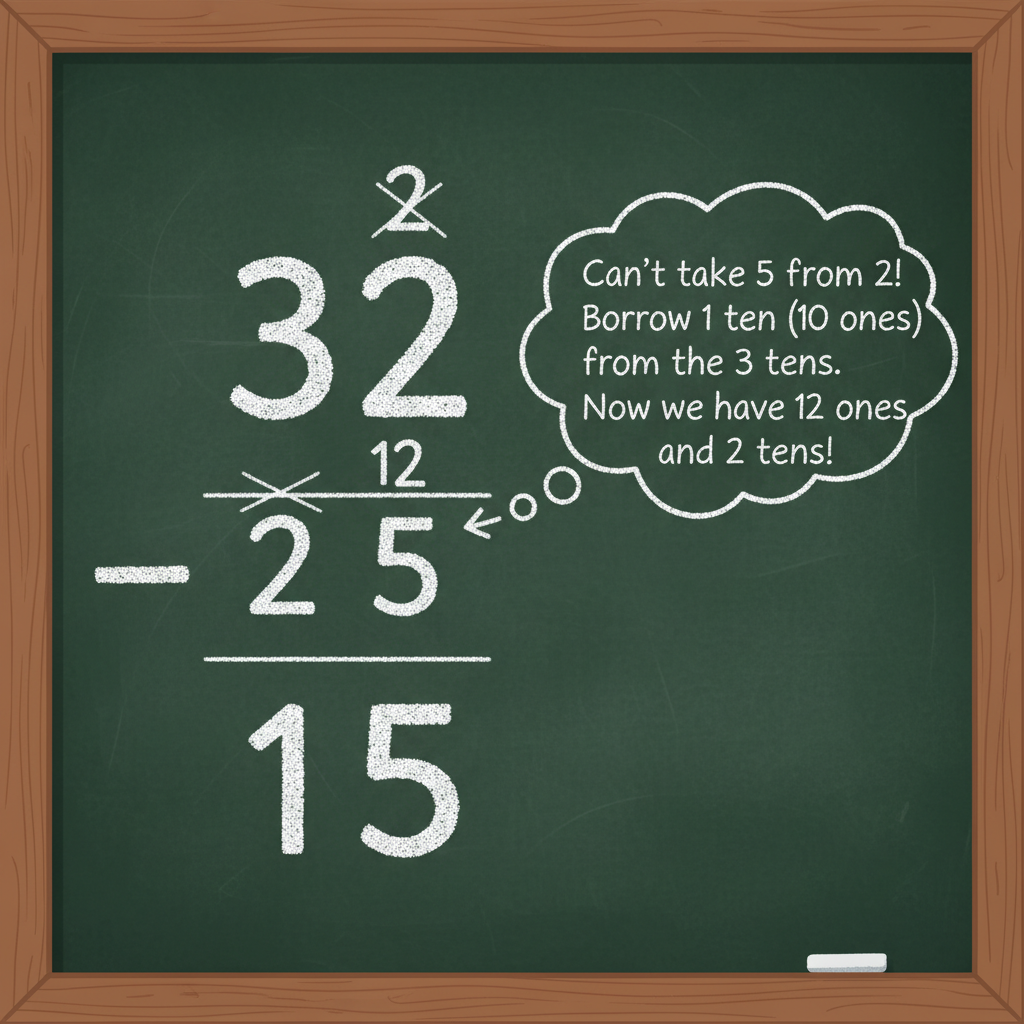
Analogy: The Cookie Jar! Imagine you have 7 bags of cookies, with 2 cookies in the first bag (total 72 cookies). You want to give away 4 bags and 5 cookies (45). When you look at the first bag, you only have 2 cookies, but you need to give away 5. So, you take one whole bag of 10 cookies from the other 6 bags and add those 10 cookies to your first bag. Now you have 12 cookies in that bag and only 6 bags left. Now you can give away 5 cookies from the 12, and you have 7 left. Then you give away the 4 bags, and you have 2 bags left. You end up with 2 bags and 7 cookies (27 cookies total)! That's borrowing!
Putting It All Together!
Adding and subtracting multi-digit numbers is all about being organized! Remember to:
- Line up your numbers by place value (ones under ones, tens under tens, etc.).
- Start with the ones place.
- Regroup (carry over) in addition if you have 10 or more in a column.
- Borrow in subtraction if the top digit is smaller than the bottom digit.
Keep practicing, and you'll be a multi-digit number master in no time!
Keep learning, free
Create a free Syllabax account to unlock practice questions and games for this topic.
Visual Learning Enhanced! 🚀
To help you master this topic, we use Advanced Syllabax AI to generate detailed diagrams and visual models.
Note on Visuals: The AI sometimes makes spelling errors in image labels. Please refer to the lesson text for the correct terminology.