Mirror & Water Images (complex shapes) – Non -Verbal Reasoning
Watch this topic in 60 seconds
Free preview · Lesson 1
Mirror & Water Images (complex shapes) – Non -Verbal Reasoning (Foundational)
Mirror & Water Images (Complex Shapes) – Non-Verbal Reasoning (Foundational)
Welcome to this lesson on mirror and water images, focusing on complex shapes. This is an important aspect of non-verbal reasoning, which tests your ability to analyze visual information and identify patterns. We will explore the fundamental principles behind these image transformations.
Understanding Mirror Images
A mirror image is a reflection of an object across a vertical line (the mirror). Imagine holding a picture up to a mirror; the image you see in the mirror is the mirror image. The key concept here is lateral inversion. The left side of the original object becomes the right side in the mirror image, and vice versa. The top and bottom remain unchanged.
To visualize this, consider a simple shape like the letter 'b'. Its mirror image would look like 'd'. For more complex shapes, mentally divide the shape into smaller parts and consider how each part would be reflected.
Understanding Water Images
A water image is a reflection of an object across a horizontal line (the surface of the water). In this case, the top and bottom of the original object are reversed, while the left and right sides remain unchanged. This is a vertical inversion.
Imagine a shape sitting on the surface of still water. The water image will appear upside down relative to the original. Again, break down complex shapes into smaller components to visualize the transformation. The letter 'p' water image would appear similar to 'b'.
Complex Shapes and Their Transformations
When dealing with complex shapes, the process remains the same but requires careful attention to detail. Look for key features and reference points within the shape and consider how these features will be positioned after the reflection.
For instance, imagine a shape that includes both curved and straight lines. Note the relative positions of these lines and how they will be inverted in both the mirror and water images.
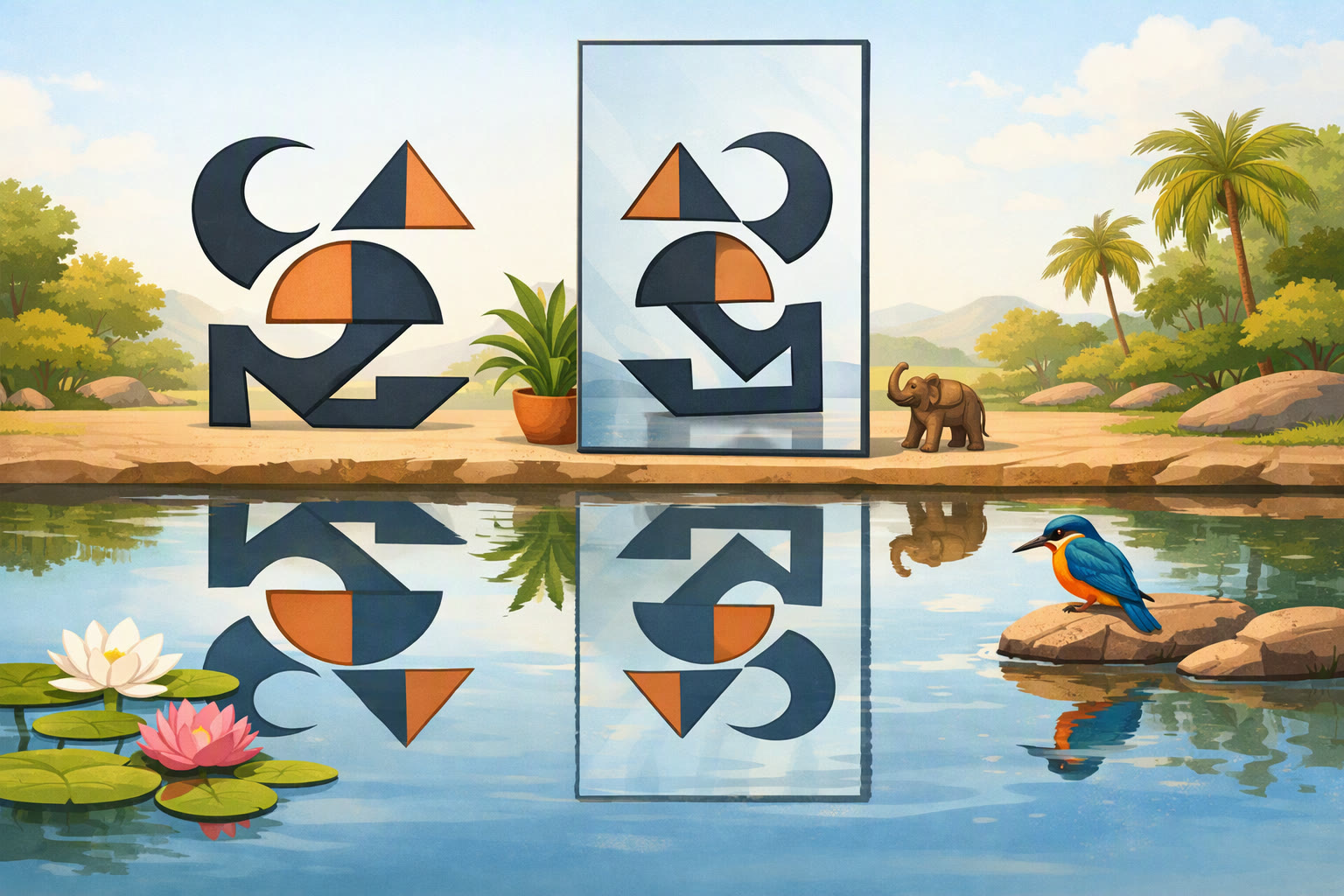
The above diagram illustrates a complex shape, along with its mirror and water images. Observe how each part of the shape is transformed in each case.
Keep learning, free
Create a free Syllabax account to unlock practice questions and games for this topic.
Visual Learning Enhanced! 🚀
To help you master this topic, we use Advanced Syllabax AI to generate detailed diagrams and visual models.
Note on Visuals: The AI sometimes makes spelling errors in image labels. Please refer to the lesson text for the correct terminology.