Regular & diffused reflection[PHYSICS]
Watch this topic in 60 seconds
Free preview · Lesson 1
Understanding Regular & diffused reflection[PHYSICS]
Understanding Reflection: Regular vs. Diffused
Hello young scientists! Today, we're going to dive into the fascinating world of light and how it bounces off surfaces. This bouncing is called reflection. You see reflection every day – in mirrors, in puddles, even in shiny spoons! But have you ever noticed that sometimes the reflection is super clear, like in a mirror, and other times it's all spread out and blurry, like looking at a wall?
That's because there are two main types of reflection: Regular Reflection and Diffused Reflection. Let's explore them!
What is Reflection?
Imagine you're playing catch with a friend. When you throw a ball, it travels in a straight line until it hits something. If it hits a wall, it bounces back, right? Light behaves in a very similar way. When light rays hit a surface, they bounce off it. This bouncing back of light is called reflection.
Think of a light ray like a tiny, speedy bouncy ball. When this light bouncy ball hits a surface, it doesn't just stop. It bounces away!
Regular Reflection: The Mirror Effect
Have you ever looked in a mirror and seen a perfect, clear image of yourself? That's regular reflection at work! Regular reflection happens when light rays hit a very smooth and polished surface.
What makes a surface smooth and polished? Think of:
- A mirror
- A calm lake's surface
- A shiny piece of metal
- The surface of a new spoon
When parallel light rays (rays traveling side-by-side) hit a smooth surface, they bounce off in a way that they all stay parallel to each other. This means that all the light rays hitting the surface bounce off in the exact same direction.
Analogy: The Bouncing Balls on a Smooth Floor
Imagine a perfectly smooth, polished dance floor. If you roll a bunch of bowling balls (our parallel light rays) across this floor, they will all hit the floor at a slight angle and bounce off in a predictable, organized way. They will all travel in the same direction after bouncing, just like they arrived. This organized bouncing is what allows us to see a clear, sharp image.
Key characteristics of Regular Reflection:
- Occurs on smooth, polished surfaces.
- Parallel incoming light rays reflect as parallel outgoing rays.
- Forms clear, sharp images (like in a mirror).
The law that governs this organized bouncing is called the Law of Reflection. It states that the angle at which light hits a surface (angle of incidence) is always equal to the angle at which it bounces off (angle of reflection). It's like the ball always bounces back at the same steepness it came in!
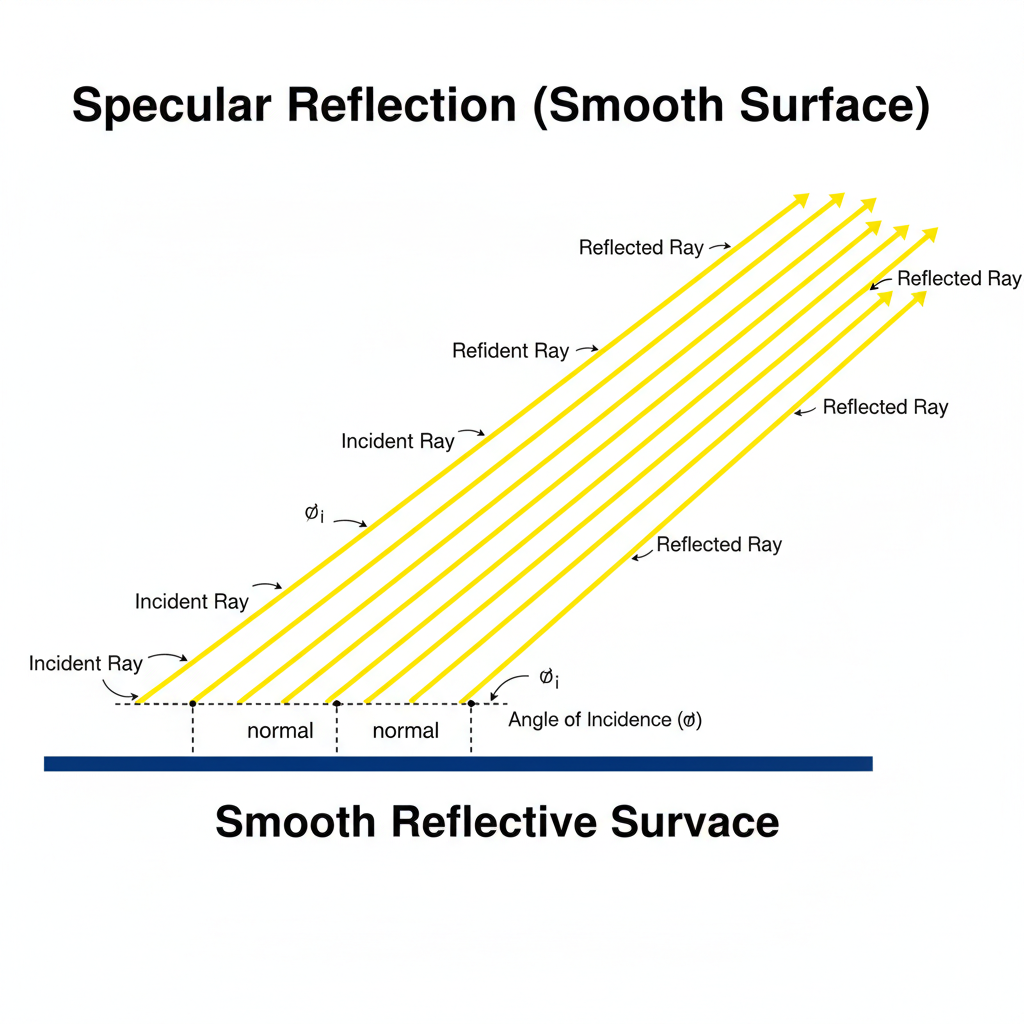 ⚠️ This picture may have spelling mistakes. Trust the words in the lesson.
Diffused Reflection: The Blurry Effect
Now, what happens when light hits a rough or uneven surface? This is where diffused reflection comes in. Most surfaces we see around us are not perfectly smooth like a mirror. Think about:
- A painted wall
- Your clothes
- A piece of paper
- The bark of a tree
- A cloudy sky
These surfaces might look smooth to our eyes, but if you were to zoom in incredibly close (like with a super-powered microscope!), you'd see they are actually bumpy and irregular.
When parallel light rays hit such a rough surface, they don't all bounce off in the same direction. Instead, they scatter in all sorts of different directions.
Analogy: The Bouncing Balls on a Bumpy Playground
Imagine rolling those same bowling balls (parallel light rays) across a bumpy playground surface with lots of bumps, hills, and holes. Some balls will hit a bump and bounce sharply to the left, others might hit a dip and go forward at a weird angle, and others might bounce high up. Each ball's path after hitting the ground will be different and unpredictable. This scattering of light in many directions is diffused reflection.
Why is this important? Diffused reflection is why we can see most objects around us! If all surfaces only showed regular reflection, we'd only see clear images of ourselves and other shiny things. But because light scatters off everyday objects, it reaches our eyes from all angles, allowing us to see the shapes, colors, and textures of everything.
Key characteristics of Diffused Reflection:
- Occurs on rough or uneven surfaces.
- Parallel incoming light rays reflect in many different directions.
- Does NOT form clear, sharp images, but allows us to see objects.
So, even though the light rays are scattering, the Law of Reflection (angle of incidence equals angle of reflection) still applies at each tiny point on the rough surface. It's just that the surface itself is tilted in many different directions at those points, causing the overall reflection to be diffused.
Regular vs. Diffused: A Quick Comparison
| Feature | Regular Reflection | Diffused Reflection |
|---|---|---|
| Surface Type | Smooth and polished | Rough and uneven |
| Incoming Rays | Parallel | Parallel |
| Outgoing Rays | Parallel | Scattered in different directions |
| Image Formation | Clear, sharp image | No clear image, but allows us to see the object |
| Example | Mirror, calm water surface | Wall, paper, clothing |
Think of it like this: Regular reflection is like a perfectly trained army marching in step, all going in the same direction. Diffused reflection is like a crowd of people leaving a concert – they all start from the same place but spread out in every direction!
Why Does It Matter?
Understanding regular and diffused reflection helps us understand how we see the world. Without diffused reflection, our world would be a very different place, filled with only mirror-like images and darkness everywhere else!
So next time you look in a mirror or at a wall, remember the amazing physics of light that makes it all possible!
Keep learning, free
Create a free Syllabax account to unlock practice questions and games for this topic.
Visual Learning Enhanced! 🚀
To help you master this topic, we use Advanced Syllabax AI to generate detailed diagrams and visual models.
Note on Visuals: The AI sometimes makes spelling errors in image labels. Please refer to the lesson text for the correct terminology.