Basic idea of tools that make work easier (Simple Machines)
Watch this topic in 60 seconds
Free preview · Lesson 1
Understanding Basic idea of tools that make work easier (Simple Machines)
Hello, Future Engineers! Understanding Simple Machines!
Have you ever had to move something really heavy, like a big box of toys, or lift something high up, like a flag to the top of a flagpole? Sometimes, these jobs can feel like super hard work! But guess what? People have invented special helpers, called Simple Machines, to make these jobs much, much easier!
Think of simple machines like your own personal superheroes that give you extra strength or make tricky tasks simpler. They don't do the work *for* you, but they change how you do the work so it feels less tiring. It's like trying to carry a heavy backpack versus putting it on a rolling cart – the cart makes it so much easier to move!
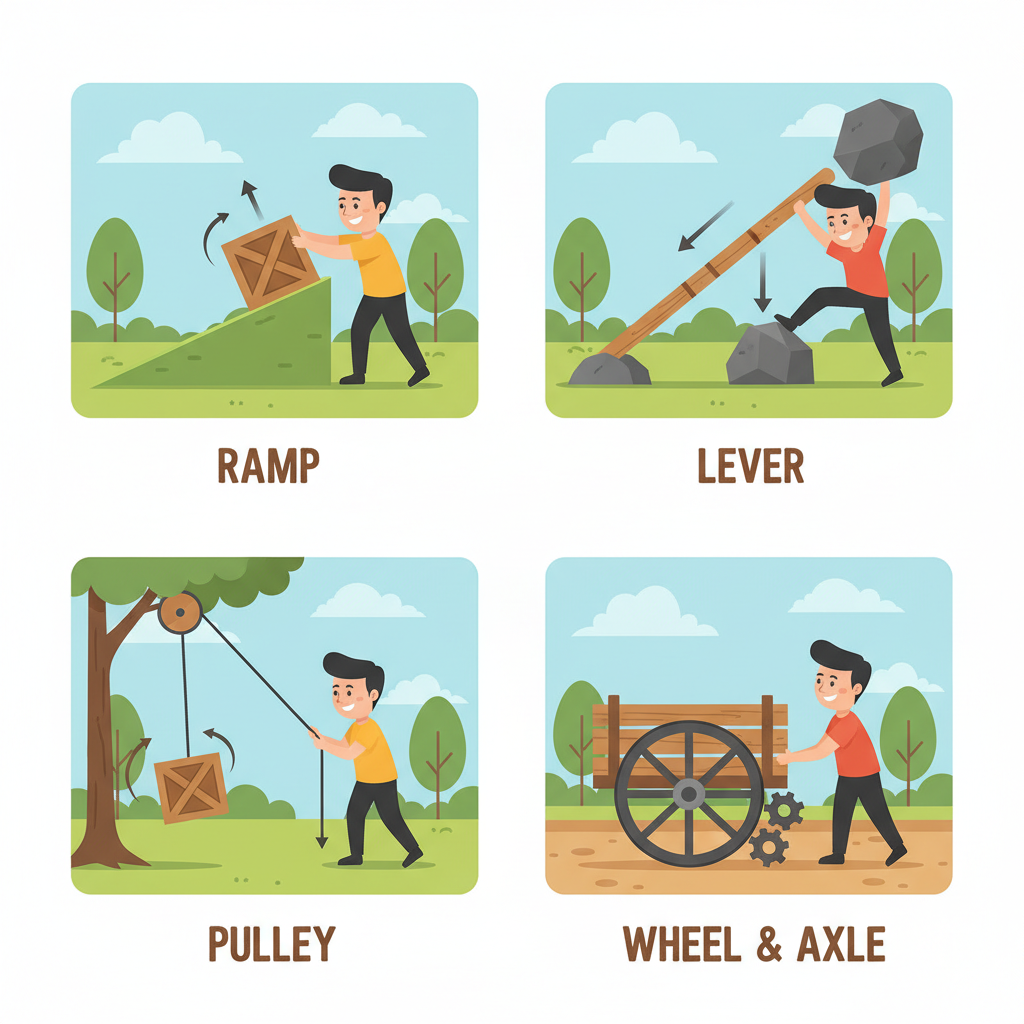
What Does "Making Work Easier" Mean?
When we say simple machines make "work easier," it doesn't mean you do less work in total. It means they help you do the same amount of work with less effort, or by changing the direction of the force. Imagine you want to lift a heavy rock. You could try to lift it straight up with your muscles (very hard!). Or, you could use a simple machine to push down on one side, and the rock lifts up on the other. Same rock, same height, but much easier for your body!
Let's Meet Our Simple Machine Superheroes!
1. The Lever (The "Push-Down-Lift-Up" Helper!)
Have you ever played on a see-saw at the park? If you push down on one side, your friend on the other side goes up! That's a lever in action! A lever is a stiff bar or rod that rests on a turning point called a fulcrum. When you push down on one end, the other end lifts something heavy. Think of it like a giant arm. A crowbar used to pull out a nail, or even a bottle opener, are all levers!
Analogy: Imagine you have a really heavy treasure chest. Instead of trying to lift it by yourself, you put a strong stick under it and place a small rock (your fulcrum) under the stick. Now, you push down on the long end of the stick, and *POOF*, the treasure chest starts to lift! Much easier than trying to pull it up with your hands alone!
2. The Inclined Plane (The "Gentle Slope" Helper!)
Do you remember sliding down a playground slide? Or walking up a ramp instead of stairs? That's an inclined plane! It's simply a flat surface tilted at an angle, like a ramp. Instead of lifting something straight up, which takes a lot of energy, an inclined plane lets you push or roll something up a gentle slope. You travel a longer distance, but you use much less force.
Analogy: Imagine trying to get your toy car from the floor to the top of your bed. You could pick it straight up (a big jump for the car!). Or, you could use a book as a ramp, and roll the car up slowly. It takes longer for the car to travel, but it's a much easier journey, right? Ramps for wheelchairs, slides, and even a zig-zag road going up a mountain are all inclined planes!
3. The Pulley (The "Pull-Down-Lift-Up" Helper!)
Have you ever seen someone hoist a flag up a flagpole? Or watched a window blind go up and down? They often use a pulley! A pulley is a wheel with a groove around its edge, and a rope or chain goes around it. When you pull down on one side of the rope, the other side lifts something up. Pulleys can change the direction of your pull, or they can make heavy things feel lighter by spreading the effort over more rope.
Analogy: Think about lifting a bucket of water from a deep well. If you just pull the rope straight up, it's very hard. But if the rope goes over a pulley wheel, you can pull DOWN, using your body weight to help, and the bucket comes UP! It feels so much easier!
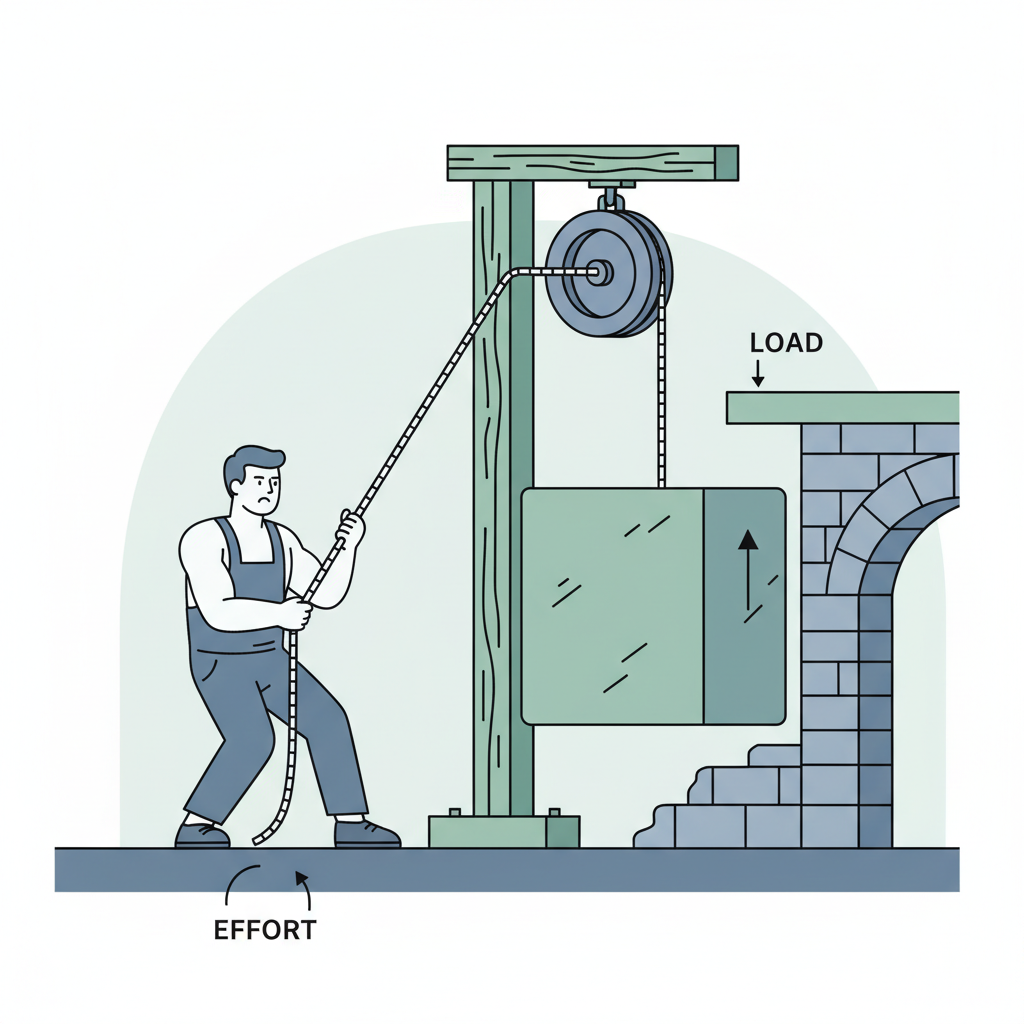 ⚠️ This picture may have spelling mistakes. Trust the words in the lesson.
4. The Wheel and Axle (The "Roll-Along" Helper!)
Look at your bicycle, a car, or even the doorknob on a door! They all use a wheel and axle. This simple machine is made of a wheel attached to a rod (the axle) in the middle. When you turn the wheel, the axle turns, and vice versa. It helps us move things over distances easily, or turn things with less effort.
Analogy: Imagine trying to drag a heavy wagon without wheels. Very hard! Now, put wheels on it. Suddenly, it rolls smoothly! The wheels and axle let you move big loads with much less pushing or pulling because they reduce friction.
5. The Wedge (The "Push-Apart" Helper!)
Have you ever seen an axe split wood? Or used a knife to cut an apple? Both are examples of a wedge! A wedge is like two inclined planes joined back-to-back. It's used to push two things apart, to cut things, or to hold things in place. When you push a wedge into something, it creates a powerful force that splits or separates it.
Analogy: Think about a doorstop. You push the thin end under the door, and as you push it further, the thicker part lifts the door a little, holding it open. The wedge pushes the door and the floor apart!
6. The Screw (The "Twist-and-Hold" Helper!)
Look at a jar lid, or a screw used to hold two pieces of wood together. That's a screw! A screw is actually an inclined plane wrapped around a central pole. When you twist a screw, it moves either into something (like wood) or up/down (like a jar lid opening). Screws are excellent for holding things tightly together or for lifting things gradually.
Analogy: Imagine trying to lift a heavy bucket of water straight up out of a well with a very long rope. Hard, right? Now, imagine if the well had a giant screw-like ramp all the way around the inside. You could slowly walk the bucket up the spiral ramp, making it much easier. That's kind of how a screw works to lift or hold!
Why Are Simple Machines So Important?
Simple machines might seem small, but they are the building blocks of almost every complex machine we use every day! From bicycles and cars to cranes and even zippers, simple machines are at their heart. They help us build tall buildings, move big objects, travel fast, and do countless tasks that would be impossible or incredibly hard without them. They are truly amazing helpers that make our world work!
Keep learning, free
Create a free Syllabax account to unlock practice questions and games for this topic.
Visual Learning Enhanced! 🚀
To help you master this topic, we use Advanced Syllabax AI to generate detailed diagrams and visual models.
Note on Visuals: The AI sometimes makes spelling errors in image labels. Please refer to the lesson text for the correct terminology.