Mixed solid interpretation (Composite Figures)
Watch this topic in 60 seconds
Free preview · Lesson 1
Understanding Mixed solid interpretation (Composite Figures)
Decoding Mixed Solids: Your Guide to Composite Figures (Grade 9, Foundational)
Imagine you're building with LEGOs. You start with a simple rectangular block, then you add a triangular piece on top to make a roof. What you've just created isn't a simple rectangle or a simple triangle; it's a new, more complex shape made by combining two simpler ones. This, my friends, is the core idea behind Mixed Solids, also known as Composite Figures!
What Are Mixed Solids (Composite Figures)?
Think of it like a chef making a fancy cake. They don't just use one ingredient; they combine flour, sugar, eggs, butter, and frosting to create something wonderful. In geometry, a Mixed Solid or Composite Figure is simply a 3D shape that is made up of two or more simpler, basic 3D shapes.
It's like taking our fundamental geometric 'ingredients' – cubes, rectangular prisms, cylinders, cones, pyramids, and spheres – and sticking them together, stacking them up, or even carving one out of another to create something new and often more realistic.
Why Do We Care About Them?
Look around you! Almost everything in the real world is a composite figure. Your house? It's often a rectangular prism with a triangular prism roof. A silo on a farm? A cylinder with a cone on top. A pencil? A cylinder with a cone tip. Even a fancy piece of furniture or a rocket ship is an intricate assembly of simpler shapes. Understanding how to 'read' these shapes is the first step to being able to calculate their volume (how much space they take up) or their surface area (how much material you'd need to cover them).
The 'Divide and Conquer' Strategy: Your Superpower!
When faced with a complex composite figure, don't panic! Your superpower is a strategy called 'Divide and Conquer'. It means breaking down the big, scary problem into smaller, manageable parts. Here's how to apply it to composite figures:
Step 1: Identify the 'Ingredients'
This is like looking at a complex sandwich and figuring out if it has bread, cheese, ham, and lettuce. For a composite figure, your job is to find the basic 3D shapes hiding within it. Does it look like a cylinder with a cone hat? Or maybe two rectangular prisms stuck together like an 'L' shape? Use your eyes and imagination!
Analogy: Imagine you're looking at a complicated drawing made with only circles, squares, and triangles. Your first task is to point out where each basic shape is located.
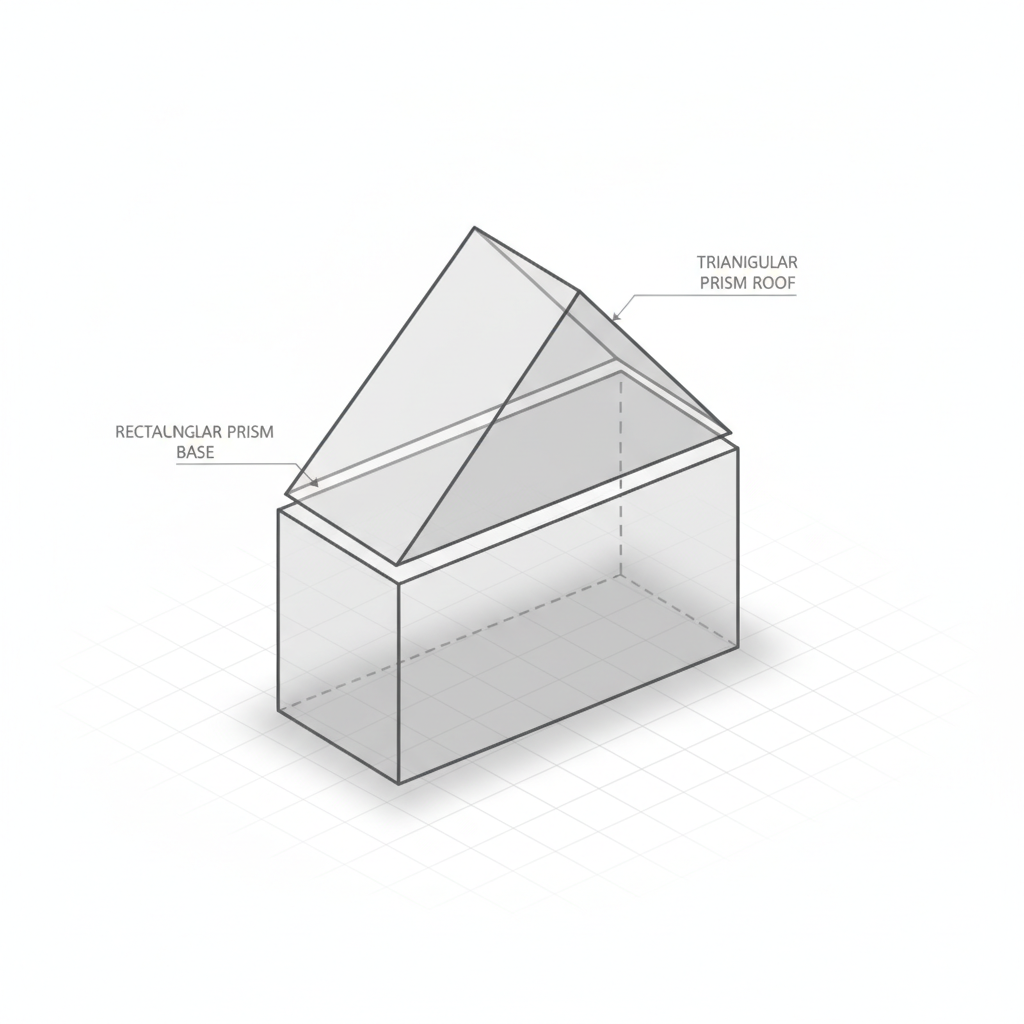 ⚠️ This picture may have spelling mistakes. Trust the words in the lesson.
Step 2: Visualize Them Separately
Once you've identified the component shapes, try to imagine them pulled apart. Picture the rectangular base of a house by itself, and then the triangular roof piece floating above it. This helps you mentally separate their properties and dimensions.
Analogy: If you have a toy car, you can imagine taking off the wheels, then the chassis, and then the body. You see each part individually, even though they were all connected.
Step 3: Understand How They're Joined: 'Addition' or 'Subtraction'?
Composite figures are formed in two main ways:
-
Addition: This is when shapes are literally put together or stacked. Like our LEGO house example (rectangular prism + triangular prism). When you're dealing with volume, you'll often add the volumes of the individual shapes. For surface area, it's trickier because some surfaces might be 'hidden' where they join.
Analogy: Building a snowman. You take one snowball and add another on top, and then a smaller one for the head. You're adding components.
-
Subtraction (or 'Hollowing Out'): This happens when one shape is carved out or removed from another. Imagine a rectangular block of wood with a cylindrical hole drilled through it. The resulting shape is the original rectangular prism *minus* the cylinder that was removed.
Analogy: Scooping ice cream out of a container. You start with a full container (a shape), and then you remove a sphere (another shape) from it.
Step 4: Connect the Dimensions
This is crucial! The dimensions (length, width, height, radius, etc.) of the composite figure will tell you the dimensions of its individual components. For example, if a house is 10 meters wide, then both the rectangular base and the triangular roof will also be 10 meters wide at their joint.
Sometimes you'll need to use a little deduction. If a total height is given, and you know the height of one part, you can find the height of the other by subtracting. It's like solving a puzzle with the numbers provided.
Analogy: If you know the total height of a two-story building is 20 feet, and the first floor is 10 feet tall, you can deduce the second floor is also 10 feet tall.
Putting It All Together (No Pun Intended!)
Interpreting mixed solids is all about careful observation and breaking things down. It's not about memorizing complex formulas for every possible combined shape, but rather mastering the skill of seeing the simpler shapes within the complex ones. With practice, you'll become a master architect of geometry, able to dissect any composite figure thrown your way!
Remember, geometry is all around us. By understanding composite figures, you're not just learning math; you're learning to 'read' the world in a whole new, geometric way!
Keep learning, free
Create a free Syllabax account to unlock practice questions and games for this topic.
Visual Learning Enhanced! 🚀
To help you master this topic, we use Advanced Syllabax AI to generate detailed diagrams and visual models.
Note on Visuals: The AI sometimes makes spelling errors in image labels. Please refer to the lesson text for the correct terminology.