Solutions vs suspensions (basic) (CHEMISTRY)
Watch this topic in 60 seconds
Free preview · Lesson 1
Understanding Solutions vs suspensions (basic) (CHEMISTRY)
Solutions vs. Suspensions: Understanding Mixtures
Have you ever mixed different things together? Maybe you stirred sugar into your tea, or perhaps you saw sand swirling in water at the beach. When you mix two or more substances, you create what scientists call a mixture. Mixtures are all around us, from the air we breathe to the food we eat! But not all mixtures are the same. Today, we're going to explore two important types of mixtures: solutions and suspensions. Think of them as two very different ways ingredients can come together.
What is a Solution? The "Super Blended" Mixture!
Imagine you're making lemonade. You take some lemon juice, water, and sugar. You stir it all up, and after a little while, the sugar seems to disappear! You can't see the individual sugar crystals anymore. The whole glass of lemonade looks clear and uniform, meaning it looks the same everywhere you look. This is a perfect example of a solution.
A solution is a special kind of mixture where one substance completely dissolves into another. Think of it like a secret agent blending in perfectly with a crowd – you can't tell them apart from anyone else! In a solution, the particles of one substance (like sugar) are so tiny and spread out evenly among the particles of another substance (like water) that you can't see them, even with a strong magnifying glass.
Here are some important things to know about solutions:
- Looks Uniform: Solutions are homogeneous mixtures. 'Homo' means same, so it looks the same throughout. Like our lemonade, every sip tastes the same!
- Clear and Transparent: You can usually see right through a solution. Light passes through it without scattering.
- Particles Don't Settle: If you leave a glass of sugar water on the table for an hour, or even a day, the sugar won't sink to the bottom. It stays mixed!
- Can't Filter Easily: You can't use a regular coffee filter to separate the sugar from the water in a sugar solution. The sugar particles are too small and pass right through the filter with the water.
- Parts: In a solution, the substance that dissolves is called the solute (like the sugar), and the substance that does the dissolving is called the solvent (like the water). Water is often called the 'universal solvent' because it can dissolve so many things!
Analogies for Solutions:
- Making a Smoothie: When you blend fruits, yogurt, and juice really well, it becomes a smooth, uniform drink. You can't easily pick out individual pieces of fruit anymore. That's how a solution works!
- Food Coloring in Water: A tiny drop of food coloring spreads out and mixes completely with a glass of water, making the whole glass a uniform color. You can't separate the coloring once it's mixed.
- Invisible Ink: The words you write with invisible ink "disappear" into the paper, becoming part of it until you heat it up. The ink is dissolved into the paper fibers, making it a kind of solution.
What is a Suspension? The "Shake It Up!" Mixture!
Now, let's think about another kind of mixture. Have you ever seen muddy water? Or maybe a bottle of orange juice with lots of pulp at the bottom? If you let muddy water sit for a while, what happens? The mud starts to sink and collect at the bottom, right? This is an example of a suspension.
A suspension is a mixture where particles are spread throughout a liquid or gas, but they are large enough that they don't dissolve and will eventually settle out over time. Think of it like a crowded bus where everyone is standing, but as soon as the bus stops, everyone sits down in their own seat. The particles in a suspension are like the passengers – they're there, but they don't blend in perfectly.
Here are some important things to know about suspensions:
- Looks Cloudy/Opaque: Suspensions are heterogeneous mixtures. 'Hetero' means different, so it doesn't look the same throughout. You might see chunks or cloudiness. You usually can't see clearly through a suspension.
- Particles Settle: If you leave a suspension alone for a while, the particles will slowly sink to the bottom due to gravity. This is why you often need to 'shake well before use' with things like natural orange juice or some medicines.
- Can Be Filtered: Because the particles in a suspension are larger, you can often separate them from the liquid using a simple filter, like a coffee filter or a strainer. This is how water treatment plants remove dirt from water!
- Scatters Light: When light shines through a suspension, it gets scattered by the larger particles, making the mixture look cloudy or opaque. You might not be able to see clearly through it.
Analogies for Suspensions:
- A Snow Globe: When you shake a snow globe, the 'snow' particles swirl around in the water. But if you leave it still, all the snow eventually settles at the bottom. That's exactly how a suspension works!
- Glitter in Glue: When you mix glitter into glue, the glitter pieces don't disappear. They float around, but if you let it sit, some might sink. And you can always see the individual glitter pieces.
- Sand in Water: If you mix sand with water, the sand doesn't dissolve. It swirls around, making the water cloudy, but given enough time, the sand settles at the bottom.
To help you visualize these differences, imagine a tall glass of water.
- If you add a spoonful of salt and stir, you get a clear solution. The salt disappears.
- If you add a spoonful of mud, you get cloudy water. The mud eventually settles.
This image shows a clear difference:
Think about pouring cereal into milk. The cereal floats around, but it doesn't disappear into the milk. It's not a solution. It's more like a suspension because the cereal pieces are big and they will eventually get soggy or you can separate them with a spoon!
Another way to think about it is how light behaves. In a solution, light passes straight through, like shining a flashlight through a clean window. In a suspension, light hits all those bigger particles and bounces around, making it hard to see through, like shining a flashlight through a foggy window.
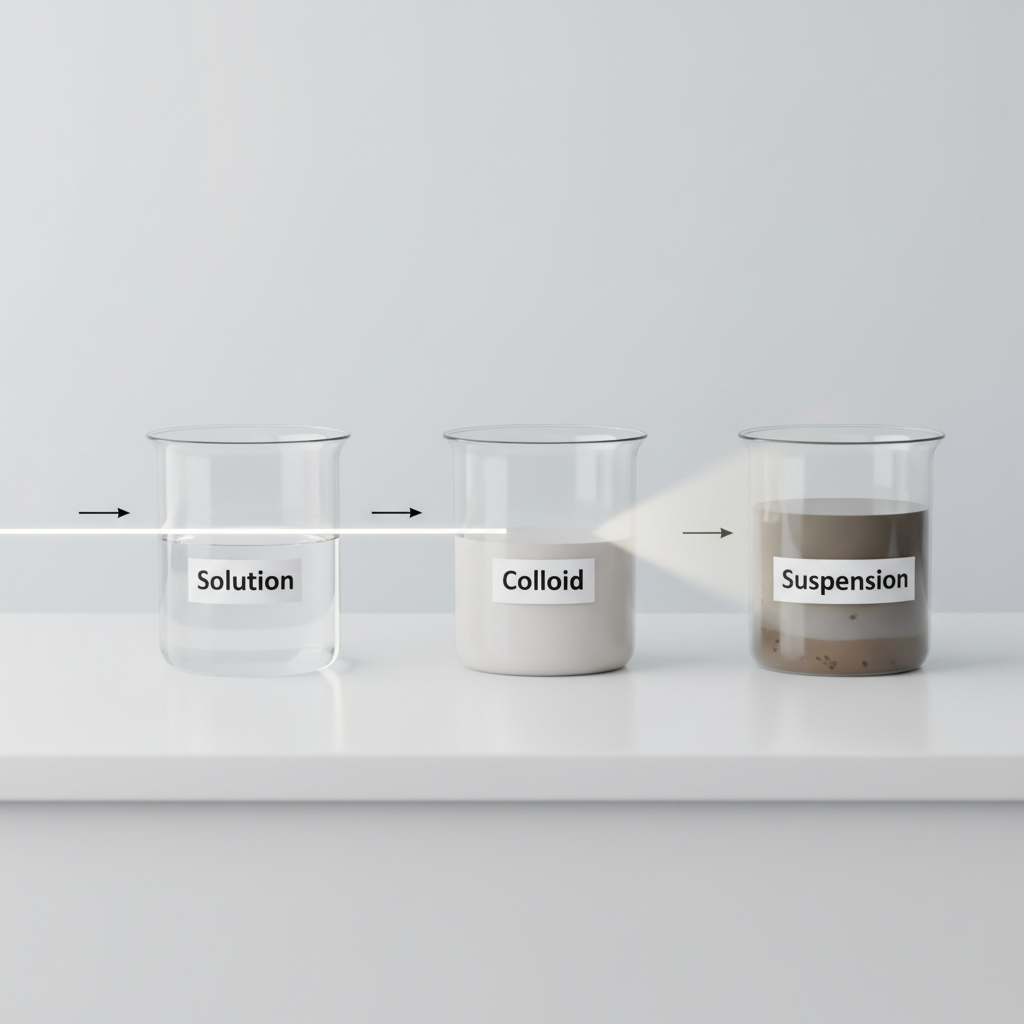
Putting It All Together: Solutions vs. Suspensions
| Feature | Solution | Suspension |
|---|---|---|
| Appearance | Clear, transparent, uniform (homogeneous) | Cloudy, opaque, not uniform (heterogeneous) |
| Particle Size | Very tiny, dissolved, cannot be seen | Larger, visible, do not dissolve |
| Settling | Particles do not settle | Particles settle over time |
| Filtering | Cannot be separated by simple filtering | Can be separated by simple filtering |
| Light Passage | Light passes through clearly | Light is scattered, appears cloudy/opaque |
| Shake Before Use? | Not usually needed | Often needed (e.g., orange juice with pulp) |
So, the next time you pour a glass of juice or stir sugar into your drink, you'll know exactly what kind of mixture you're looking at! Understanding solutions and suspensions helps us understand the world around us, from the medicines we take to the water we drink.
Keep learning, free
Create a free Syllabax account to unlock practice questions and games for this topic.
Visual Learning Enhanced! 🚀
To help you master this topic, we use Advanced Syllabax AI to generate detailed diagrams and visual models.
Note on Visuals: The AI sometimes makes spelling errors in image labels. Please refer to the lesson text for the correct terminology.