Global Warming & Greenhouse Effect – Environment & Ecology
Watch this topic in 60 seconds
Free preview · Lesson 1
Global Warming & Greenhouse Effect – Environment & Ecology (Foundational)
Global Warming & Greenhouse Effect: A Foundational Understanding
Welcome to this foundational lesson on global warming and the greenhouse effect. Understanding these concepts is crucial for comprehending the environmental challenges our planet faces.
What is the Greenhouse Effect?
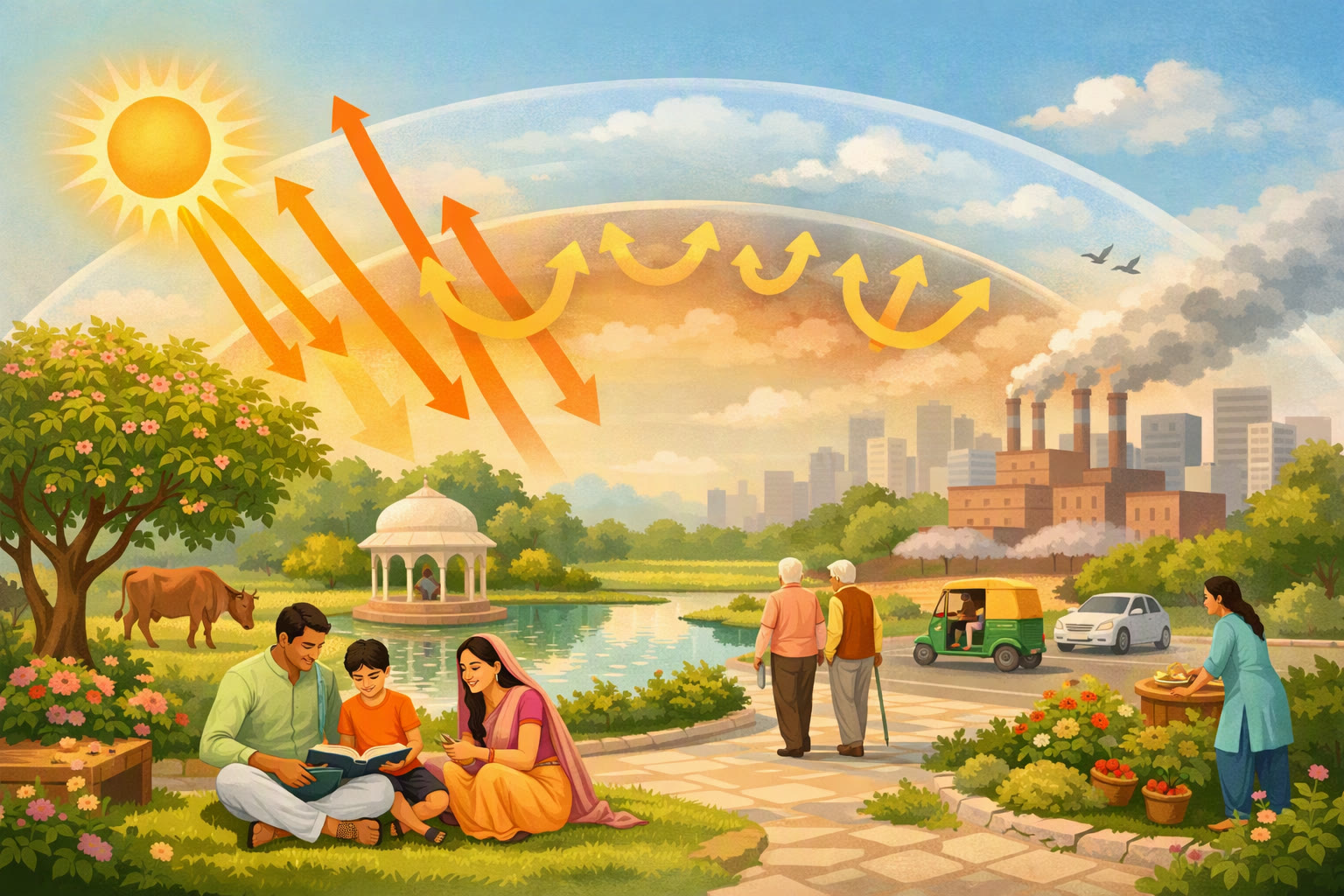
The greenhouse effect is a natural process that warms the Earth's surface. When the Sun's energy reaches the Earth, some of it is absorbed, and the rest is radiated back into space. However, certain gases in the Earth's atmosphere, known as greenhouse gases, trap some of this outgoing radiation. This trapped radiation warms the atmosphere and the Earth's surface. Think of it like a blanket around the Earth.
Key Greenhouse Gases:
- Carbon Dioxide (CO2): Released through burning fossil fuels (coal, oil, and natural gas), deforestation, and industrial processes.
- Methane (CH4): Emitted from livestock, natural gas leaks, and decomposition of organic waste.
- Nitrous Oxide (N2O): Released from agricultural and industrial activities, as well as burning fossil fuels and solid waste.
- Water Vapor (H2O): The most abundant greenhouse gas, but its concentration in the atmosphere is largely controlled by temperature.
What is Global Warming?
Global warming refers to the long-term heating of Earth's climate system observed since the pre-industrial period (between 1850 and 1900) due to human activities, primarily fossil fuel burning, which increases heat-trapping greenhouse gas levels in Earth's atmosphere. Global warming is a major aspect of climate change, and is evidenced by the increase in global average surface temperatures.
The Connection Between the Greenhouse Effect and Global Warming
The greenhouse effect is a natural and necessary process. Without it, the Earth would be too cold to support life. However, human activities are increasing the concentration of greenhouse gases in the atmosphere, enhancing the greenhouse effect. This enhanced greenhouse effect is causing the Earth's temperature to rise, leading to global warming.
Causes of Increased Greenhouse Gases
The primary cause of increased greenhouse gas concentrations is the burning of fossil fuels for energy. Other contributing factors include:
- Deforestation: Trees absorb CO2 from the atmosphere. When forests are cut down, this CO2 is released.
- Industrial Processes: Some industrial processes release greenhouse gases as byproducts.
- Agriculture: Certain agricultural practices, such as the use of fertilizers and livestock farming, release greenhouse gases.
Consequences of Global Warming
Global warming has numerous consequences, including:
- Rising Sea Levels: As the Earth warms, glaciers and ice sheets melt, adding water to the oceans and causing sea levels to rise.
- More Frequent and Intense Heatwaves: Higher average temperatures lead to more frequent and intense heatwaves.
- Changes in Precipitation Patterns: Some regions may experience more droughts, while others may experience more floods.
- Disruptions to Ecosystems: Changes in temperature and precipitation can disrupt ecosystems and threaten plant and animal species.
Keep learning, free
Create a free Syllabax account to unlock practice questions and games for this topic.
Visual Learning Enhanced! 🚀
To help you master this topic, we use Advanced Syllabax AI to generate detailed diagrams and visual models.
Note on Visuals: The AI sometimes makes spelling errors in image labels. Please refer to the lesson text for the correct terminology.