Simple Probability: Coin Flips
Watch this topic in 60 seconds
Free preview · Lesson 1
Understanding Simple Probability: Coin Flips
Simple Probability: Understanding Coin Flips
Welcome, young mathematicians! Today, we're going to dive into the exciting world of probability. Don't let the big word scare you; it's simply about figuring out how likely something is to happen. Think of it like a detective trying to predict the future, but with numbers!
What is Probability? The Detective's Game
Imagine you're checking the weather forecast. When the meteorologist says, 'There's a 70% chance of rain tomorrow,' they are talking about probability! They're telling you how likely it is that you'll need your umbrella. If it's a 0% chance, it means no rain, impossible! If it's a 100% chance, get ready for a downpour, it's certain!
Probability helps us understand the chances of different things happening, from winning a game to picking the right color sock from a messy drawer. It's used in many everyday decisions, even if we don't always notice it.
Our Tool: The Humble Coin Flip
To start our probability adventure, we're going to use one of the simplest and fairest tools around: a coin! A coin flip is perfect because it has only two possible things that can happen, and each one is equally likely. It's like a tiny, fair game of 'either/or'.
Core Concepts: Your Probability Toolkit
Before we flip our first coin, let's learn some important words that are like the tools in our probability toolkit:
-
Outcome: What Can Happen?
An outcome is simply one possible result of an event. When you flip a coin, what are the outcomes? You can get 'Heads' or 'Tails'. It's like choosing between two flavors of ice cream – each flavor is an outcome. If you were rolling a regular six-sided die, the outcomes would be 1, 2, 3, 4, 5, or 6. -
Event: What Are We Interested In?
An event is a specific outcome or a set of outcomes that we are interested in. For a coin flip, an event could be 'getting Heads'. Another event could be 'getting Tails'. If you were picking a marble from a bag, the event might be 'picking a blue marble'. -
Sample Space: All the Possibilities!
The sample space is the list of all possible outcomes. It's like making a complete list of every single thing that could happen. For a single coin flip, the sample space is {Heads, Tails}. That's it! If you were choosing a day of the week, the sample space would be {Monday, Tuesday, Wednesday, Thursday, Friday, Saturday, Sunday}.
Let's Flip That Coin! Calculating Simple Probability
When you flip a coin, what are the chances of getting Heads? What about Tails? Since there are only two outcomes (Heads or Tails), and they are equally likely, it feels like it should be half and half, right? You're absolutely correct!
We can use a simple formula to calculate probability:
Probability of an Event = (Number of Favorable Outcomes) / (Total Number of Possible Outcomes)
Let's break this down for our coin flip:
- Number of Favorable Outcomes: This is how many ways your specific event can happen. If your event is 'getting Heads', there's only 1 way to get Heads. If your event is 'getting Tails', there's only 1 way to get Tails.
- Total Number of Possible Outcomes: This is the total number of items in your sample space. For a coin flip, there are 2 possible outcomes (Heads and Tails).
Example 1: Probability of Getting Heads
Event: Getting Heads
- Favorable Outcomes (Heads): 1
- Total Possible Outcomes (Heads, Tails): 2
So, the Probability of Heads = 1 / 2
Example 2: Probability of Getting Tails
Event: Getting Tails
- Favorable Outcomes (Tails): 1
- Total Possible Outcomes (Heads, Tails): 2
So, the Probability of Tails = 1 / 2
This means there is a 1 out of 2 chance for each. We can also write probabilities as decimals or percentages:
- Fraction: 1/2
- Decimal: 0.5
- Percentage: 50%
So, the chance of getting Heads is 50%, and the chance of getting Tails is 50%. This makes sense because a coin flip is fair!
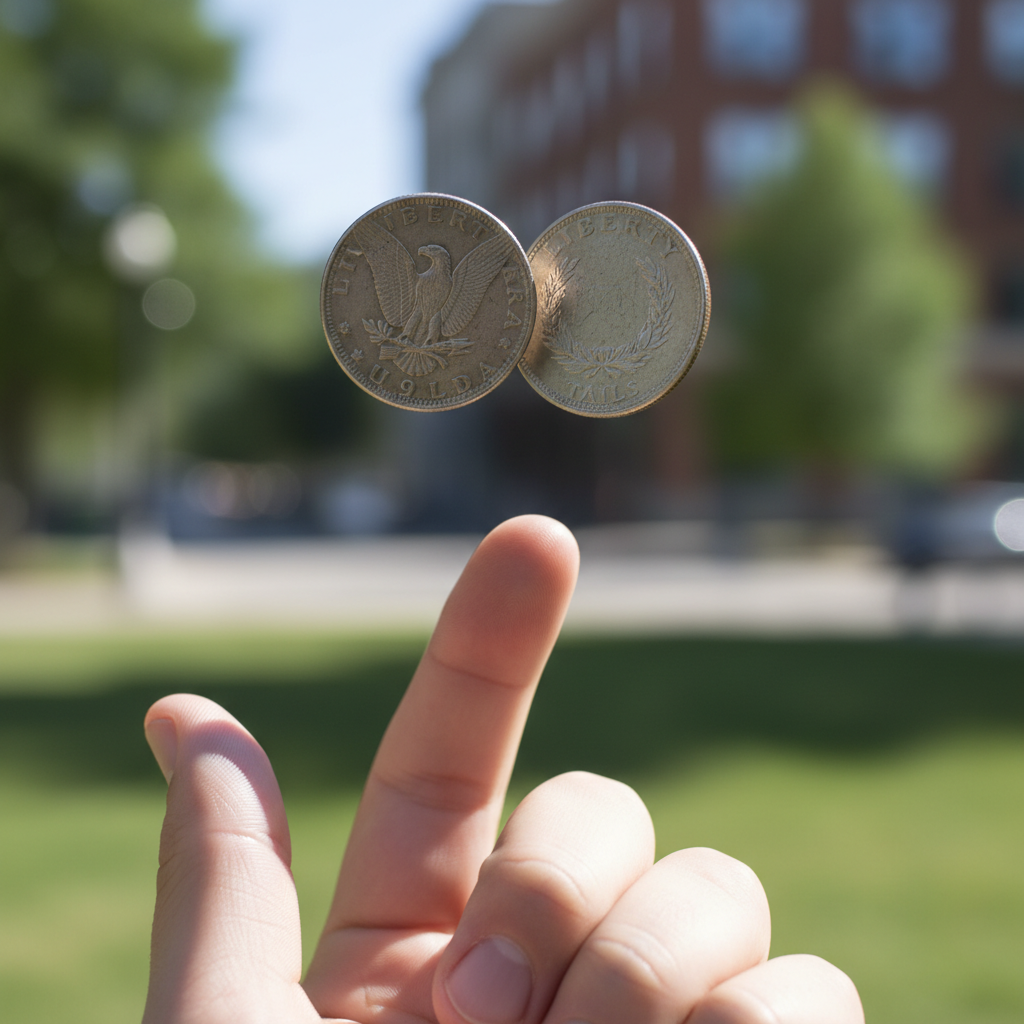 ⚠️ This picture may have spelling mistakes. Trust the words in the lesson.
Probability on a Scale: From Impossible to Certain
Think of probability like a line from 0 to 1:
- 0 (or 0%): Impossible! This means something absolutely cannot happen. What's the probability of a coin landing on its side and staying perfectly balanced? Very, very close to 0! What's the probability of a coin turning into a banana when you flip it? 0!
- 0.5 (or 50%): Equally Likely! This is our coin flip example. It means the event is just as likely to happen as it is not to happen.
- 1 (or 100%): Certain! This means something will definitely happen. What's the probability that the sun will rise tomorrow? Very, very close to 1 (unless you are at the North Pole in winter!). What's the probability that a flipped coin will either be Heads OR Tails? 100%! It has to be one or the other.
So, the probability of any event will always be a number between 0 and 1 (or 0% and 100%).
Why is This Important?
Understanding simple probability helps you make smarter choices and understand the world around you. It helps you decide if it's worth taking a chance, like in a board game, or if you should carry an umbrella. It's the first step to becoming a probability pro!
Keep practicing with coin flips, and you'll soon be a master of predicting chances!
Keep learning, free
Create a free Syllabax account to unlock practice questions and games for this topic.
Visual Learning Enhanced! 🚀
To help you master this topic, we use Advanced Syllabax AI to generate detailed diagrams and visual models.
Note on Visuals: The AI sometimes makes spelling errors in image labels. Please refer to the lesson text for the correct terminology.