Simple Interest formula (Simple Interest)
Watch this topic in 60 seconds
Free preview · Lesson 1
Understanding Simple Interest formula (Simple Interest)
Understanding Simple Interest: Making Your Money Grow!
Welcome to the fascinating world of money and how it can work for you! Today, we're going to learn about something called Simple Interest. Think of it like a magic potion for your money that helps it grow over time. We'll explore what it is, how it works, and why it's super useful, especially when you're just starting to learn about managing money.
What is Simple Interest?
Imagine you have a piggy bank. Normally, the money you put in just stays there, right? But what if, every so often, someone added a little extra money to your piggy bank, just for letting them 'borrow' your money for a while? That extra money is like simple interest!
In the world of finance, simple interest is a way that lenders (people or banks who give out money) reward borrowers (people who take out money) for using their money. It's a straightforward way to calculate the extra money earned or paid. It's called 'simple' because it's easy to understand and calculate – no complicated tricks involved!
The Core Idea: A Fair Exchange
Think of it like this:
- You have some money (Principal): This is the initial amount of money you start with, or the amount you borrow. Let's call this your Principal. It's like the main ingredient in our magic potion.
- You let someone use your money (Time): The longer your money is used or borrowed, the more extra money you might earn (or owe). This is the Time period.
- There's a 'rent' for using the money (Rate): The lender charges a fee for letting you use their money, or you get paid a fee for letting them use yours. This fee is usually expressed as a percentage and is called the Interest Rate. It's like the 'strength' of our magic potion.
Simple interest is calculated *only* on the original amount of money (the Principal). It doesn't grow on the interest you've already earned. Imagine planting a seed (your Principal). Each year, you get a small harvest (the Interest). With simple interest, you replant the *original* seed every year to get the same harvest size. You don't plant the harvests themselves to get even more harvests.
The Simple Interest Formula: Your Magic Recipe!
To make our money magic happen, we use a special recipe, or formula. It's like a secret code that tells us exactly how much extra money we'll get or pay.
The formula is:
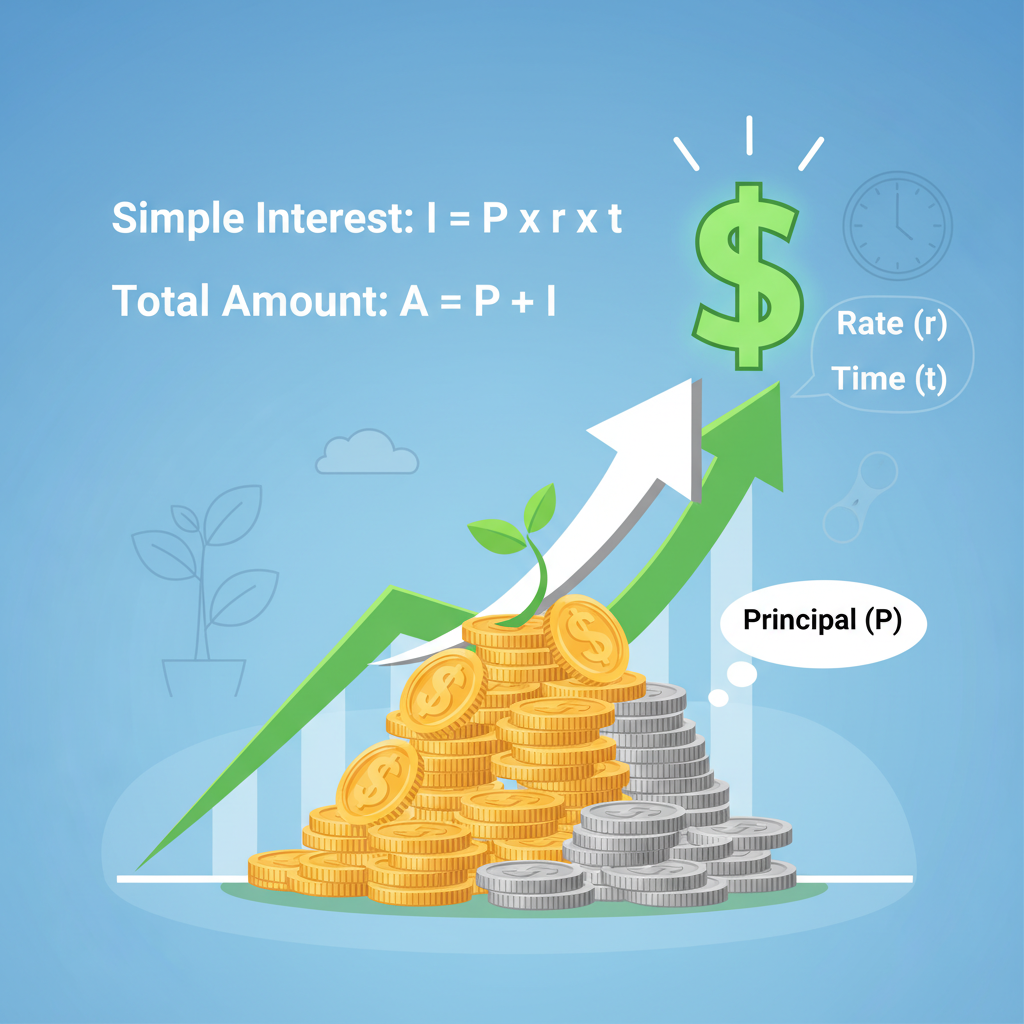
Simple Interest (SI) = Principal (P) × Rate (R) × Time (T)
Let's break down what each part means:
- P (Principal): This is the starting amount of money. It's usually in dollars ($) or any other currency.
- R (Rate): This is the interest rate. It's almost always given as a percentage (%). But, when we use it in the formula, we need to turn the percentage into a decimal. To do this, we divide the percentage by 100. For example, if the rate is 5%, we use 0.05 in our calculation (5 ÷ 100 = 0.05).
- T (Time): This is the duration for which the money is borrowed or invested. It must be in the same units as the rate's period. Usually, time is measured in years. So, if the rate is per year, the time should be in years. If it's 6 months, you'd write it as 0.5 years (6 months ÷ 12 months/year).
Let's See It in Action! An Example
Imagine you have
Let's use our formula:
Simple Interest = P × R × T
Simple Interest = $100 × 0.05 × 3
Simple Interest = $5 × 3
Simple Interest = $15
So, after 3 years, you would earn
If you wanted to know the total amount of money you'd have after 3 years, you'd add the interest to the original principal:
Total Amount = Principal + Simple Interest
Total Amount =
Total Amount = $115
You now have $115!
Why is Simple Interest Important?
Simple interest is like the building blocks for understanding more complex financial ideas. It helps us understand:
- Savings Accounts: Many basic savings accounts use simple interest to help your money grow slowly but surely.
- Loans: When you take out a loan (like for a bike or a game console), you often pay simple interest. It helps you understand how much extra you'll be paying back.
- Budgeting: Knowing about interest helps you make smart decisions about saving and borrowing.
Analogy Time: The Ice Cream Cone!
Let's use one more analogy. Imagine you have a special ice cream cone. The ice cream itself is your Principal ($100). The shopkeeper offers you a deal: for every day you don't eat the ice cream, they'll add a tiny bit more ice cream on top. This 'extra' ice cream is the Interest. The 'rule' for how much extra ice cream they add each day is the Rate (e.g., a tiny scoop size). The number of days you wait is the Time.
With simple interest, no matter how many days you wait, the shopkeeper only adds the *same small amount of extra ice cream* each day. They don't add extra ice cream to the extra ice cream you already got. It's a consistent, predictable addition.
So, simple interest is a fair and easy way to understand how money grows or how costs add up when you borrow or save.
Key Things to Remember:
- Principal (P): The original amount of money.
- Rate (R): The percentage charged or earned, converted to a decimal for calculations.
- Time (T): The duration, usually in years.
- Simple Interest (SI): The extra money earned or paid, calculated only on the principal.
- Total Amount: Principal + Simple Interest.
Now you're ready to start calculating!
Keep learning, free
Create a free Syllabax account to unlock practice questions and games for this topic.
Visual Learning Enhanced! 🚀
To help you master this topic, we use Advanced Syllabax AI to generate detailed diagrams and visual models.
Note on Visuals: The AI sometimes makes spelling errors in image labels. Please refer to the lesson text for the correct terminology.