Pattern Completion – Non – Verbal Reasoning (Diagrammatic)
Watch this topic in 60 seconds
Free preview · Lesson 1
Pattern Completion – Non – Verbal Reasoning (Diagrammatic) (Foundational)
Hello Future Pattern Detectives!
Are you ready to use your super-sleuth skills to uncover hidden secrets? Today, we're going on an exciting adventure into the world of Pattern Completion! Don't worry, it's not about complicated words or numbers – it's all about pictures and shapes. This is a foundational step in understanding Non-Verbal Reasoning (Diagrammatic).
What in the World is a Pattern?
Think about your favorite song. It has a chorus that repeats, right? Or maybe the stripes on a zebra, or the way bricks are laid in a wall. These are all examples of patterns! A pattern is:
- A regular way in which something is repeated.
- A repeating design or sequence.
- Something that follows a predictable rule.
In our lesson, we'll be looking at diagrammatic patterns, which means patterns made of pictures, shapes, and figures. There are no words involved!
Your Mission: Pattern Completion!
Your mission, should you choose to accept it, is to find the missing piece in a pattern. Imagine a puzzle where one piece is missing, and you need to figure out which shape fits perfectly to complete the picture or sequence.
Pattern Completion means:
- Looking at a series of pictures or shapes.
- Understanding the rule or way they are changing or repeating.
- Choosing the correct picture or shape that logically continues or completes the pattern.
Why is this important? Because spotting patterns helps your brain become better at problem-solving, understanding how things work, and even predicting what might happen next – skills you use every day, from playing games to organizing your desk!
How Do We Become Pattern Completion Champions?
Here are some simple tricks to help you complete diagrammatic patterns:
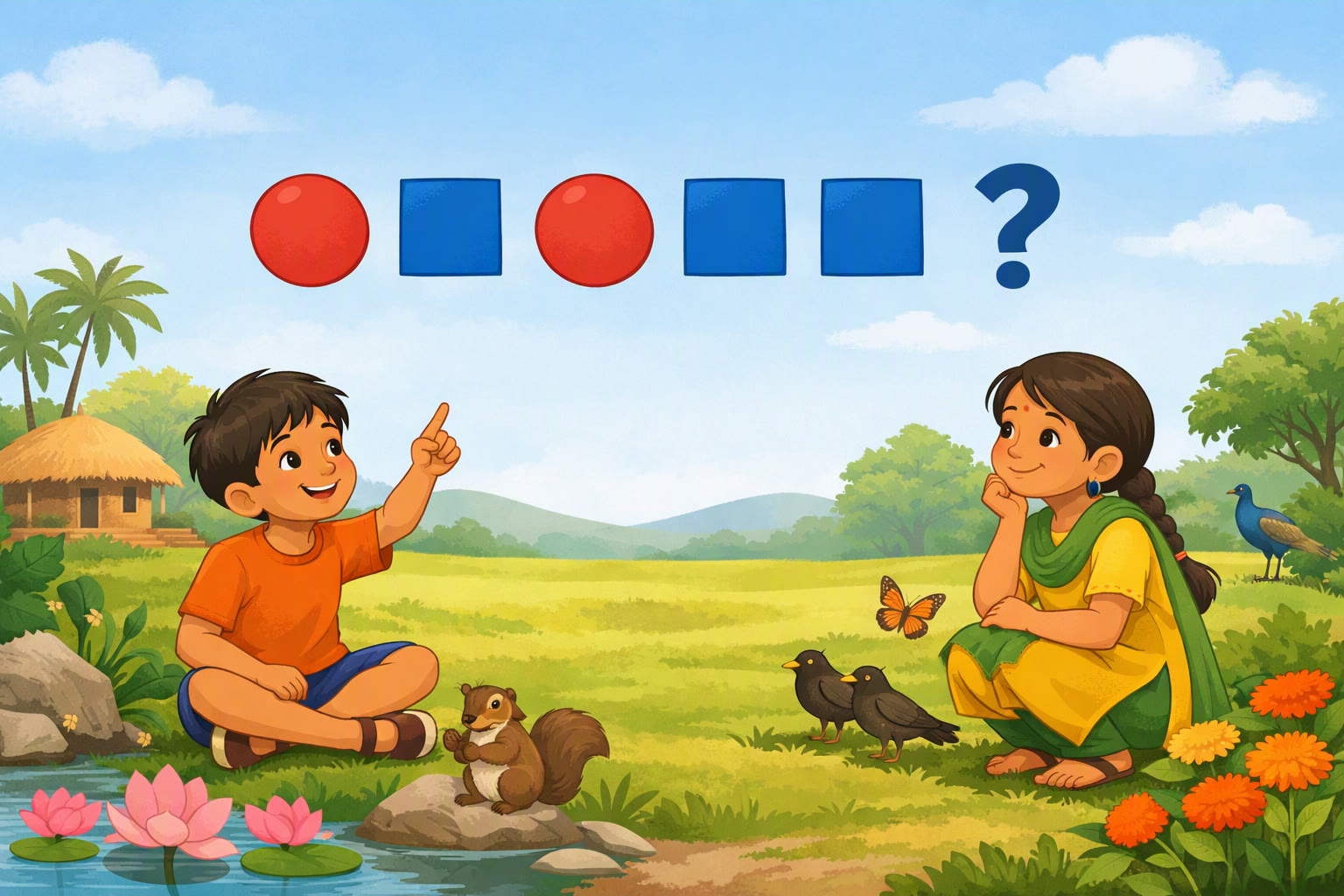
1. Look for Repetition
Is there a shape or group of shapes that keeps showing up again and again? For example, if you see: Circle, Square, Circle, Square, Circle, ____? The pattern is "Circle, Square" repeating. So the missing piece would be a Square!
2. Notice Changes
Sometimes, patterns don't just repeat; they change in a specific way. Look closely for these changes:
- Size: Is the shape getting bigger or smaller? (Small, Medium, Large, Small, ____?)
- Position: Is the shape moving? (Top, Middle, Bottom, Top, ____?)
- Number: Are there more or fewer of something? (1 star, 2 stars, 3 stars, ____?)
- Color/Shading: Is the color or shading changing in a sequence? (Light, Dark, Light, ____?)
3. Watch for Rotation or Reflection
- Rotation: Is the shape turning around? Like a clock hand moving or a wheel spinning. (Arrow pointing up, Arrow pointing right, Arrow pointing down, ____?)
- Reflection: Is the shape flipping over, like looking in a mirror?
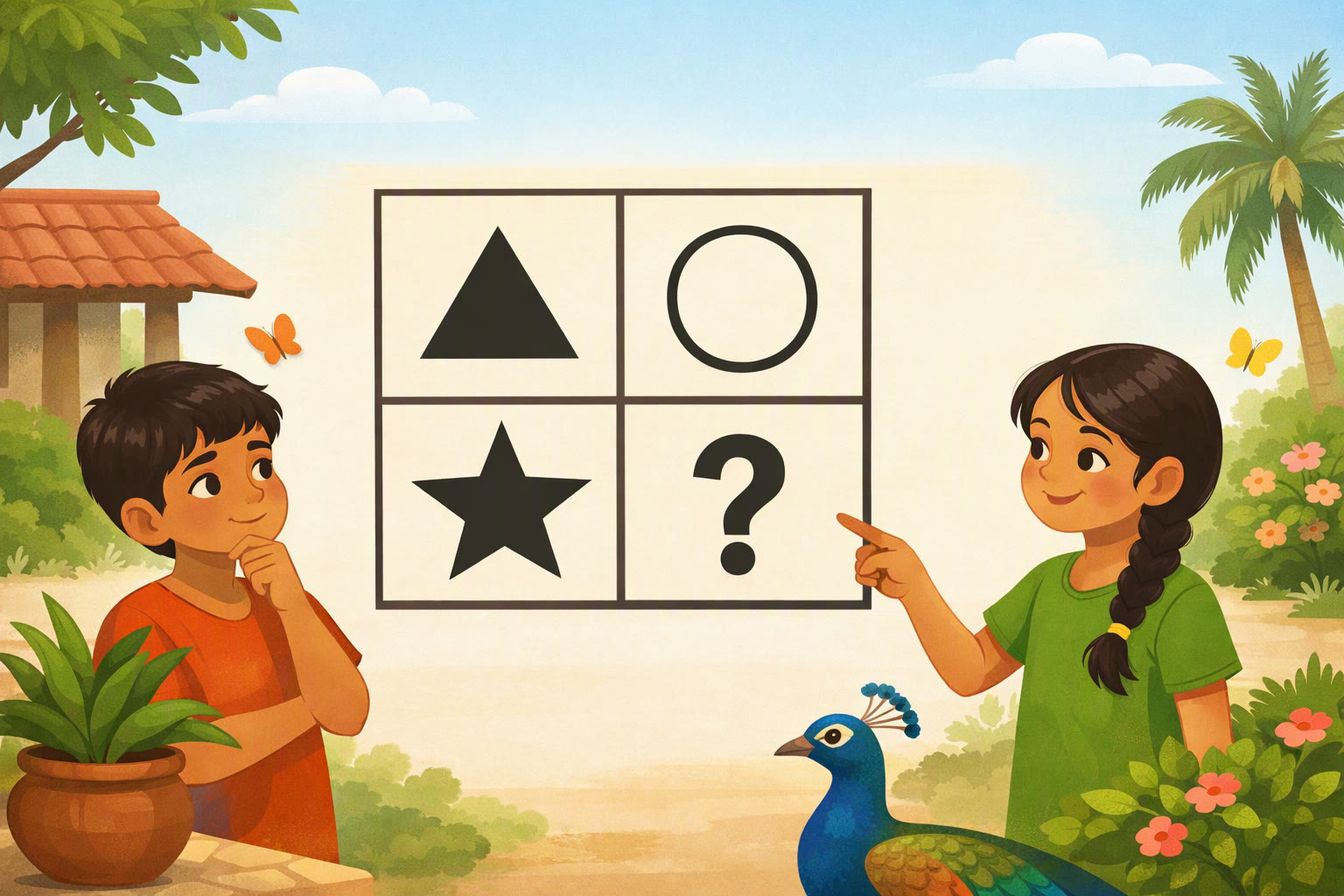
4. Complete the Grid!
Many diagrammatic patterns come in a grid, like a tic-tac-toe board. Your job is to find the missing square that makes the whole grid make sense. Look at rows (left to right) and columns (up and down) and even diagonals!
For grid patterns, ask yourself:
- What is the relationship between the shapes in the first row?
- What is the relationship between the shapes in the first column?
- Does the missing shape need to match a pattern going across or down?
Let's Summarize Your Tools:
- Observe Carefully: Look at EVERYTHING – shapes, lines, dots, colors, positions.
- Find the Rule: What is happening from one picture to the next? Or from one part of the grid to another?
- Predict: Once you know the rule, what should come next?
You've got this! With a keen eye and a bit of practice, you'll be a Pattern Completion Master in no time!
Keep learning, free
Create a free Syllabax account to unlock practice questions and games for this topic.
Visual Learning Enhanced! 🚀
To help you master this topic, we use Advanced Syllabax AI to generate detailed diagrams and visual models.
Note on Visuals: The AI sometimes makes spelling errors in image labels. Please refer to the lesson text for the correct terminology.