Learning Journey
Watch this topic in 60 seconds
Free preview · Lesson 1
Understanding Strong vs weak acids/bases[CHEMISTRY]
The Power Play: Strong vs. Weak Acids and Bases
Welcome, future chemists! Today, we're going to unravel a fundamental concept in chemistry: the difference between strong and weak acids and bases. You might hear these terms often, and while they sound like they're talking about how 'dangerous' a chemical is, in chemistry, 'strong' and 'weak' have a very specific meaning related to how they behave in water. It's not just about concentration, but about something called dissociation!
What Are Acids and Bases, Briefly?
Before we dive into 'strong' and 'weak', let's quickly remember what acids and bases are:
- Acids: Think of substances that often taste sour (like lemon juice) and can react with certain metals. In simple terms, acids release hydrogen ions (H⁺) when dissolved in water.
- Bases: These are often slippery to the touch (like soap) and taste bitter. Bases release hydroxide ions (OH⁻) when dissolved in water.
The Big Idea: Dissociation in Water
Imagine you have a team of Lego bricks. When you put them in water, do they all fall apart into individual pieces, or do only some of them break apart while others stay connected? This is similar to what happens with acids and bases in water, and it's key to understanding strength.
When an acid or a base dissolves in water, its molecules can break apart (or 'dissociate') into ions. The extent to which they do this determines if they are strong or weak.
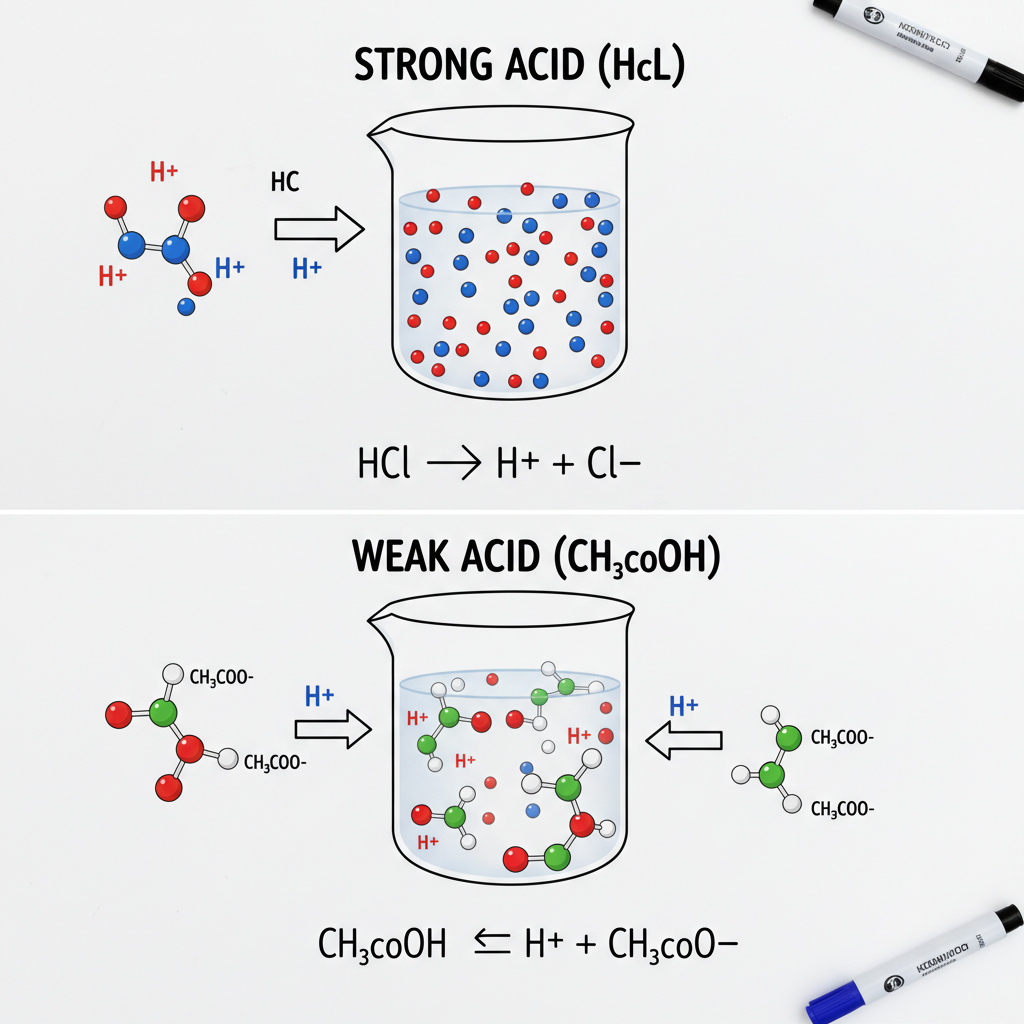 ⚠️ This picture may have spelling mistakes. Trust the words in the lesson.
Strong Acids: The All-In Approach
What makes an acid 'strong'?
A strong acid is like a very committed team of Lego bricks – as soon as you put it in water, every single molecule breaks apart completely into its ions. There are no intact acid molecules left; they've all donated their H⁺ ions.
Think of it this way: Imagine you have a company of 100 soldiers, and their job is to drop off a special package (the H⁺ ion) at a specific location. If it's a strong acid, all 100 soldiers will successfully drop off their packages and become individual, package-less soldiers. No soldier will return to base with their package still in hand!
Key Characteristics of Strong Acids:
- Complete Dissociation: They ionize 100% in water.
- One-Way Reaction: The reaction largely goes in one direction. We use a single arrow (→) in their chemical equations to show this.
- High Concentration of H⁺: Because all molecules release their H⁺ ions, a solution of a strong acid will have a very high concentration of H⁺ ions.
Common Examples of Strong Acids:
- Hydrochloric acid (HCl): HCl(aq) → H⁺(aq) + Cl⁻(aq)
- Sulfuric acid (H₂SO₄): H₂SO₄(aq) → 2H⁺(aq) + SO₄²⁻(aq)
- Nitric acid (HNO₃): HNO₃(aq) → H⁺(aq) + NO₃⁻(aq)
Weak Acids: The Hesitant Approach
What makes an acid 'weak'?
A weak acid is different. When you put it in water, only a small fraction of its molecules break apart and release their H⁺ ions. Most of the acid molecules stay intact, just like some Lego bricks might stay connected even when submerged.
Using our soldier analogy: If it's a weak acid, out of 100 soldiers, maybe only 5 or 10 will successfully drop off their special package (H⁺ ion). The rest will return to base still holding their packages. There's a constant back-and-forth, with some packages being dropped off and some being picked back up.
Key Characteristics of Weak Acids:
- Partial Dissociation: They ionize only partially in water (e.g., typically less than 10%).
- Equilibrium Reaction: The reaction is reversible. Acid molecules break apart, but their ions can also recombine to form the original acid molecule. We use a double arrow (⇌) in their chemical equations to show this equilibrium.
- Lower Concentration of H⁺: Because only some molecules release H⁺ ions, a solution of a weak acid will have a much lower concentration of H⁺ ions compared to a strong acid of the same concentration.
Common Examples of Weak Acids:
- Acetic acid (found in vinegar, CH₃COOH): CH₃COOH(aq) ⇌ H⁺(aq) + CH₃COO⁻(aq)
- Carbonic acid (found in carbonated drinks, H₂CO₃): H₂CO₃(aq) ⇌ H⁺(aq) + HCO₃⁻(aq)
- Citric acid (found in citrus fruits)
Strong Bases: The Complete Absorption
What makes a base 'strong'?
Just like strong acids, a strong base is one that completely dissociates in water. Every single molecule breaks apart and releases its hydroxide ions (OH⁻).
Imagine you have a sponge whose job is to release water (OH⁻) into a bucket. If it's a strong base, as soon as you put it in water, it instantly releases all the water it possibly can, completely emptying itself.
Key Characteristics of Strong Bases:
- Complete Dissociation: They ionize 100% in water.
- One-Way Reaction: The reaction largely goes in one direction, indicated by a single arrow (→).
- High Concentration of OH⁻: A solution of a strong base will have a very high concentration of OH⁻ ions.
Common Examples of Strong Bases:
- Sodium hydroxide (NaOH): NaOH(aq) → Na⁺(aq) + OH⁻(aq)
- Potassium hydroxide (KOH): KOH(aq) → K⁺(aq) + OH⁻(aq)
- Calcium hydroxide (Ca(OH)₂): Ca(OH)₂(aq) → Ca²⁺(aq) + 2OH⁻(aq)
Weak Bases: The Partial Absorption
What makes a base 'weak'?
A weak base is one that only partially dissociates in water. Only some of its molecules release hydroxide ions (OH⁻) or accept H⁺ ions from water to form OH⁻. Most molecules remain intact or only react slightly.
Going back to our sponge analogy: If it's a weak base, when you put it in water, it only releases a small amount of its water (OH⁻). Most of the water stays within the sponge, and there's a constant effort to release a little bit more, but it never fully empties.
Key Characteristics of Weak Bases:
- Partial Dissociation: They ionize only partially in water.
- Equilibrium Reaction: The reaction is reversible, indicated by a double arrow (⇌).
- Lower Concentration of OH⁻: A solution of a weak base will have a much lower concentration of OH⁻ ions compared to a strong base of the same concentration.
Common Examples of Weak Bases:
- Ammonia (NH₃): NH₃(aq) + H₂O(l) ⇌ NH₄⁺(aq) + OH⁻(aq)
- Methylamine (CH₃NH₂)
Strength vs. Concentration: A Crucial Distinction!
This is extremely important! Don't confuse 'strength' with 'concentration'. They are two different things:
- Strength: Refers to how much an acid or base dissociates (breaks apart) in water. (e.g., completely vs. partially). This is an inherent property of the substance itself.
- Concentration: Refers to how much of the acid or base solute is dissolved in a given amount of water (e.g., dilute vs. concentrated). You can have a lot of molecules (concentrated) or a few (dilute).
Analogy: Imagine a professional boxer. Their punch is naturally very strong (strength). Whether they throw one punch (dilute solution) or twenty punches in a row (concentrated solution) changes the overall impact, but the strength of *each individual punch* remains the same. You can have a very strong boxer throwing a single punch, or a weak boxer throwing many punches. Similarly, you can have a dilute strong acid (e.g., a few drops of HCl in a large bucket of water) or a concentrated weak acid (e.g., a lot of vinegar, which is a weak acid, in a small cup).
Why Does It Matter?
The strength of an acid or base affects many things:
- pH: Strong acids and bases lead to more extreme pH values (very low for strong acids, very high for strong bases) because they produce many H⁺ or OH⁻ ions.
- Reactivity: Strong acids and bases are generally more reactive and can be more corrosive than weak ones (though concentration also plays a huge role in safety!).
- Titrations and Buffers: Understanding strength is essential for more advanced chemistry topics like titrations and buffer solutions.
Summary Table: Strong vs. Weak
| Feature | Strong Acid/Base | Weak Acid/Base |
|---|---|---|
| Dissociation in water | Complete (100%) | Partial (less than 10%) |
| Chemical Equation Arrow | Single arrow (→) | Double arrow (⇌) |
| Ion Concentration (H⁺/OH⁻) | High | Low |
| Example (Acid) | HCl, H₂SO₄, HNO₃ | CH₃COOH, H₂CO₃ |
| Example (Base) | NaOH, KOH | NH₃ |
Safety Note
Always remember that both strong and concentrated acids and bases can be very dangerous and corrosive. Always handle chemicals with care, using proper safety equipment!
Conclusion
You've now learned that 'strong' and 'weak' in chemistry describe how completely an acid or base breaks apart into ions in water. Strong substances dissociate completely, while weak ones only dissociate partially. This distinction is fundamental to understanding their chemical behavior and is a cornerstone of acid-base chemistry. Keep practicing, and these concepts will become second nature!
Keep learning, free
Create a free Syllabax account to unlock practice questions and games for this topic.
Visual Learning Enhanced! 🚀
To help you master this topic, we use Advanced Syllabax AI to generate detailed diagrams and visual models.
Note on Visuals: The AI sometimes makes spelling errors in image labels. Please refer to the lesson text for the correct terminology.