Learning Journey
Watch this topic in 60 seconds
Free preview · Lesson 1
Understanding Sorting Shapes
Sorting Shapes: A Fun Adventure!
Hello, young shape explorers! Have you ever helped your grown-ups sort things around the house? Maybe you've sorted your toys, putting all the cars in one box and all the building blocks in another. Or maybe you've helped sort laundry, putting all the socks together! That's exactly what sorting is all about – putting things into groups based on what makes them alike. Today, we're going to become shape sorters!
What is Sorting? (It's Like Tidying Up!)
Imagine your toy box is a big mess! All your cars, dolls, puzzles, and books are mixed up. If you want to find your favorite race car, it would be hard, right? But if you sort your toys, putting all the cars in a special garage, all the dolls in a dollhouse, and all the books on a shelf, finding things becomes super easy! Sorting shapes is just like that. We look at different shapes and put the ones that are similar into their own groups.
Why Do We Sort Shapes? (To Make Sense of Our World!)
We sort shapes to help us understand them better. When we put all the circles together, we can see what makes them special. When we put all the squares together, we notice their unique features. It helps our brains organize information, just like how organizing your toys helps you play better! It makes the world around us feel neat and understandable.
Meet Our Shape Friends!
Before we can sort shapes, we need to know who our shape friends are! For now, we're going to focus on four very special flat shapes that we see almost everywhere.
1. The Circle (Round and Round We Go!)
A circle is like a wheel on a car, a big yummy cookie, or a bouncy ball. It's perfectly round! It doesn't have any straight sides, and it doesn't have any pointy corners. If you try to roll it, it just keeps rolling and rolling! Can you think of other things that are shaped like a circle?
Key Idea: No straight sides, no corners, just round!
2. The Square (Four Equal Friends!)
A square is a super tidy shape! It has four straight sides, and guess what? All four of its sides are exactly the same length! It also has four pointy corners. Think of a cracker, a square windowpane, or a block of cheese. If you have building blocks, many of them are squares! Try to count the sides and corners of a square.
Key Idea: Four straight sides (all the same length), four corners.
3. The Triangle (Three Sides to See!)
A triangle is like a slice of pizza, a piece of a sandwich cut diagonally, or the roof of a small house! It has three straight sides, and it has three pointy corners. Triangles can sometimes look a little different from each other, but they always, always have three sides and three corners. Can you make a triangle with your fingers?
Key Idea: Three straight sides, three corners.
4. The Rectangle (Longer or Shorter Sides!)
A rectangle is a lot like a square's cousin! It also has four straight sides and four pointy corners. But here's the big difference: in a rectangle, the two opposite sides are the same length. So, two sides are usually longer, and the other two sides are usually shorter (or vice versa!). Think of a door, a book, or a yummy chocolate bar. Look around your room – can you spot anything shaped like a rectangle?
Key Idea: Four straight sides, four corners, but not all sides are the same length (opposite sides are equal).
Time to Sort! How Can We Group Our Shapes?
Now that we know our shape friends, let's learn how to sort them. We can sort shapes in many different ways, just like you can sort your toys by color, size, or type!
Sorting Rule #1: Sort by Shape Type (Who are you?)
This is probably the most common way to sort! We put all the circles together in one group, all the squares in another, all the triangles in a third group, and all the rectangles in a fourth. It's like putting all the apples in the 'apple' basket and all the bananas in the 'banana' basket. Easy peasy!
Imagine you have a big pile of different shapes, all mixed up:
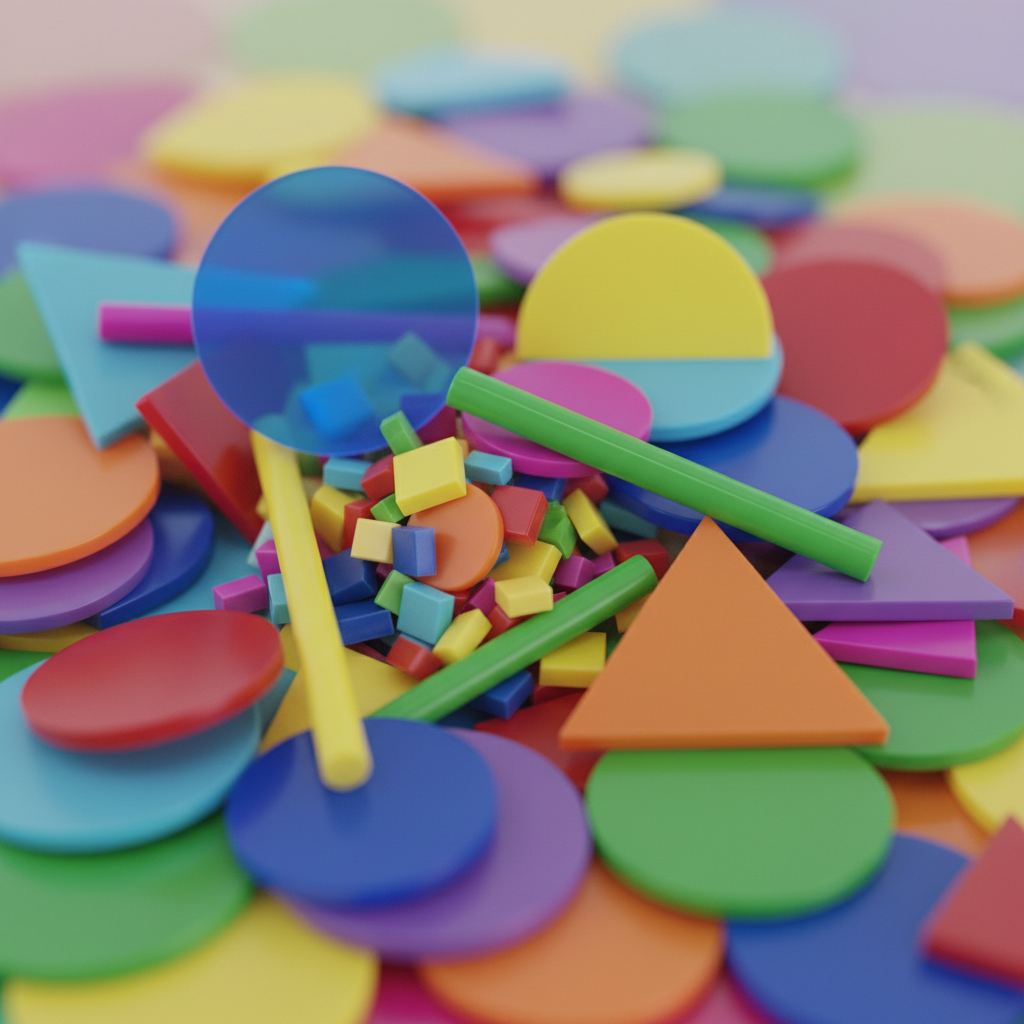 ⚠️ This picture may have spelling mistakes. Trust the words in the lesson.
Your job is to make separate piles: one for circles, one for squares, one for triangles, and one for rectangles!
Sorting Rule #2: Sort by Color (What color are you?)
Sometimes, we don't care what kind of shape it is, but what color it is! You could put all the red shapes together, all the blue shapes together, all the yellow shapes together, and so on. This is like sorting your LEGO bricks by color – all the red ones go in the red bin, all the blue ones in the blue bin.
Sorting Rule #3: Sort by Size (Are you big or small?)
We can also sort shapes by how big or small they are. You might have a pile of big circles, big squares, and big triangles, and another pile of small circles, small squares, and small triangles. Think of sorting your clothes – big shirts go in one pile, and tiny socks go in another!
Sorting Rule #4: Sort by Number of Sides or Corners (How many edges do you have?)
This is a super smart way to sort! We can count the sides or corners of each shape.
- Circles have 0 sides and 0 corners.
- Triangles have 3 sides and 3 corners.
- Squares have 4 sides and 4 corners.
- Rectangles have 4 sides and 4 corners.
So, if we sorted by 'number of sides', circles would be in one group, triangles in another, and squares AND rectangles would be together in a third group! This shows us that shapes can belong to more than one group depending on our sorting rule.
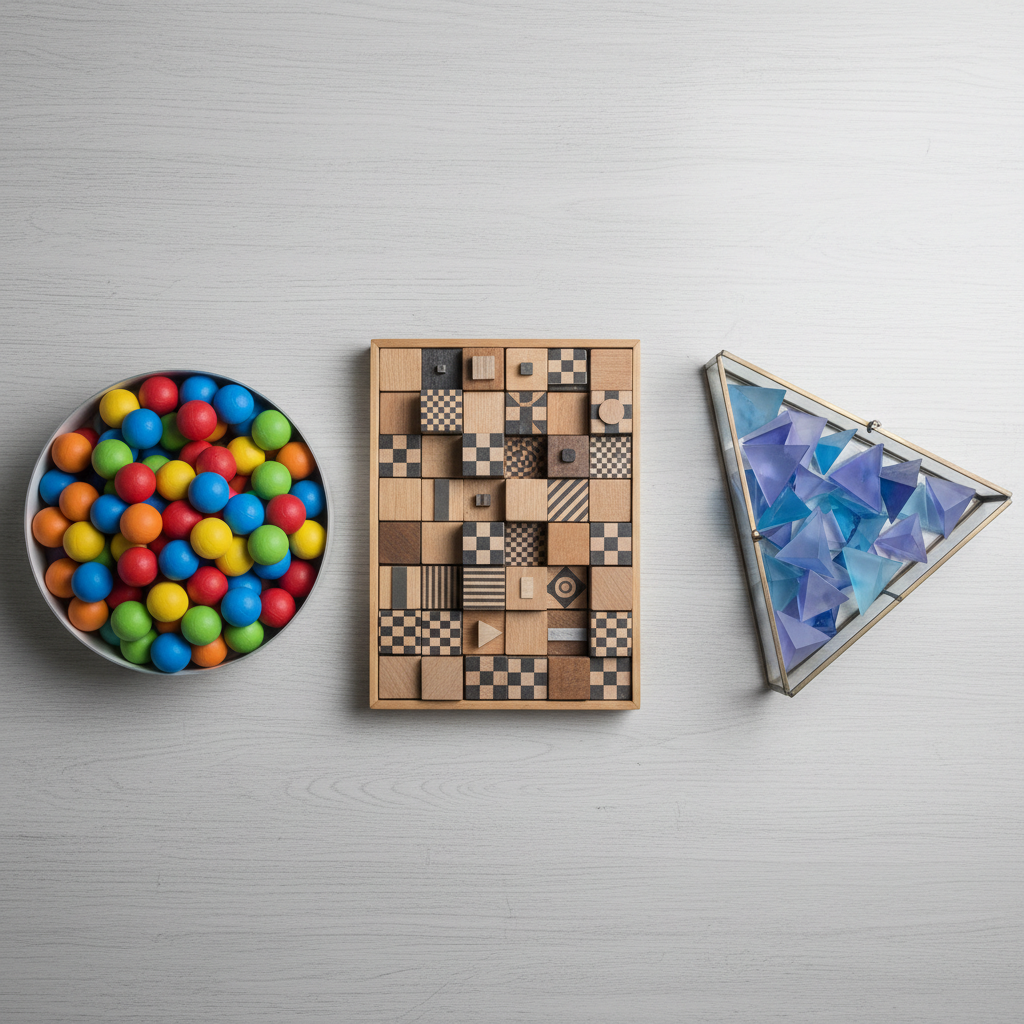
After you sort, your shapes might look much neater, like this:
Let's Practice Our Sorting Skills!
Imagine you have a basket full of shapes. Some are big, some are small, some are red, some are blue, and there are circles, squares, and triangles. If I ask you to "put all the red shapes together," you would look for any shape that is red, no matter if it's a circle or a square. If I ask you to "put all the circles together," you would look for all the round shapes, no matter their color or size!
Sorting helps us understand patterns and similarities. It's a foundational skill for math and science, and it makes our world a little bit tidier and easier to understand. Keep practicing, and you'll become a sorting superstar!
Keep learning, free
Create a free Syllabax account to unlock practice questions and games for this topic.
Visual Learning Enhanced! 🚀
To help you master this topic, we use Advanced Syllabax AI to generate detailed diagrams and visual models.
Note on Visuals: The AI sometimes makes spelling errors in image labels. Please refer to the lesson text for the correct terminology.